Our Time

My last post prompted several readers to note (and I’m paraphrasing here) that they were surprised to read something from me that wasn’t accompanied by a large black cloud.  Damn.  While I readily admit that my Scotch glass is often half-empty, I hate being predictable.

To demonstrate that I haven’t always been the curmudgeon that I am today, I thought I’d share a post from a previous incarnation of this blog.  I wrote this in early 2008, not long after Barack Obama kicked off a political campaign that would eventually result in his first term as President.  I noted at the time that this was written to be given as a speech:

Although the words are mine, I attempted a style compatible with the verbal tone and cadence of Barack Obama — at least to my amateur ear and to the limits of my meager abilities – to honor the prospect of an American President whose command of the language of Shakespeare is superior to my own.

It’s still a speech I’d like to hear.


Posted: Monday, 2/18/08

There are those who would have us believe that we as Americans are defined by our differences. They would have us believe that the choice before us in the upcoming election is young or old, black or white, male or female.

They are mistaken.

Those are choices of the past, divisions of the past, politics of the past.

Those who believe that this election is about age would do well to remember that neither wisdom nor foolishness are bestowed based upon the year of one’s birth.

Those who believe that this election is about race would do well to remember that human eyes were designed by the Almighty to appreciate a full and vibrant spectrum of colors — colors that are themselves mere perceptions of the same light.

Those who believe that this election is about gender would do well to remember that neither man nor woman would survive even one generation without the other.

No. Our choice today is not about gender, race, or age. Neither is the choice today between north and south, east and west, urban and rural, conservative and liberal, nor even Democrat and Republican.

The choice today is between the past and the future.

America is most certainly the product of a grand heritage. We are greatly enriched by our past and we are gratefully indebted to our past. Indeed, there are many good people who sincerely believe that America needs to retreat into its past to find solutions to the problems of its present.

Again, they are mistaken.

We best honor our nation’s proud history not by repeating it, but by learning from it and by applying those lessons to our own unique time.

In the midst of the Civil War, Abraham Lincoln promised his America “a new birth of freedom, and that government of the people, by the people, for the people shall not perish from the earth.”

As our nation struggled through the Great Depression, Franklin Delano Roosevelt reminded his America that “the only thing we have to fear is fear itself.”

And even as the Cold War escalated, John F. Kennedy challenged his America with the words “ask not what your country can do for you; ask what you can do for your country.”

In this place and at this crucial moment in our nation’s history, it is now our time.

It is our time to ask ourselves what each and every one of us can do to build a better America.

It is our time to reject the politics of fear that threaten to paralyze a free and open American society.

It is our time to endow our America with a glorious rebirth of freedom that is worthy of the many sacrifices of those who came before us.

We are not naive. We know that the voices of our better angels can often be lost within a cacophony of old grudges and reflexive responses. But here we need not be bound by our recent history.

We are free to decide that accommodation is not always the equivalent of weakness.

We are free to agree that a compromise solution is often better than the originals.

We are free to creatively debate those with whom we disagree while neither impugning their motivations nor questioning their patriotism.

Change will not be easy; the past is well-entrenched. But our future demands a new beginning. And it is our time.

So let it be declared by all of America’s proud children and let it resonate throughout the world…

That America hereby reclaims its rightful role as the premier model of a fair, free, and inclusive society.

That America will never fear to act, but will also never act out of fear.

That America will be defined no longer by the ideas that divide us but by the ideals that unite us.

It is our time.

It is our time.

Doughy Optimism

Exactly 92 years ago today, an enterprising baker in Chillicothe, Missouri named Frank Bench sold the very first loaf of machine-cut bread using the brand new invention of one Otto F. Rohwedder.

Okay.  So?

Well, after yesterday’s post recounting our H1 2020 version of the signs of the Apocalypse, I thought I might share some soft, measured optimism with respect to H2 2020.

As of today, …

  • Democrats are polling ahead of Republicans in numerous contested House races.  If the elections were held today, House Democrats would not only hold onto their majority, they might well expand it.
  • Senate Democratic candidates are polling better than expected.  Democrats have a lead over the margin of error in enough states to claim a one-seat Senate majority.  Races in two additional states are currently polling even.
  • Biden is polling above Trump in enough swing states to win the Presidency.  If Biden carries every state in which he is now leading, he’d collect 333 Electoral votes – considerably more than the 270 he needs to win.  More importantly, if Biden carries every state in which he now leads by more than 6 points, he’d collect 297 Electoral votes – still enough to win with a decent cushion.

I’ll expand on the above in subsequent posts – and will undoubtedly throw some pessimistic shade here and there.  Hey.  I am who I am.

For the moment, though, I’m quite content to simply bask in the possibility of a Democratic trifecta in November.

And wouldn’t that just be the best thing since sliced bread?

Monumental Folly

We’ve only just passed the halfway mark in 2020.  Here’s a few highlights of the year thus far:

  • An accelerating COVID-19 pandemic coupled with idiots who won’t take basic precautions to help slow it down.
  • An economy on the brink of disaster coupled with an overvalued stock market artificially supported by Congressional and Federal Reserve actions which will eventually make the economic issues much worse.
  • An overdue national recognition of institutional police discrimination and violence coupled with racial unrest on a scale not seen since the 1960s.
  • Upcoming elections in the midst of the pandemic coupled with politicians who aren’t interested in efforts to let people safely exercise their right to vote.
  • Numerous intelligence reports of Russian bounties on the lives of American soldiers coupled with an Administration that is uninterested in pursuing those reports.

Of course, there were no shortage of pre-2020 national issues (a deteriorating infrastructure, a healthcare system in political flux, etc.) and global issues (world hunger, climate change, the Israeli-Palestinian conflict, North Korea, etc.).  No one may be paying attention to these issues, but they didn’t go away… and they’re likely exacerbated by the pandemic.

Oh, and by the way… we just started the 2020 hurricane season.  The NOAA is predicting that 3-6 major hurricanes (Category 3 or higher) will hit the United States by the end of November.

Dandy.

What we need is a leader who can prioritize the myriad issues facing our country, set solid plans in motion to address them, and convince us that we can get through this together as a nation.

Yeah.  We don’t have that.

In an Independence Day speech at Mount Rushmore, our President turned a traditionally patriotic and unifying moment into a partisan rally at the taxpayers’ expense.  Rather than focus on any number of issues contributing to our nation’s current quagmire, Trump announced that he will put the full weight of his Administration behind a militaristic defense of … monuments.

Trump declared that a “left-wing cultural revolution” was designed to “wipe out our history, defame our heroes, erase our values, and indoctrinate our children.”  Wow.  Apparently, the greatest danger facing our nation today involves statues.  Who knew?  But fear not.  Trump intends to protect said statues through the aggressive use of law enforcement.

Damn, dude.  Read the room.

Of course, Trump’s attention to the matter has zero correlation to his actual interest in the preservation of our nation’s history.  It’s laughable to imagine Trump actually reading a history book.  His tactic is simply a lame attempt at misdirection.  Since he has neither the desire nor the ability to solve any issue that actually matters, he manufactured a problem that he can address with an iron fist.  As an added bonus, the issue is a dog whistle to the racial bigots within his base of support.

Never ones to understand nuance, Trump and his supporters have missed important aspects of the movement to re-examine some of our nation’s history and how we choose to honor it.

While Americans have numerous reasons for national pride, our historical record is not without serious blemishes – including our history of slavery.  Our country’s founders certainly had their flaws and, indeed, some of them were slave owners.  However, that fact alone does not necessarily disqualify them from being honored with memorials.  The accompanying historical record should always capture both the good and the bad, but a person’s overall positive contributions to the American story must be considered when we choose who we honor.  Few would argue that George Washington and Thomas Jefferson – both one-time slave owners – are not deserving of their places on the National Mall.

To be sure, there have been isolated incidents where national monuments, constructed to honor true national heroes, have been vandalized.  While some of these acts of vandalism have been conducted under the guise of the current racial protests, that is no excuse.  The perpetrators are criminals and should be treated as such by the proper authorities.  Such action does not require the attention of the President of the United States.

However, there is an entirely separate and overdue discussion to be had with respect to various honors bestowed on leaders of the Confederacy.  While I still contend that we should currently be laser-focused on issues related to our survival, if we must discuss Civil War monuments now, let’s get it right.

Allow me to first state that I spent most of my childhood in Georgia, Virginia, and Texas and most of my adult life in Texas.  If someone wants to talk about indoctrination, I’d like to refer them to my seventh grade history teacher who drew a straight and glorious line between the defenders of the Alamo and Confederate rebels.  In short, I am well aware of the passionate Southern pride often associated with the Confederacy and that disagreements aren’t welcome.  So be it.

While recognizing that the history of the Civil War is complex, these facts are simple:

  • The Confederate states seceded from the United States, disavowing allegiance to the U.S. Constitution.
  • The Confederate flag was an explicit replacement of the American flag.
  • The Confederacy’s prime motivation was to protect the institution of slavery and the economic system that slavery allowed.
  • The Confederacy went to war against the United States.
  • The Confederate Army killed approximately 400,000 soldiers fighting under the American flag.
  • The Confederacy lost.

The unvarnished truth from this moment in American history should certainly be preserved as part of our national story.  While the Confederacy does not need to be demonized, it also does not deserve to be canonized.  The Confederate flag flew over an army, led by Confederate generals, that fought against the United States of America.  There is no sane reason for the country that defeated them to honor them.

It is very important to note that the vast majority of Confederate monuments were built in the South during the eras of Jim Crow laws and the Civil Rights movement.  They were not merely honoring leaders of an insurrection.  These were state-sponsored middle-fingers to the African-American community that were quite literally cast in stone.  They were intentionally designed to serve as constant reminders that the war may have been lost but that white supremacy remained.

The parallel fact that we have U.S. military bases named after Confederate generals is even more egregious.

Most U.S. military installations are named after military heroes and the name selection has often been granted as a local choice.  As such, there are currently ten U.S. Army bases named after Confederate Generals who fought against the United States Army.

The largest military base in the world, Ft. Bragg in North Carolina, is named after Confederate General Braxton Bragg.  Bragg won the Battle of Chickamaug, a significant Confederate victory that resulted in the deaths of about 1700 American soldiers.  Ft. Hood in Texas, a premier Army training facility, is named after Confederate General John Bell Hood.  Hood’s failed aggressiveness against Union forces actually got him demoted.  And, of course, there’s Ft. Lee in Virginia – an Army support command named after the Commander of the Confederate Army, Robert E. Lee.

While the Pentagon and Congress have agreed to consider renaming these bases, our President has threatened to veto a bipartisan $740 billion defense bill to preserve the Confederate names.

We’re better than this.

As we contemplate a precarious second half of 2020, we need to learn from the mistakes of both our distant and recent past.  We do not need to honor these mistakes; we need to correct them.  And we’ll have an opportunity to do so on November 3.
McGrath vs. Booker

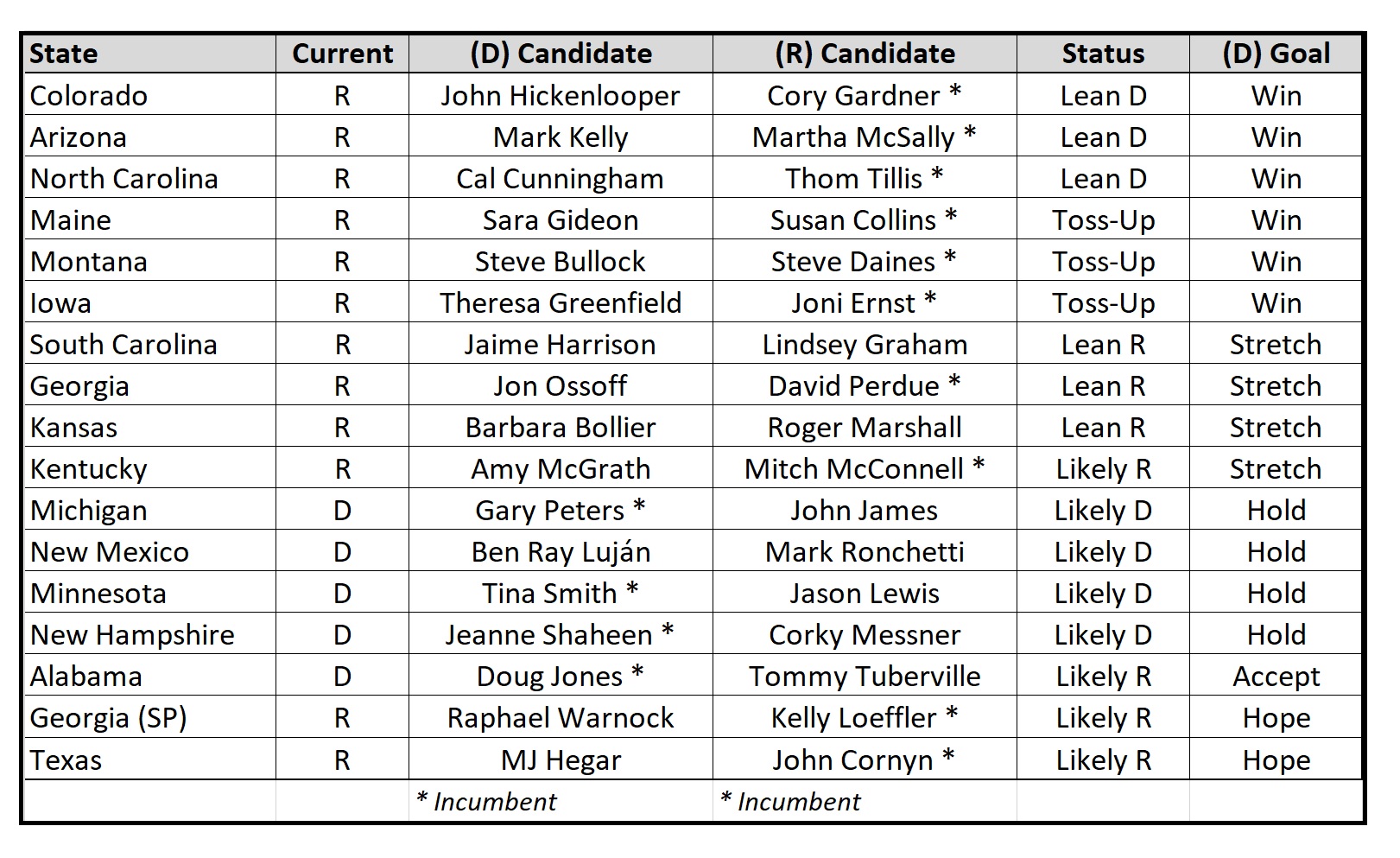
An unexpected Kentucky primary battle is brewing (distilling?) over who gets the Democratic nod to run for the U.S. Senate in November.  Slate recently dubbed it “The battle for who gets to lose to Mitch McConnell” … and they’re probably right.  Still, Democrats need to make a best effort to retire the dystopian Toby the Turtle.

Just last month, Amy McGrath was the presumptive Democratic candidate to take on McConnell.  I guess I knew that there was an Democratic primary, but it hadn’t even registered as a blip on my political radar.  I suspect the same was true of most voters in Kentucky.  McGrath raised a massive amount of money and polls were showing her within striking distance of McConnell.  At the very least, she was going to make Republicans spend money in Kentucky at the expense of other Senate races – and perhaps help deprive McConnell of a Senate majority even if he himself is returned to the chamber.

But then, our entire country – including Kentucky – was gripped by racial protests, mostly related to the role of the police in American society.

Suddenly, another candidate in the Democratic primary started getting attention.  Charles Booker, Kentucky’s youngest black lawmaker, surged into the limelight at the expense of McGrath.  Progressives were immediately falling all over themselves to endorse Booker – including Elizabeth Warren, Bernie Sanders, and Alexandria Ocasio-Cortez.

Back in August, I wrote about why I like Amy McGrath and why I can’t stand Mitch McConnell.  I won’t repeat myself.  I will add that my preference for a McGrath win is exceeded by my preference for a McConnell loss.  If I thought that Booker might have the best chance to beat McConnell, I’d be on board with his candidacy.  But he doesn’t and I’m not.

Kentucky has shown that it will elect a statewide Democrat if the circumstances are perfect.  A moderate Democrat did the win Governor’s office in 2019, but the Democrat was the popular son of a popular former Governor and the Republican was a poster-child of corruption.  In general, Kentucky is a very red state which Trump won in 2016 with 63% of the vote.

Booker is most definitely not a moderate.  In fact, his platform reads like a Progressive wet dream:  Medicare for All, Green New Deal, universal basic income, student loan forgiveness, free college tuition, etc.  That platform simply isn’t compatible with a majority of Kentucky voters.  He’ll get no Republican votes, few independent votes, and even many moderate Democrats may just stay home.  McGrath’s center-left platform is a much better fit for Kentucky.

Booker won his first and only election in 2018 for a Kentucky State House seat in a solidly Democratic district.  He won the Democratic nomination for that seat with only 30% of the vote in a crowded primary field.  Prior to that, his resume is decidedly uninteresting.  While Booker may well have a bright future, his credentials are not yet impressive… particularly in comparison to McGrath’s.

Booker might win in his hometown of Louisville against McConnell … and nowhere else.  McGrath still has the only chance at a general election win.

Come on, Kentucky.  Show me you’re as good at politics as you are at bourbon.

COVID-19 Analysis IV

Here’s an update to my COVID-19 analytics, now reflecting 6/20/2020 data.  This snapshot begins to show the impact of the lifting of restrictions in the U.S.  See below for commentary and some explanatory notes.  Click on any table to display a larger version; hit the back button to return here.

Selected Countries by % of Cases

Selected States by % of Cases

Selected Metropolitan Areas by % of Cases

Selected Metropolitan Areas by Acceleration Rate

Commentary

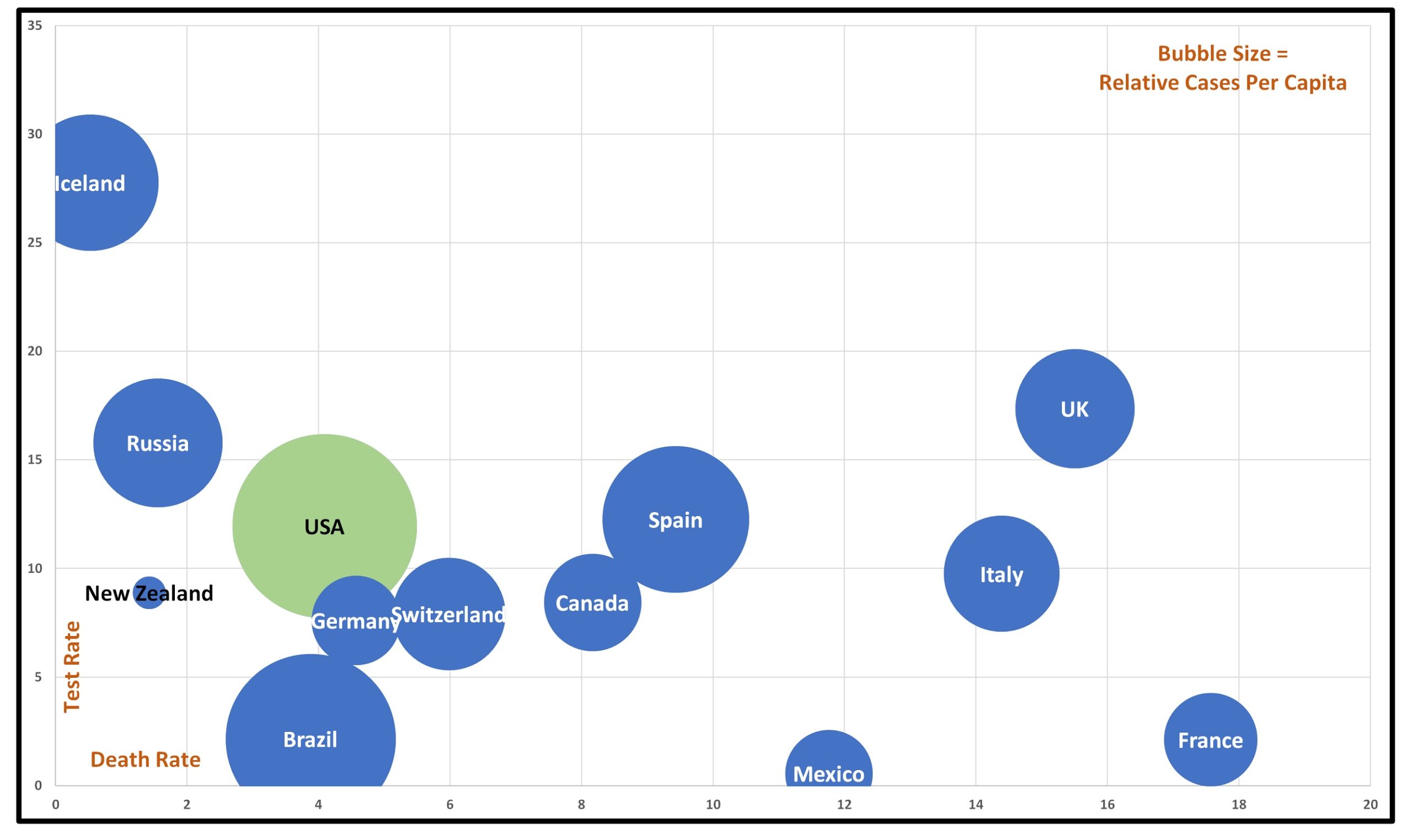
  • The U.S. now leads the world in COVID-19 cases per capita.  Go team!
  • Iceland still leads the world in COVID-19 responses.  They’ve tested 20% of their population and have a very low fatality rate of 1%.
  • U.S. testing has improved, but it’s still nothing to celebrate.  On a per capita basis, we’re still lagging behind numerous other countries.
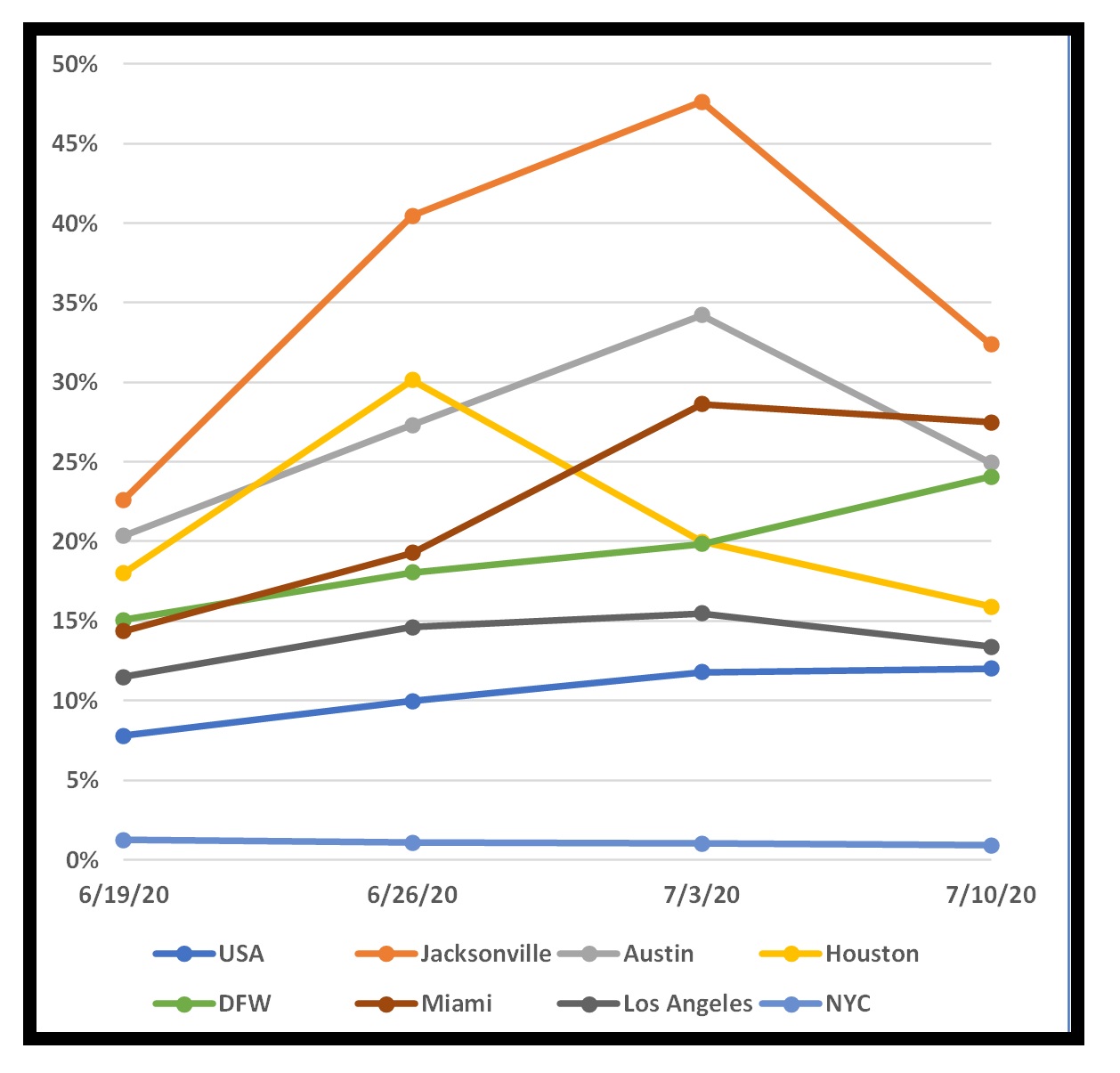
  • As expected, many U.S. metropolitan areas are now trending in the wrong direction.  Increased testing is identifying more cases, but that doesn’t nearly account for the spikes.  The relaxation of restrictions has been largely unsuccessful.  This is not a second wave; it’s a resurgence of the first wave.
  • While some of the original U.S. hotspots (NYC, New Orleans, Detroit) still have the highest percentages of cases at the moment, their acceleration rates are significantly lower than some new hotspots (Houston, Dallas, Las Vegas, DFW). The problem definitely didn’t go away.  It just moved.
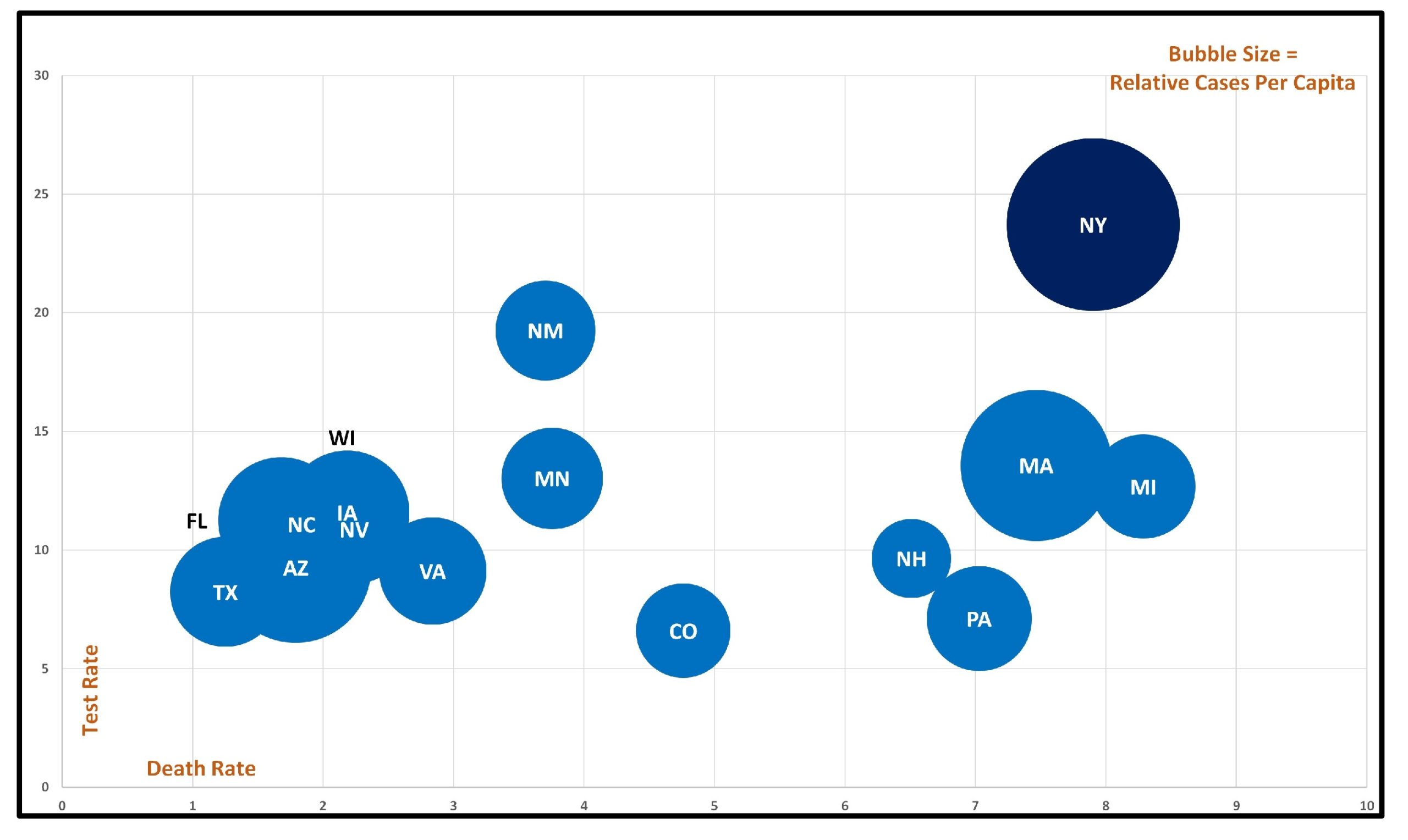
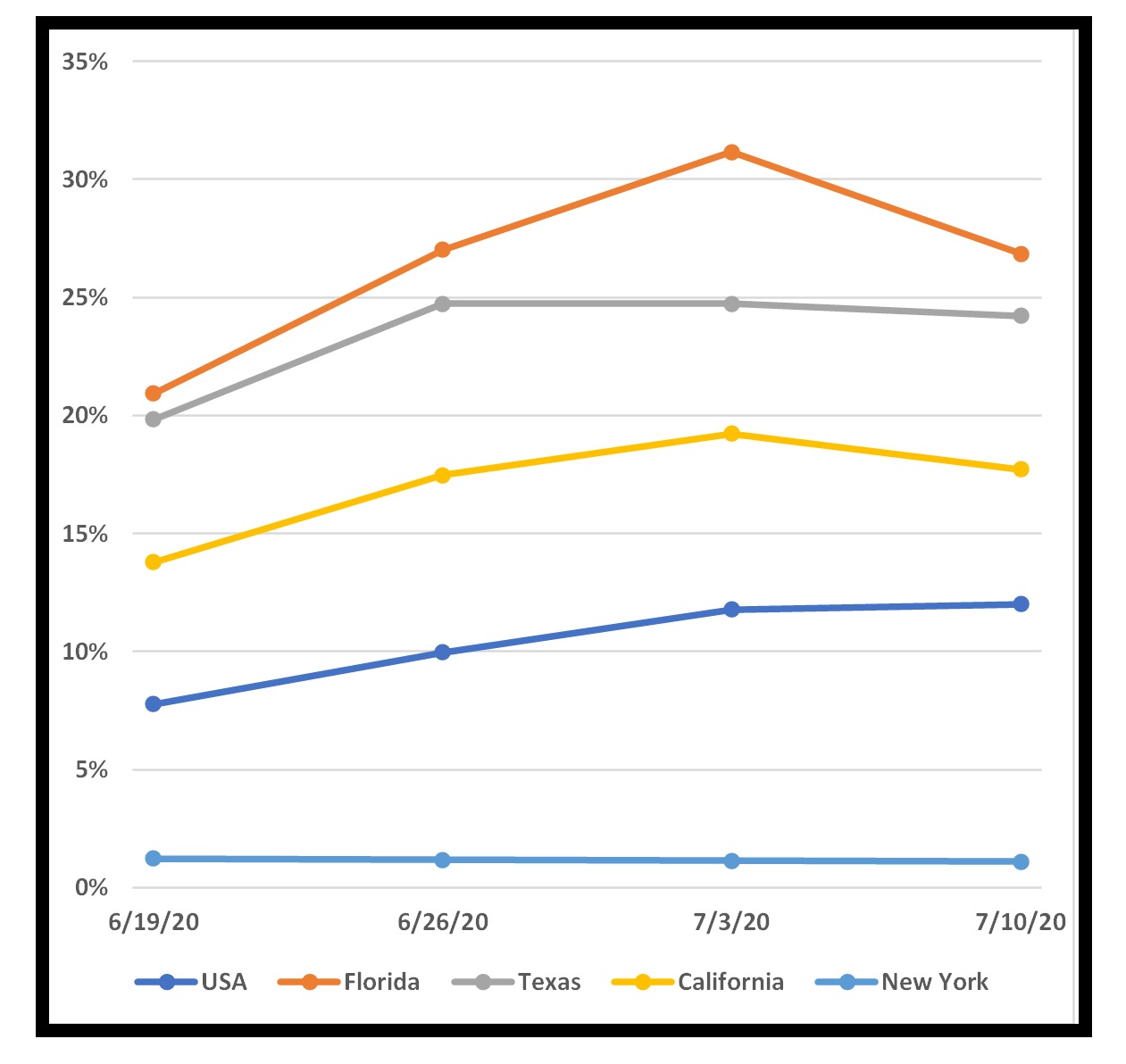
  • My home state of Texas yet again looks at first glance like it’s doing well.  Of the states I currently track, we have the least number of reported cases per capita.  However, we still rank near the bottom in testing and, more importantly, there are rising rates of cases in major Texas metropolitan areas:  15% in DFW, 21% in Houston, and 23% in Austin.
  • Some of my “Estimated Peak” dates are now unknown.  When acceleration rates are rising, there is no end in sight.  Note again that any constant rate of acceleration is bad.  Even a low rate of acceleration still means that the problem is getting worse every single week.
  • I started tracking Tulsa (the site of Trump’s recent rally) and Jacksonville (the site of the Republican convention in August).  Each is already trending in the wrong direction and I suspect their numbers will get worse.
  • I added a simple line chart corresponding to the weekly case rate increase table for the metropolitan areas that I track.

Approach

  • Most published analytics focus on case counts.  However, case counts are only meaningful in the context of potential case counts.  I thus look at the percentage of cases within a given population center.  Since these percentages are mostly less than 1% (at least for now), I also report cases in terms of an easier to grasp “One of Every N People”.
  • I report deaths as a percentage within a given population center, in terms of  “One of Every N People”, and as a percentage of the reported cases (the fatality rate).
  • I currently follow hard-hit states, 2020 toss-up states, and a few others.
  • I also currently follow several metropolitan areas in the U.S.  Since the virus spreads via close contact, this would seem to be the most useful information.  For these, I add a simple means to track progression.  Within four rolling weeks (to avoid both daily noise and old data), I report the rate of increase in the number of cases.  This is akin to tracking the acceleration of the infection.  Obviously, the goal is to first get the acceleration to zero with a resultant constant rate of infection.  Only then can the area begin to decelerate until the actual number of new cases approaches zero.  Finally, I add an extremely rough linear projection as to when each area could reach an acceleration of zero if everything stays the same (which it won’t).  If the rate of acceleration in increasing, no end date can be calculated.
  • My primary data sources:  New York Times, COVID Tracking Project, Texas DSHS, Worldometer, US Census Bureau.
  • All analytics are only as good as the underlying data and there are numerous reasons to question the validity of some of my datasets.
    • Some entities only report confirmed cases; others report presumed cases.  Some entities (e.g. China) are pretty obviously under-reporting their numbers.
    • Case counts depend on access to testing and that varies wildly from country-to-country, state-to-state, and county-to-county.
    • Reporting on testing itself is even more uneven.  My data source for U.S. test data felt the need to grade each state’s data quality.
    • While I attempt to normalize data from multiple sources, the fact remains that each source dataset is independently generated with its own collection methodology.
  • If asked nicely, I can try to add reporting for other countries, states, and/or metropolitan areas in future posts.

Redefining the Police

As a non-young, middle-class, white male, I hesitated to immediately offer my thoughts on the racially-charged unrest currently sweeping the country.  I am certainly in no position to comprehend the perspectives of any black American.  I am even more incapable of fully understanding how a young, poor, black person views our shared country.

However, as the author of a political blog, it seems somewhat disingenuous (read: chickenshit) to use that has an excuse to avoid weighing in on an issue that will undoubtedly be a major factor in the 2020 elections.

There are valid conversations to be had with respect to numerous symbols of our racial divide – military bases named after Confederate generals, black portrayals in movies and on television, public displays of Confederate statues and flags, protests related to the American flag, commercial brands that invoke racial stereotypes, and many, many more.  While symbols are important and these topics deserve serious discussions, I hope we can also use this moment to focus on the tangible.  I find myself specifically drawn to the sparkpoint of the current protests – the role of the police in modern society.

I don’t for a moment believe that all police officers are racists.  However, the problem is not simply a few bad actors in a few police departments.  Institutionalized racial discrimination is an unfortunate fact of the American police force.  The lethal implications of that discrimination have been made painfully apparent.  Black Americans are 2.5 times more likely to be killed by the police than white Americans and yet the former are 2 times more likely to be unarmed when killed.  The discrimination, however, runs considerably deeper.  Here are just a couple of non-lethal examples:

  • Numerous studies have shown that marijuana usage is generally race-agnostic – people of every race have comparable usage rates.  Cannabis arrests account for almost half of all drug arrests and 90% of those were for possession alone.  While these statistics are an independent issue, black people in the U.S. are 3.6 times more likely than white people to be arrested for marijuana possession.  In Kentucky, black people are 9.4 times more likely to be arrested.  In some predominately white communities, it’s even worse.  In Pickens County, Georgia (north of Atlanta, with a 94% white population), black people are 97.2 times more likely to be arrested.
  • A recent study in North Carolina revealed that black drivers were stopped 2 times as often and searched 4 times as often as white drivers – despite the fact that white drivers were more likely to be found with contraband.  A Stanford University analysis of about 100 million traffic stops nationwide also found that black drivers were more likely to be pulled over than white drivers and additionally found that the disparity was significantly less after dark – when the driver’s skin color was harder to determine.

Other studies tell similar stories.  We have a problem.

I am struck by the political battlelines currently being drawn over numerous competing proposals for police reforms by Democrats and Republicans.  Rather than dive into the details of these proposals, I’ll simply offer my broad perspective:  All of them are little more than band-aids, differing only in the size of the wound they attempt to cover.  None of the proposals do much, if anything, to address the root cause of the injury.

At long last, the problem needs to be addressed by more than meaningless rhetoric and politically expedient calls for minor reforms.

While state and local governments will, in our form of government, have final control over their respective police forces, the federal government can and should provide specific guidelines enforced by withholding funding and/or other legal actions were possible.

Below are three fundamental changes that need to be made.  Unfortunately, these are by no means new ideas.  Versions have been proposed numerous times over the course of decades but there has never been the political will to implement them in the face of entrenched resistance.  I hope that now is the time.

Redefine the Role of the Police

The “Defund the Police” movement isn’t nearly as ominous as it sounds.  While there are numerous definitions, no sane person is proposing that all police departments be immediately shut down.  Few want a real-life version of “The Purge”.  The movie was bad enough.

That said, the solution is also not a simple “reform” of existing police structures and policies.

As a society, we have assigned way too many tasks to our police departments.  They are not only responsible for addressing serious crimes; they are tasked with handling issues related to homelessness, truancy, family disputes, mental health, substance abuse, immigration, traffic control, crowd control, minor drug violations, etc.  If we merely step back for a moment, the insanity of that approach is obvious.  We do need a police function; we don’t need it to be – nor should we expect it to be – an enforcer and arbiter of everything imaginable.  An all-powerful police force is not only an open invitation to institutionalized racial discrimination.  It’s also just a bad idea.

The basic concept of a role redefinition is to redirect a portion of the money currently allocated to police departments to other organizations and programs that are better suited to handle a specific job.  The responsibility would transfer with the money.  This serves two purposes.  First, we’d have specific issues dealt with by people appropriately trained and equipped to handle those issues.  Second, we’d decentralize the raw power that society has forfeited to the police over time.

I’d fully suspect that many police officers would welcome the opportunity to focus.  Few reasonable people want to be responsible for things they aren’t properly trained to handle.

On the other hand, there will undoubtedly be some police departments, individual police officers, and police unions that will be extremely resistant to any changes that diminish their current powers.  In extreme cases, yes, whole departments or agencies may need to be abolished and rebuilt from scratch by the communities they serve.  In those cases, the solution is still not an elimination of the police function; it is a replacement of a dysfunctional department with one that meets the needs of its constituents.

Redefine the Police Officer

We can’t simply change the definition of the police department and claim victory.  We also need to change the job requirements for the people in those departments.

In general, the professional police officer is fairly well compensated for a job that, frankly, comes with pretty minimal requirements.

For example, to become an Austin police officer, candidates must be a U.S. citizen, have a valid driver’s license, meet physical and health requirements, have a clean criminal history, have responsible driving & financial records, and attend a 32-week training academy.  During academy training, they are paid an annual salary of about $50K.  Immediately after graduation, they make about $60K and progress to at least $98K after 16 years on the force.  High ranking officers can make up to $155K.  All ranks can make more if they have college degrees and there are numerous incentive pay options, including overtime pay.  After 23 years, officers can retire with 74% of their salary and that increases to 96% at 30 years.  In addition, the APD has generous health, life, and disability insurance plans.

In all, the above is a pretty decent deal.  I don’t want to turn this post into a career analysis, but I’ll note that a licensed massage therapist is required to have about the same amount of training and that teacher certification requires substantially more training.  Neither comes with the employment package of a police officer.  While I don’t begrudge the police their compensation, I do think that it should necessarily come with a set of very high expectations.

The fundamental requirement must be for a professional police officer to earn and continually pursue the trust of the people they serve.  That trust cannot be conveyed by the mere presence of a badge and a gun.  Numerous other professionals understand that dealing with uncooperative people is an occupational hazard.  Successful massage therapists, teachers, bartenders, Uber drivers, flight attendants, and hotel staff have developed the necessary skills to handle such people without the use of weapons or deadly chokeholds.  It’s really not too much to expect the same from a police officer.  We need more Andy Taylors and less Harry Callahans.

Most importantly, police officers need to be held organizationally accountable against clear rules of engagement.  While such accountability should be swift and sure, it has unfortunately been quite rare.  As just one example of many, Derek Chauvin – the Minneapolis policeman charged with killing George Floyd – had a history of 17 prior misconduct complaints but was disciplined only once. Over the past decade, Minneapolis had over 2600 misconduct complaints filed against individual police officers but only 12 resulted in any punishment at all – the most severe of which was a one-week suspension.

The current implementation of qualified immunity – where police officers are largely exempt from civil lawsuits – also needs to be seriously curtailed.  While the police should perhaps be shielded from nuisance lawsuits, they shouldn’t simply get a pass in civil courts.

Police officers are no less entitled to due process than any other citizen.  They are not, however, entitled to special treatment under the law.  If anything, they should be held to an even higher standard.

Demilitarize the Police

Both political parties have historically shown little resistance to arming police departments with weapons of war – including armored vehicles, weaponized aircraft, grenade launchers, M-16 assault rifles, sniper rifles, combat gear, and tear gas.  A byproduct of giving people hammers is the danger that they start to think of everything as a nail.  Worse, from an outside perspective, a police force that is dressed in full riot gear and armed for combat naturally projects to the community they serve that they’re preparing for battle in a war zone.  While the police in wealthy, white communities remain largely out of sight if not responding to a specific issue, the police in poor, black communities are often seen as an occupying force.  That’s simply not conducive to building an atmosphere of trust.

Except in extreme cases, there is no reason for the police to function as a quasi-military force nor for individual police officers to be as well-armed as a soldier in combat.  In those cases, use of the National Guard should be the first consideration.  While an extremely elite, well-trained police unit might sometimes be appropriate, that’s not what we have.  Entrance into U.S. Military Special Forces is extraordinarily competitive and requires about a year and a half of very intense training with a 70% attrition rate. Members are subject to a military court martial if they fail to strictly follow established rules of engagement.  On the other hand, while anyone with three years on many police forces can apply for a 19-week SWAT training course, even that training isn’t generally required to gain full access to military weapons.

Use of such weapons against American citizens on American soil should be exceptionally rare and should require considerable senior oversight.  Indeed, the use of tear gas on peaceful citizens protesting the death of a man whose last words were “I can’t breathe” is well beyond ironic.  It’s inexcusable.

___

None of these changes will happen overnight.  It just seems like an excellent time to start.

Mask Not For Whom the Bell Tolls…

It tolls for thee.

The twisted John Donne poem is sadly appropriate.  Donne was saying that we’re all interconnected and that anyone’s death is a loss for all of mankind.

So wear a damn mask!

Here are just a few ideas for conversations with people that won’t.

For those that don’t believe masks are necessary:  Scientific evidence is extremely clear that masks significantly slow the spread the airborne COVID-19 virus.  While most masks provide only marginal protection for the wearer, even basic cloth masks are quite effective in reducing the spread of the virus from an infected individual to others.  In other words:  IT’S NOT ABOUT YOU.  Refusing to wear a mask says that you don’t give a shit about anyone other than yourself.  I’d suggest you simply wear a red t-shirt with “Narcissistic Asshole” written in large, white letters … but I’m absolutely sure that you’d misspell at least one of those words.

For those that think they’re virus-free and thus don’t need no stinkin’ mask:  The fact is that 50-80% of people with the COVID-19 virus are asymptomatic but still contagious.  You simply don’t know if you’re infected.  You.  Don’t.  Know.

For those that think requiring people to wear a mask is unconstitutional government overreach:  Get over yourself.  Our Texas Governor is trying to walk a fence that doesn’t exist.  He says he encourages people to wear masks but refuses to allow government enforcement.  That’s like nicely asking the school bully to please stop punching you.  This is a public health issue.  There are legal penalties and fines for taking a dump on the streets of Texas, so why is not wearing a mask any different?  If anything, I’d argue that you generally won’t die from stepping in a pile of poop.

For those that think being mask-free is a political statement:  A recent study did show an unfortunate political divide with 73% of Democrats wearing masks as opposed to 59% of Republicans.  “The 2020 GOP: Now with 14% more idiots!”  Still, a majority of BOTH parties are wearing masks.  There are zero reasons for this to be a party loyalty issue.  If you want to make a political statement, wear a button on your mask.

For those that won’t wear a mask because Trump won’t wear one:  The President of the United States should be setting an example… just not this one.  Indeed, he has even mocked Joe Biden for wearing a mask.  Why on Earth am I even talking to you?  Go away.

COVID-19 Analysis III

Here’s an update to my prior COVID-19 analytics, now reflecting 5/23/2020 data.  This snapshot is largely prior to the free-for-all lifting of restrictions in the U.S.  See below for commentary and some explanatory notes.  Click on any table to display a larger version; hit the back button to return here.

Selected Countries by % of Cases

Selected States by % of Cases

Selected Metropolitan Areas by % of Cases

Selected Metropolitan Areas by Estimated Peak

Commentary

  • The new orders vary greatly from state-to-state so it will be quite interesting to see how things look in a 2-3 weeks.  Since the current numbers show some progress, I suspect the trends will be reversed.  I seriously hope I’m wrong.
  • Despite claims otherwise, the data shows that the overall U.S. response to COVID-19 has been decidedly sub-par.  Of the countries I track, only Spain and Iceland have more reported cases per capita – and those countries lead in testing.  Victory laps are decidedly premature.
  • Iceland has now tested 1 out of every 6 of their residents – far more than anyone else – and they’ve proven that a large number of people with COVID-19 are asymptomatic carriers.  Iceland’s overall success is underscored by a very low fatality rate of 1%.
  • In the U.S., NYC is still the major hotspot with 1 in 42 people testing positive.  Detroit has the worst fatality rate at 12%.
  • My home state of Texas once again looks like it’s doing well… until you look a bit deeper.   Of the states I currently track, we do have the least number of reported cases per capita.  Unfortunately, “reported” would be the key word here.  Our testing is pathetic.  We’ve tested only 2.59% of our population – compared with 4.28% nationwide.  And that national testing percentage is still less than many other countries.  Testing in my home city of Austin is even worse than Texas as a whole with only 1.93% of Austin residents tested.  It is thus likely that neither Austin, nor Texas, nor the United States are doing nearly as well as they think they are.  And yet, most restrictions have just recently been lifted.
  • You may notice that my “Estimated Peak” dates keep moving out.  My simple algorithm assumes that future reductions in the rates of increase are linear… and they clearly are not.  This is not good news.  Until a municipality can get the rate of increase to zero, their problem by definition is only getting worse.  At first glance, New Orleans might appear to have a good handle on COVID-19 since their rate of increase has held steady at 3% for three weeks.  However, what that means is that their problem is getting slowly worse every single week.  Any constant rate of increase is definitely not a solution.

Approach

  • Most published analytics focus on case counts.  However, case counts are only meaningful in the context of potential case counts.  I thus look at the percentage of cases within a given population center.  Since these percentages are mostly less than 1% (at least for now), I also report cases in terms of an easier to grasp “One of Every N People”.
  • I report deaths as a percentage within a given population center, in terms of  “One of Every N People”, and as a percentage of the reported cases (the fatality rate).
  • I currently follow states that are either the hardest hit or that are 2020 toss-up states.  It’s too early to tell how COVID-19 will impact the swing states, but it will definitely be a major issue.
  • I also currently follow several metropolitan areas in the U.S.  Since the virus spreads via close contact, this would seem to be the most useful information.  For these, I add a simple means to track progression.  Within four rolling weeks (to avoid both daily noise and old data), I report the rate of increase in the number of cases.  This is akin to tracking the acceleration of the infection.  Obviously, the goal is to first get the acceleration to zero with a resultant constant rate of infection.  Only then can the area begin to decelerate until the actual number of cases approaches zero.  Finally, I add an extremely rough linear projection as to when each area could reach an acceleration of zero if everything stays the same (which it won’t).
  • There are way too many variables at this point to model any future deceleration.
  • My primary data sources:  New York Times, COVID Tracking Project, Texas DSHS, Worldometer, US Census Bureau.
  • All analytics are only as good as the underlying data and there are numerous reasons to question the validity of some of my datasets.
    • Some entities only report confirmed cases; others report presumed cases.  Some entities (e.g. China) are pretty obviously under-reporting their numbers.
    • Case counts depend on access to testing and that varies wildly from country-to-country, state-to-state, and county-to-county.
    • Reporting on testing itself is even more uneven.  My data source for U.S. test data felt the need to grade each state’s data quality.
    • While I attempt to normalize data from multiple sources, the fact remains that each source dataset is independently generated with its own collection methodology.
  • If asked nicely, I can try to add reporting for other countries, states, and/or metropolitan areas in future posts.

Thoughts from Across the Pond

Ever wonder what foreigners think of Trump?

A “Nate White” apparently posted a response to that question last year on Quora.  While an appropriate Quora profile exists, I can find no direct proof of authorship.  No matter.  The essay has been preserved on the Internet and, regardless of the author, it deserves to be repeatedly shared.  The piece precedes the pandemic but is still, unfortunately, a quite accurate summary of the man.

I only wish I’d written it.

—-

Quora Question:  “Why do some British people not like Donald Trump?”

Nate White’s Reply:

A few things spring to mind. Trump lacks certain qualities which the British traditionally esteem. For instance, he has no class, no charm, no coolness, no credibility, no compassion, no wit, no warmth, no wisdom, no subtlety, no sensitivity, no self-awareness, no humility, no honour and no grace – all qualities, funnily enough, with which his predecessor Mr. Obama was generously blessed. So for us, the stark contrast does rather throw Trump’s limitations into embarrassingly sharp relief.

Plus, we like a laugh. And while Trump may be laughable, he has never once said anything wry, witty or even faintly amusing – not once, ever. I don’t say that rhetorically, I mean it quite literally: not once, not ever. And that fact is particularly disturbing to the British sensibility – for us, to lack humour is almost inhuman. But with Trump, it’s a fact. He doesn’t even seem to understand what a joke is – his idea of a joke is a crass comment, an illiterate insult, a casual act of cruelty.

Trump is a troll. And like all trolls, he is never funny and he never laughs; he only crows or jeers. And scarily, he doesn’t just talk in crude, witless insults – he actually thinks in them. His mind is a simple bot-like algorithm of petty prejudices and knee-jerk nastiness.

There is never any under-layer of irony, complexity, nuance or depth. It’s all surface. Some Americans might see this as refreshingly upfront. Well, we don’t. We see it as having no inner world, no soul. And in Britain we traditionally side with David, not Goliath. All our heroes are plucky underdogs: Robin Hood, Dick Whittington, Oliver Twist. Trump is neither plucky, nor an underdog. He is the exact opposite of that. He’s not even a spoiled rich-boy, or a greedy fat-cat. He’s more a fat white slug. A Jabba the Hutt of privilege.

And worse, he is that most unforgivable of all things to the British: a bully. That is, except when he is among bullies; then he suddenly transforms into a sniveling sidekick instead. There are unspoken rules to this stuff – the Queensberry rules of basic decency – and he breaks them all. He punches downwards – which a gentleman should, would, could never do – and every blow he aims is below the belt. He particularly likes to kick the vulnerable or voiceless – and he kicks them when they are down.

So the fact that a significant minority – perhaps a third – of Americans look at what he does, listen to what he says, and then think ‘Yeah, he seems like my kind of guy’ is a matter of some confusion and no little distress to British people, given that:

  • Americans are supposed to be nicer than us, and mostly are.
  • You don’t need a particularly keen eye for detail to spot a few flaws in the man.

This last point is what especially confuses and dismays British people, and many other people too; his faults seem pretty bloody hard to miss. After all, it’s impossible to read a single tweet, or hear him speak a sentence or two, without staring deep into the abyss. He turns being artless into an art form; he is a Picasso of pettiness; a Shakespeare of shit. His faults are fractal: even his flaws have flaws, and so on ad infinitum. God knows there have always been stupid people in the world, and plenty of nasty people too. But rarely has stupidity been so nasty, or nastiness so stupid. He makes Nixon look trustworthy and George W look smart. In fact, if Frankenstein decided to make a monster assembled entirely from human flaws – he would make a Trump.

And a remorseful Doctor Frankenstein would clutch out big clumpfuls of hair and scream in anguish: ‘My God… what… have… I… created?’ If being a twat was a TV show, Trump would be the boxed set.

The Politics of COVID-19, Part III

It irritates the hell out of me that I have to keep coming back to this topic.  The latest reason is the Republican argument against providing financial assistance to the states in the next stimulus package.

The pandemic should rightfully be a political issue in the 2020 campaign.  However, politics should be kept to a minimum with respect to our national response to the pandemic.  Americans need help.  If the federal government has a purpose, I’d think this would be it.

Republicans are free to argue against providing budgetary help directly to state and local governments.  I’ll personally note that those budgets fund things like schools, police, and firefighters.  And, since we just spent $2.2 trillion propping up corporations, I’ll contend that also throwing some money at public services isn’t completely out of line.  However, a debate on the merits of the funding is at least valid.

My problem is that Republicans aren’t arguing the merits.  McConnell said that federal aid would be a “blue state bailout” and Trump claimed it’s “not fair to the Republicans, because all the states that need help, they’re run by Democrats in every case.”

Even if those statements were true (spoiler: they aren’t), they would be entirely beside the point.  When disaster strikes one or more states in any form, consideration of their political disposition is simply disgusting.

As to the validity of the statements, here’s just a few quick reminders:

  • The two hardest hit areas are New York and California.  And, yes, both happen to be Democratic states.  However, metropolitan airports in those two states handle 57% of our country’s international flights – the major source of the COVID-19 outbreak in the U.S.  And who is responsible for international travel into the U.S.?  That’s right.  The federal government.  If you break it, you buy it.
  • New York consistently pays the federal government over $35 billion a year more than it gets back.  McConnell’s home state of Kentucky consistently receives over $40 billion a year more from the federal government that it pays in.  So who exactly is “bailing out” whom?
  • Many states controlled by both parties are seeing major budget shortfalls.  By no stretch of the imagination is this a “blue state” problem.
    • The very red state of Georgia (whose Atlanta airport handles 7% of international flights) is projecting a budget shortfall of about $4 billion.
    • The swing state of Florida (whose Miami airport handles 12% of international flights) is looking at a $10 billion budget shortfall.
    • My home (and red) state of Texas (whose DFW and Houston airports handle 11% of international flights) doesn’t yet know how bad we’ll be hit (given our 24-month budget cycle).  However, the concurrent oil & gas slump isn’t going help things and our financial picture won’t be at all pretty.

While the premise of a “blue state bailout” is easily contradicted by the facts, it just isn’t important.  Multiple states need help.  It doesn’t matter if those states are red, blue, or green.  The federal government needs to their damn jobs and stop playing political games.