COVID-19 Analysis II

Since I had a positive response to my initial COVID-19 analytics, I’ll try to post updates on a semi-regular basis.  This post uses data as of 4/24/20.  See below for commentary and some explanatory notes.  Click on any table to display a larger version; hit the back button to return here.

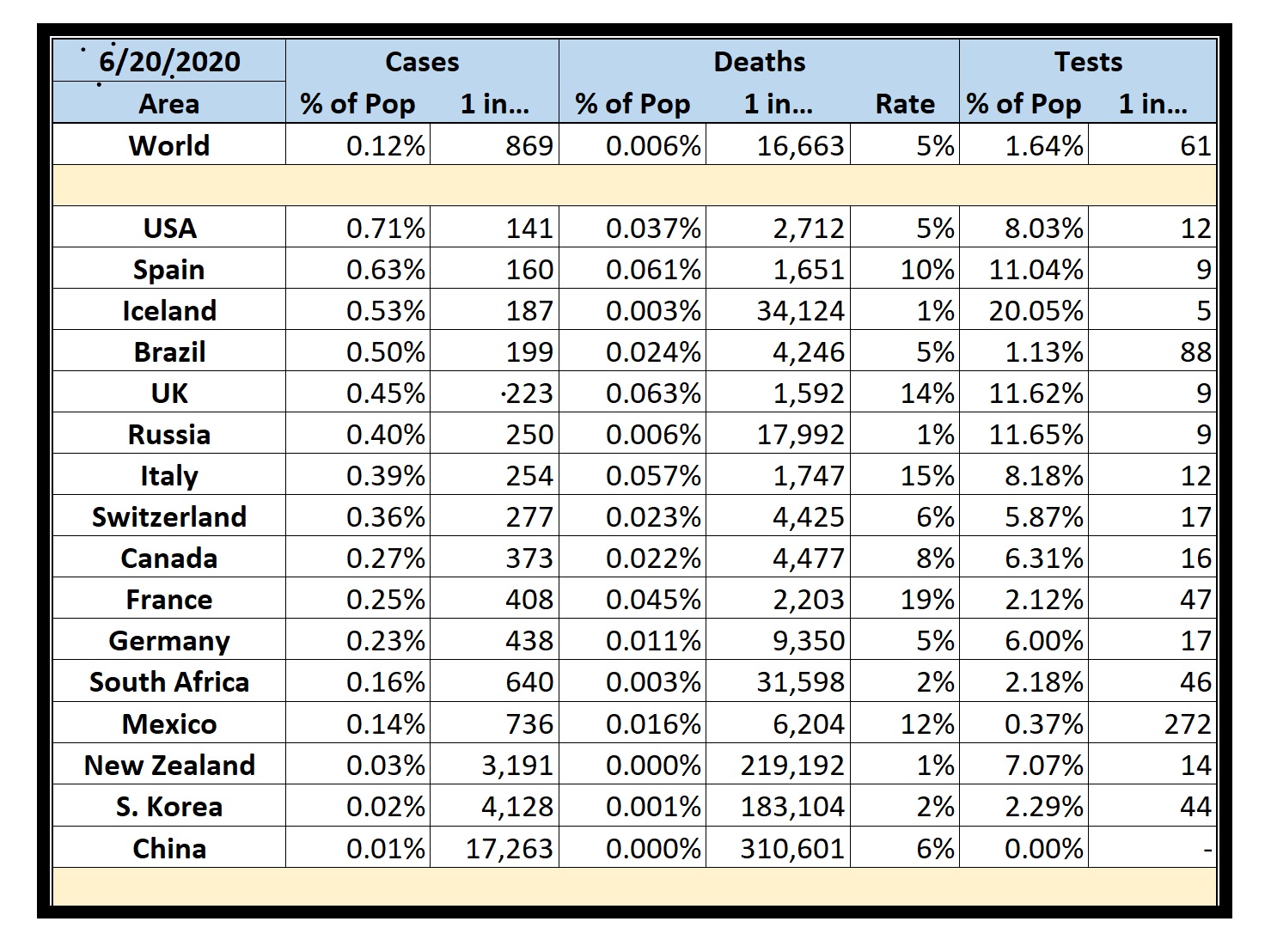
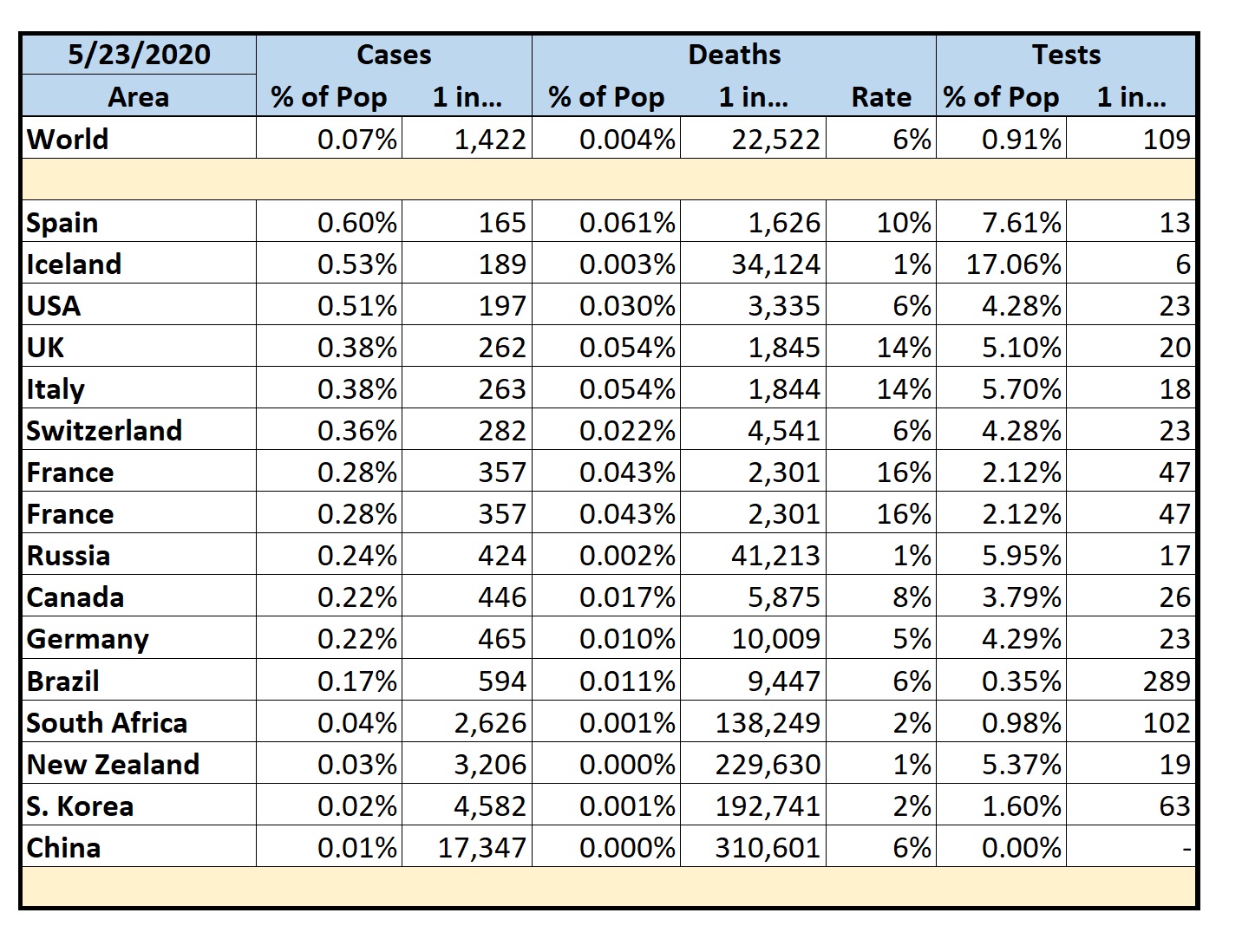
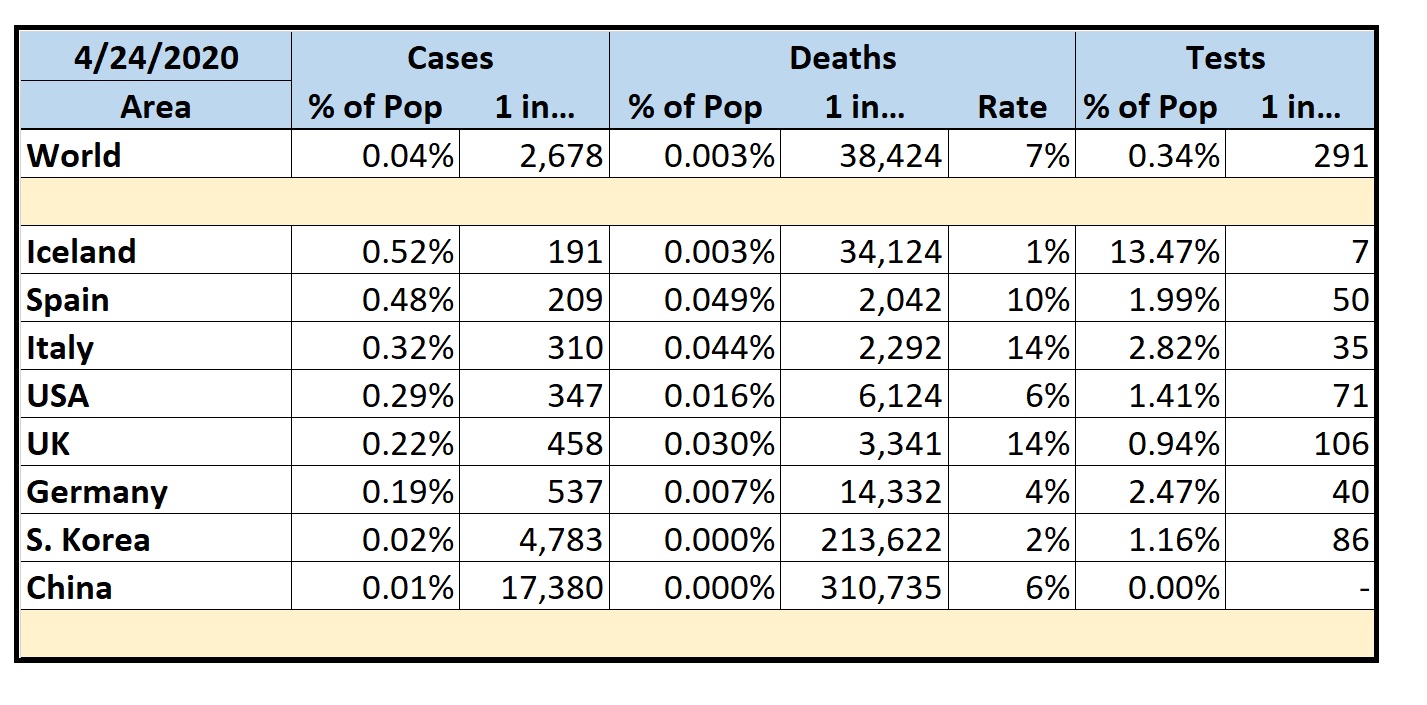
Selected Countries by % of Cases

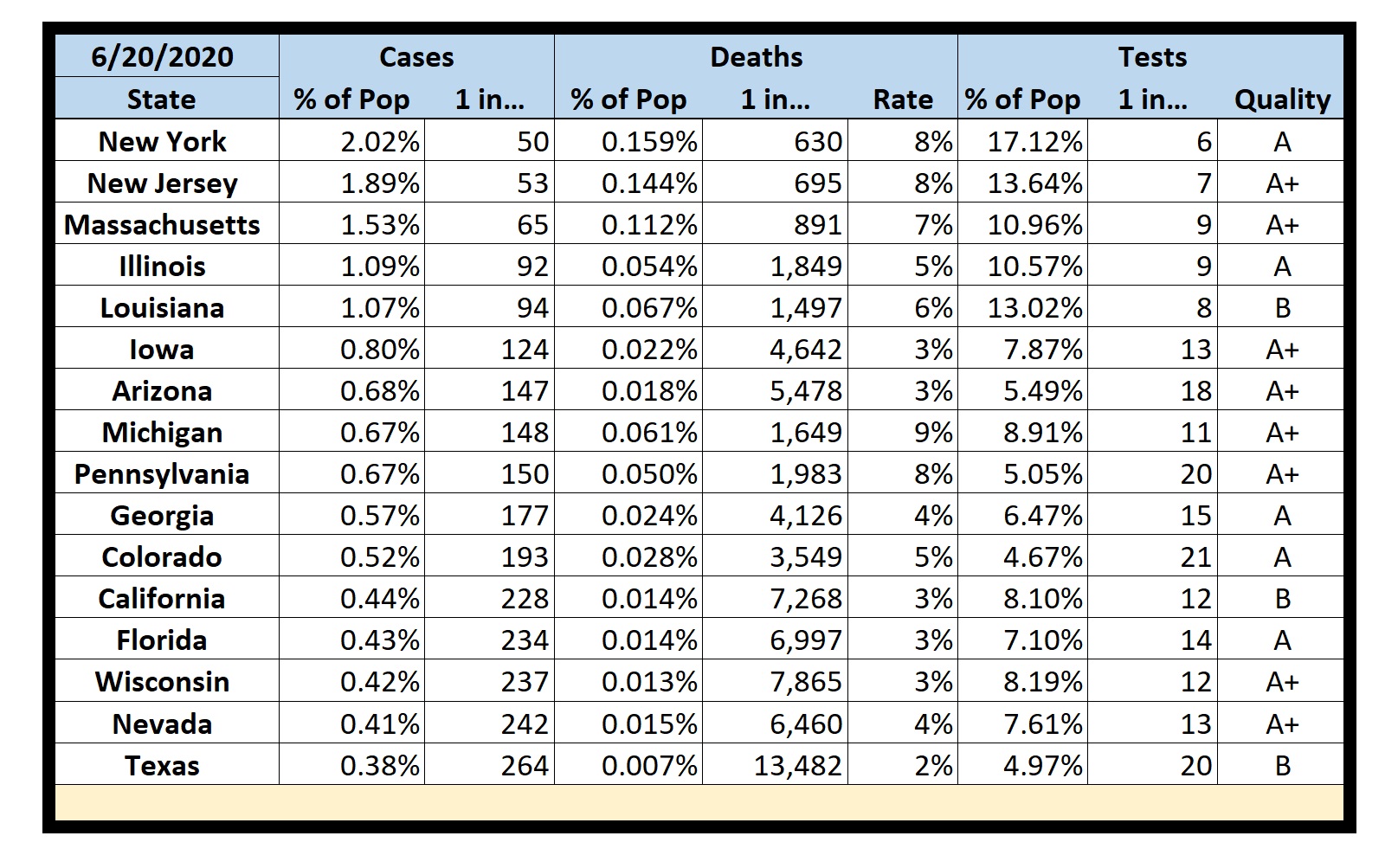
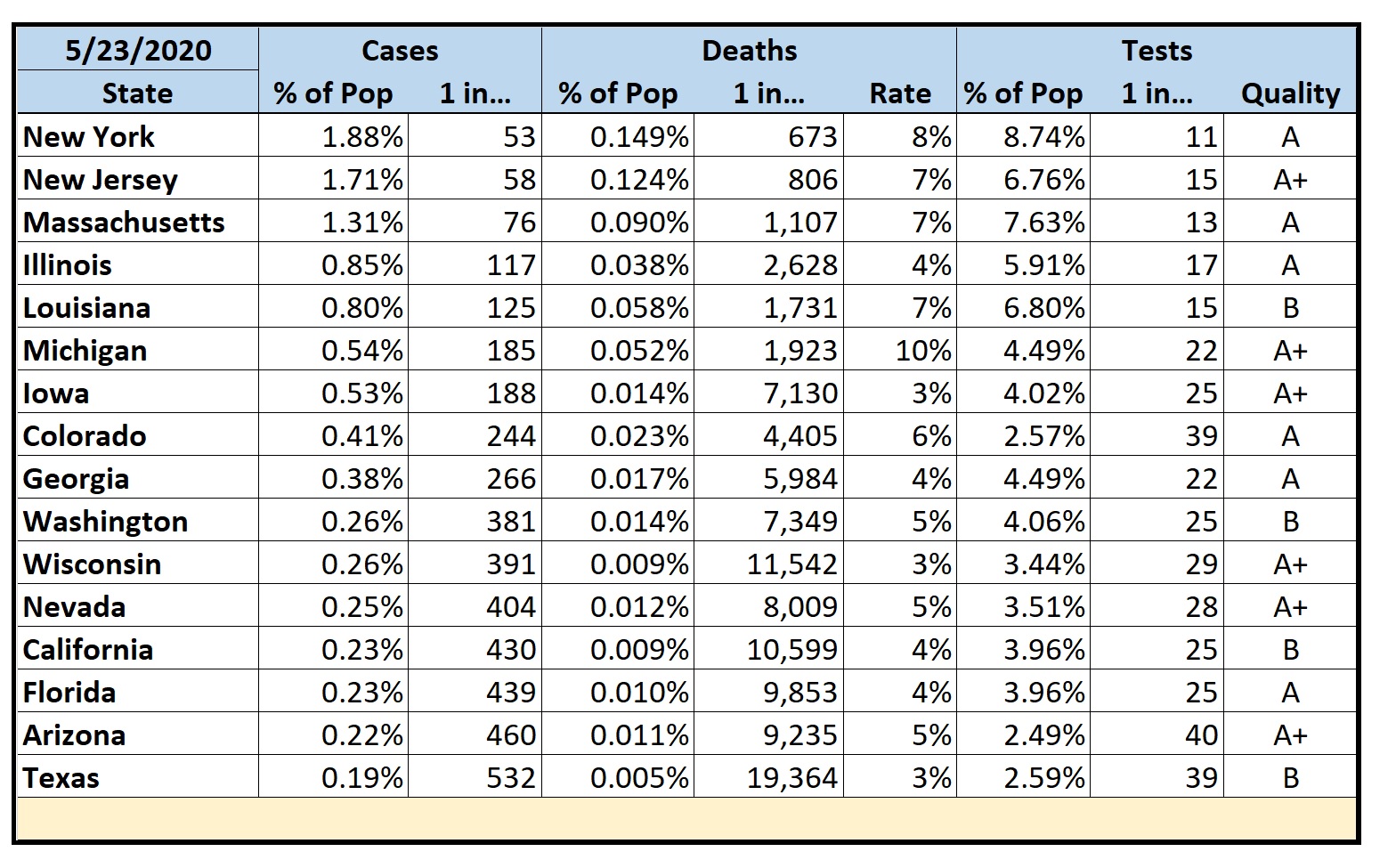
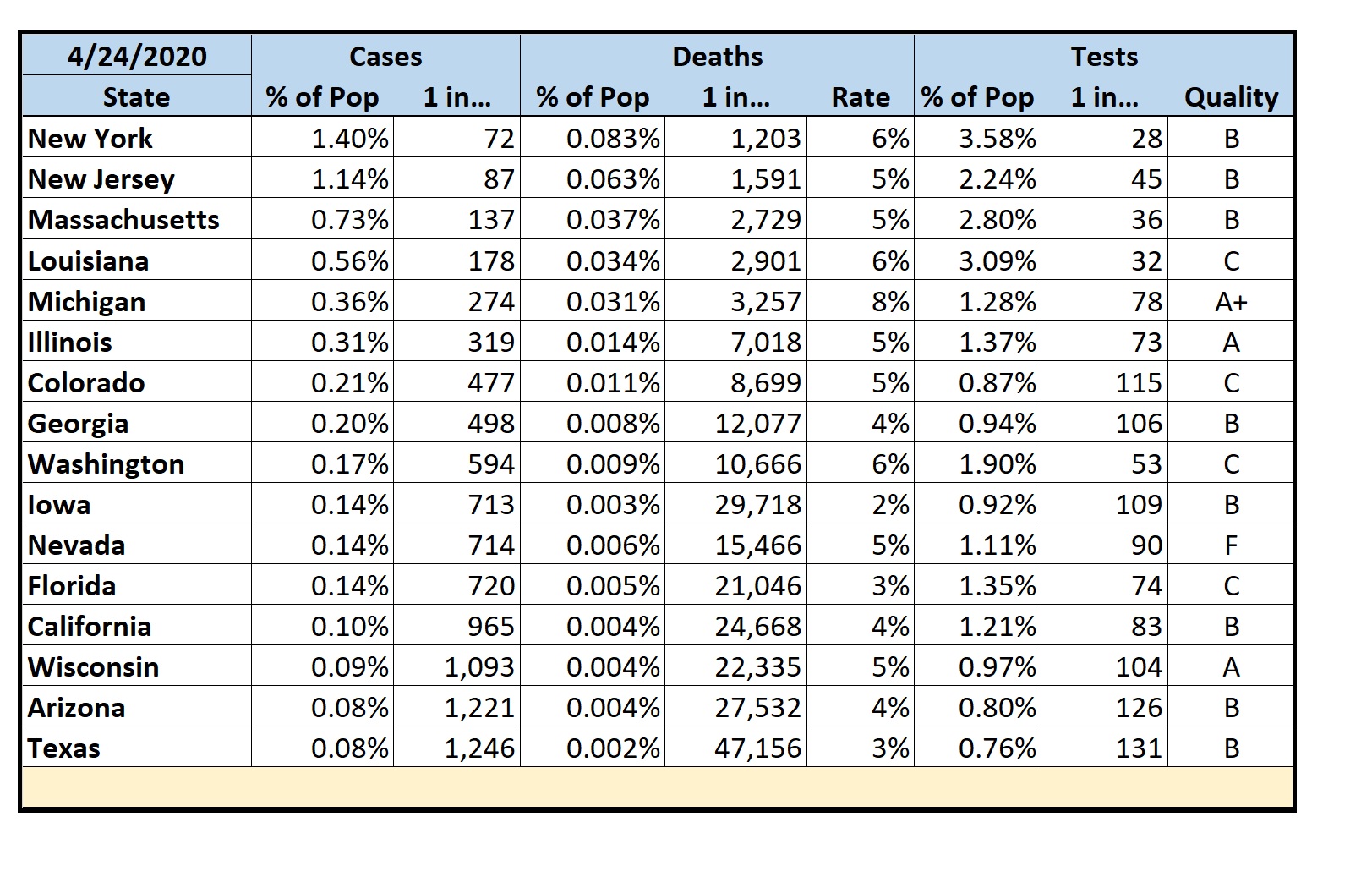
Selected States by % of Cases

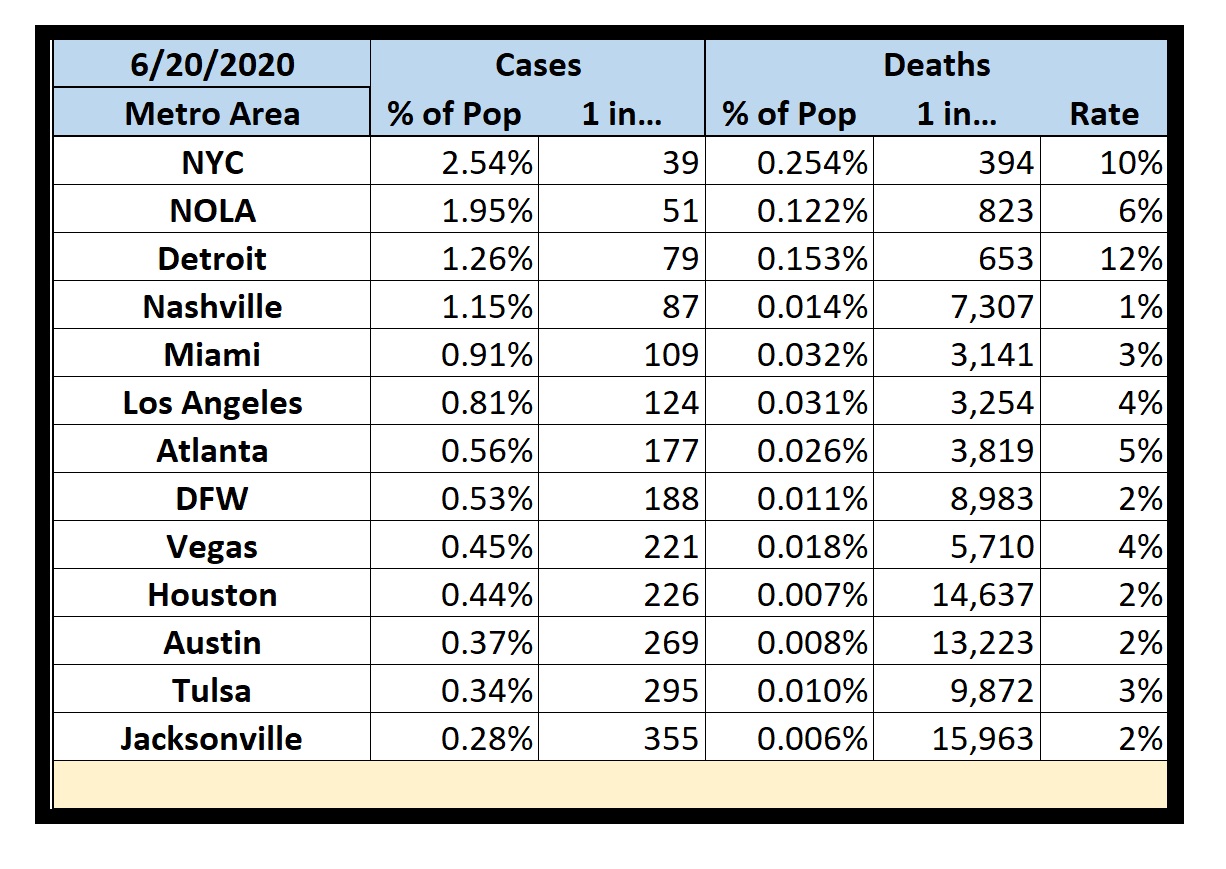
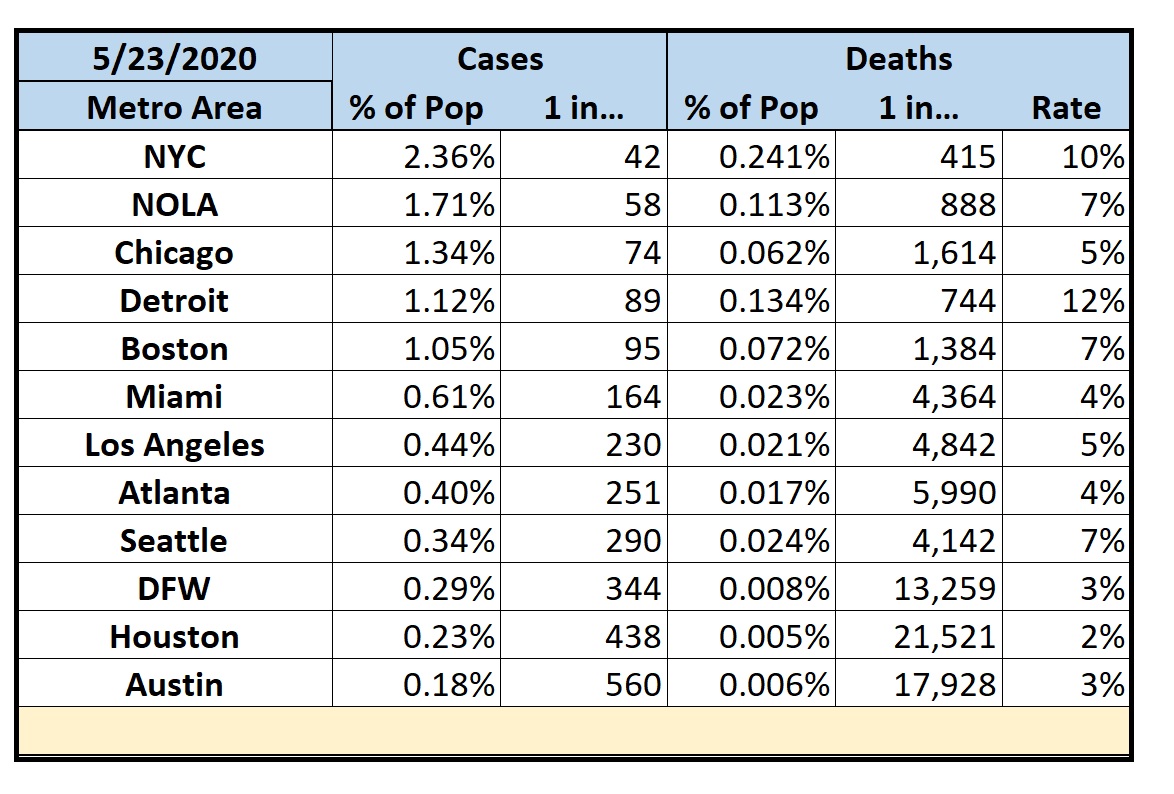
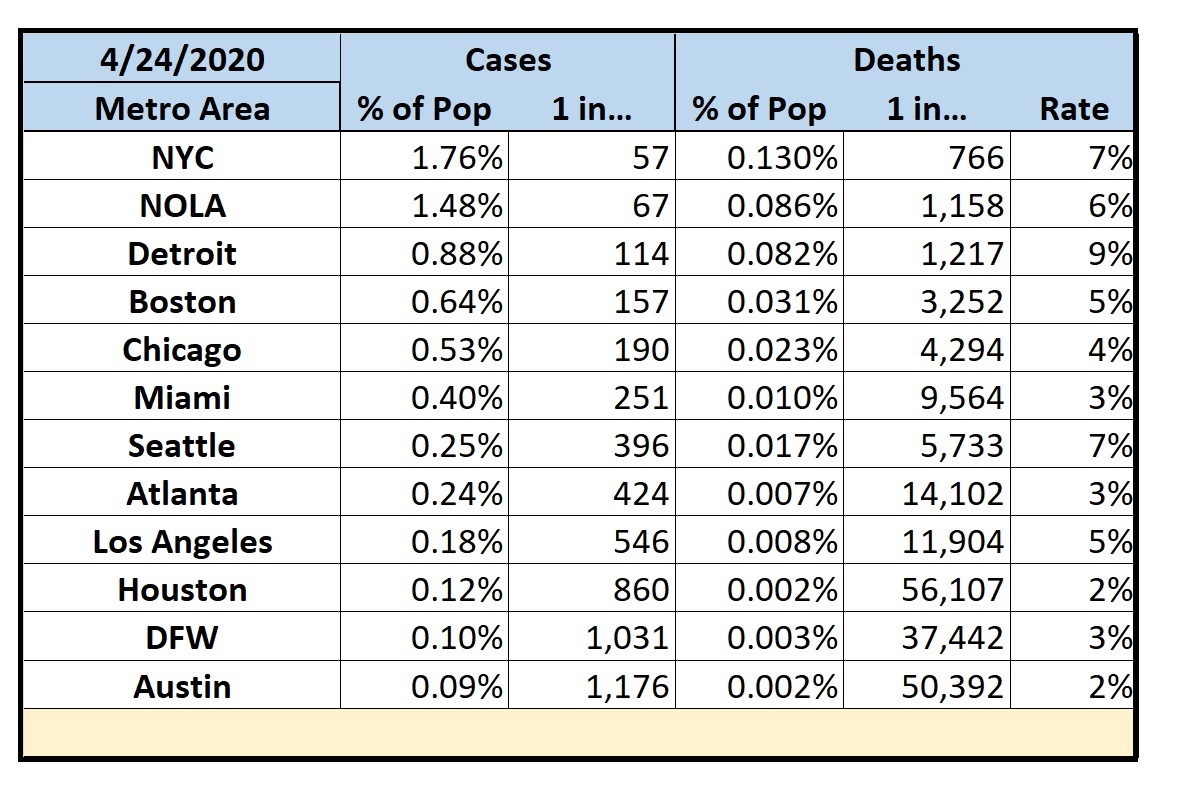
Selected Metropolitan Areas by % of Cases

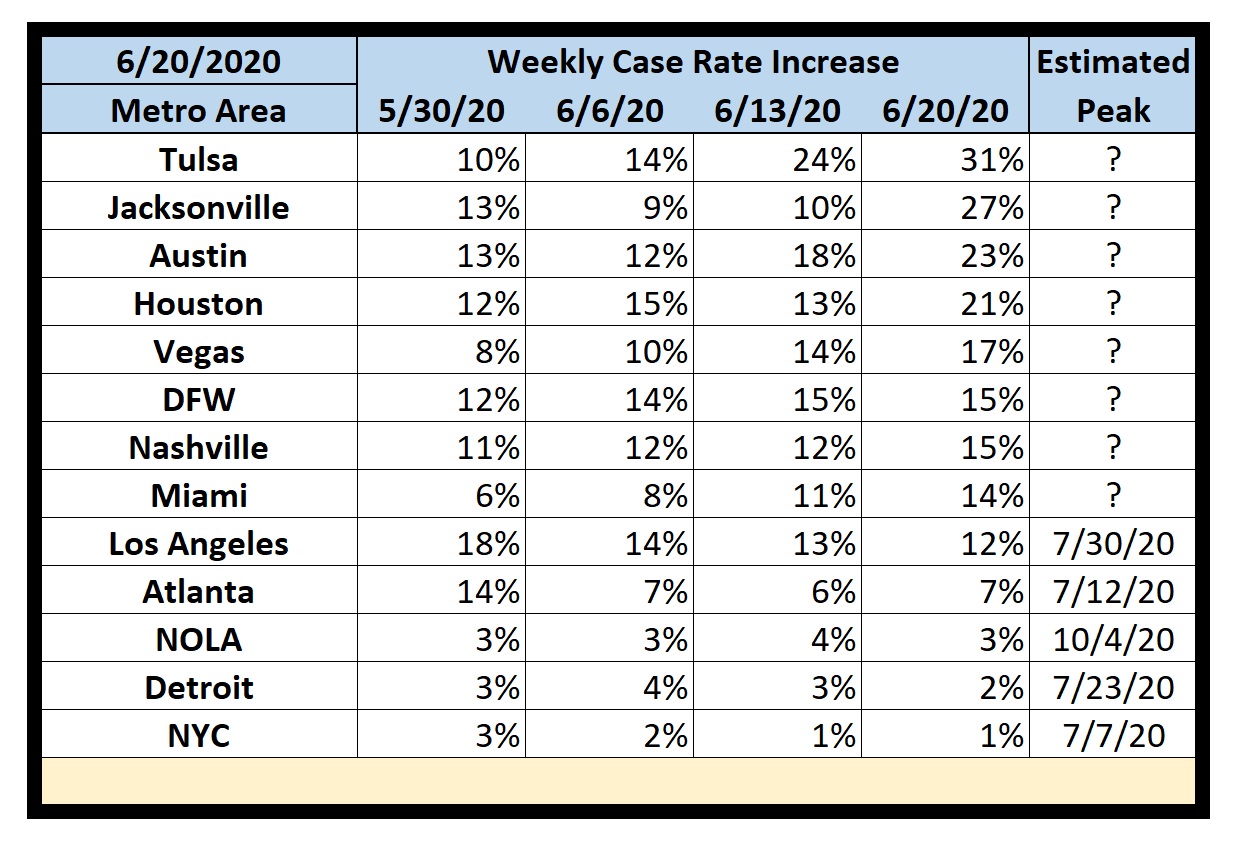
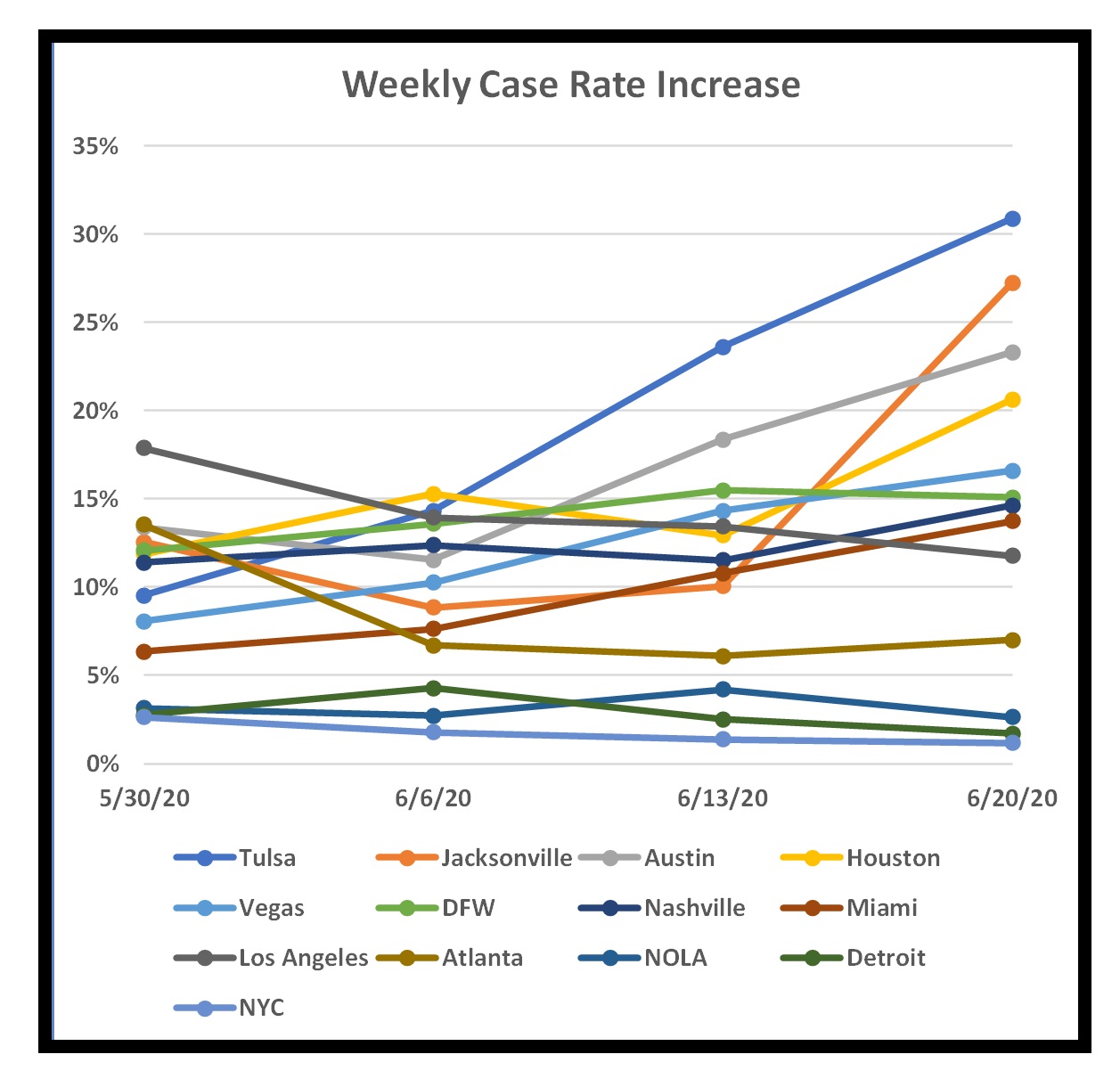
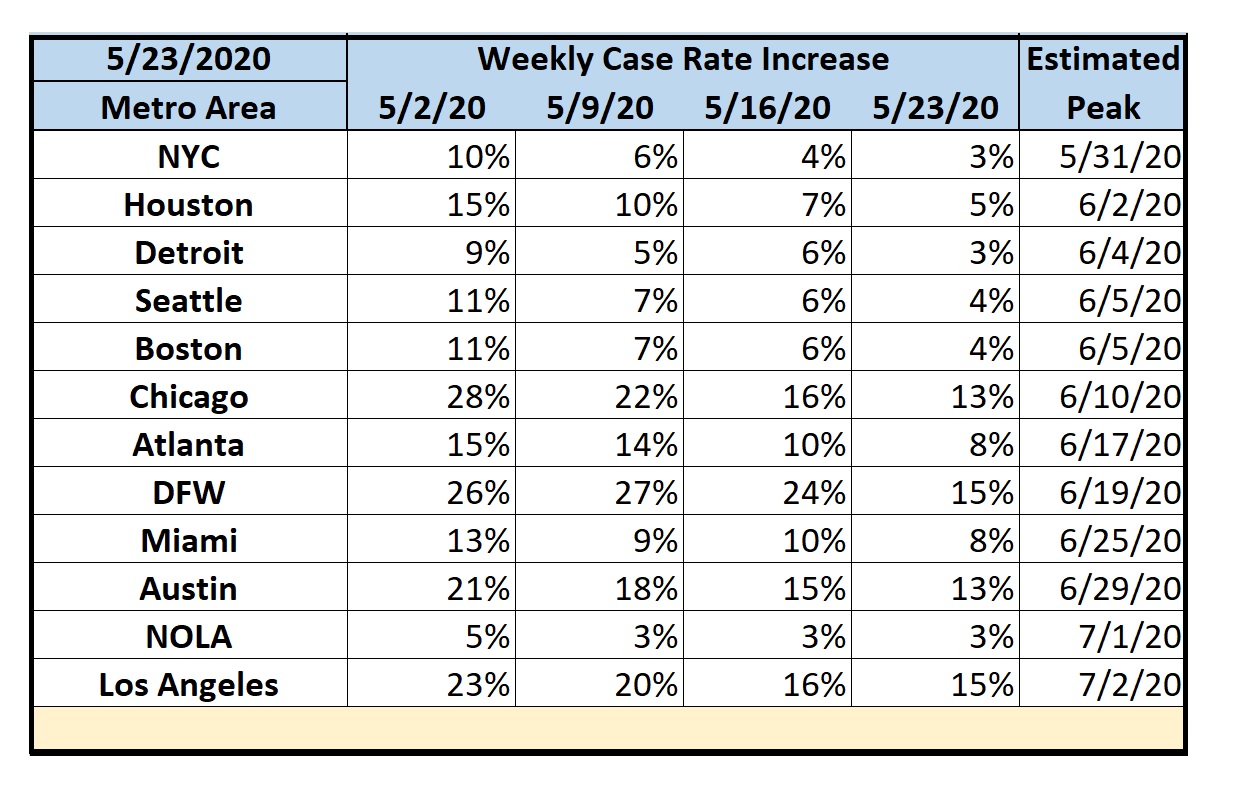
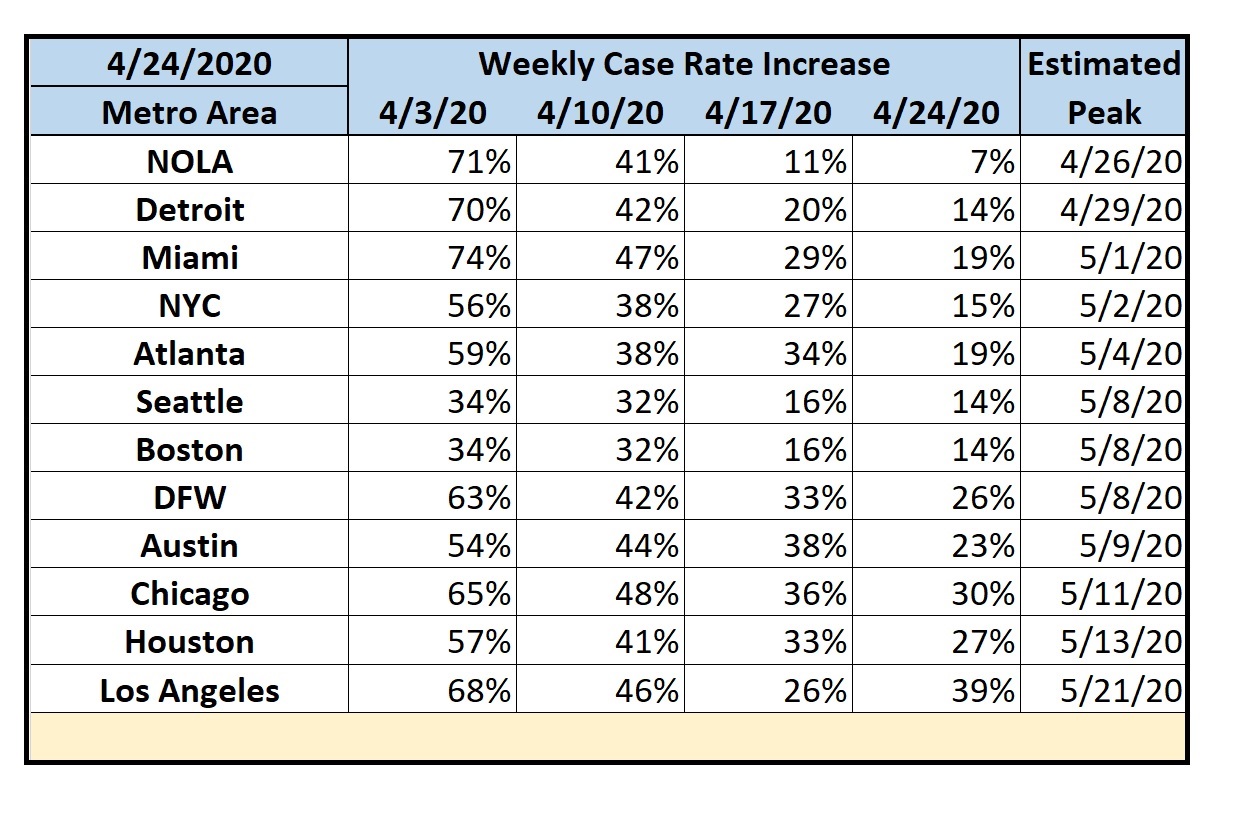
Selected Metropolitan Areas by Estimated Peak

Commentary

  • Iceland continues to show the world how to handle COVID-19.  With 1 in 191 people testing positive, they do show a higher incidence of cases than most countries.   However, since Iceland has tested 1 out of every 7 of their residents – far more than anyone else – they’ve proven that a large number of people with COVID-19 are asymptomatic carriers.  This implies that other countries conducting  only minimal testing likely don’t know the extent of their actual problem.  Iceland’s overall success is underscored by a very low fatality rate of 1%.
  • The U.S. still lags in testing coverage at only 1 in 72 people.
  • In the U.S., NYC is still the major hotspot with 1 in 57 people testing positive.  New Orleans is close behind at 1 in 67.  Detroit has the worst fatality rate at 9%.
  • While my home state of Texas still appears to be doing comparatively well, Texas has pitiful testing coverage at only 1 in 121 people.  Compare that to New York where 1 in 28 people have been tested.  It’s likely we’re not doing nearly as well as we think we are.
  • The data shows that current restrictions are working and also suggests that it’s too early to relax them.  While businesses do eventually have to reopen, a few extra weeks would seem to be prudent.

Approach

  • Most published analytics focus on case counts.  However, case counts are only meaningful in the context of potential case counts.  I thus look at the percentage of cases within a given population center.  Since these percentages are mostly less than 1% (at least for now), I also report cases in terms of an easier to grasp “One of Every N People”.
  • I report deaths as a percentage within a given population center, in terms of  “One of Every N People”, and as a percentage of the reported cases (the fatality rate).
  • I currently follow states that are either the hardest hit or are 2020 toss-up states.
  • I also currently follow several metropolitan areas in the U.S.  Since the virus spreads via close contact, this would seem to be the most useful information.  For these, I add a simple means to track progression.  Within four rolling weeks (to avoid both daily noise and old data), I report the rate of increase in the number of cases.  This is akin to tracking the acceleration of the infection.  Obviously, the goal is to first get the acceleration to zero with a resultant constant rate of infection.  Only then can the area begin to decelerate until the actual number of cases approaches zero.  Finally, I add an extremely rough projection as to when each area could reach an acceleration of zero if everything stays the same (which it won’t).
  • There are way too many variables at this point to model any future deceleration.
  • My primary data sources:  New York Times, COVID Tracking Project, Texas DSHS, Worldometer, US Census Bureau.
  • All analytics are only as good as the underlying data and there are numerous reasons to question the validity of some of my datasets.
    • Some entities only report confirmed cases; others report presumed cases.  Some entities (e.g. China) are pretty obviously under-reporting their numbers.
    • Case counts depend on access to testing and that varies wildly from country-to-country, state-to-state, and county-to-county.
    • Reporting on testing itself is even more uneven.  My data source for U.S. test data felt the need to grade each state’s data quality.
    • While I attempt to normalize data from multiple sources, the fact remains that each source dataset is independently generated with its own collection methodology.
  • If asked nicely, I can try to add reporting for other countries, states, and/or metropolitan areas in future posts.

Quoting Trump

The Priorities USA super PAC released a 30-second ad that juxtaposed Trump’s own pandemic statements with concurrent case counts.  In response, the Trump campaign sent cease-and-desist letters to numerous TV stations – including a threat to pull their broadcast licenses – to try to keep the ad off the air.

What an absolutely brilliant campaign move.

The result was to give the ad a whole lot of media attention, tons of free air time, and, of course, a massive number of internet plays. (See: The Streisand Effect.)

Just wanted to do my bit to spread the word.

2020 1st Look – The Texas House

It’s time to take an early look at the Texas State House of Representatives.

Democrats have a slight chance to reclaim the Texas House for the first time in 20 years.  It’s a VERY long shot at the moment, but it’s worth some premature attention due to the vast importance of that flip both to Texas and to the nation.

The next Texas legislature will redraw the state’s districts for the next decade and a Democratic House could stop the severe gerrymandering that Republicans will impose if they completely control the government.  Since a Republican Texas Governor and a Republican Texas Senate are foregone conclusions, the Texas House is the only option for Democrats.  Note that districts will be redrawn both for the Texas Legislature and for the Texas seats in the U.S. House.   The latter could impact control of the U.S. House through 2030.  In short: It’s important.

To retake the Texas House, Democrats need a net gain of 9 seats in November.  The Texas Democratic party claims to be targeting 22 seats to flip.  An independent Democratic group claims to be targeting 17 seats to flip.  On the other side of the aisle, the Republican party claims to be targeting all 12 seats that they lost to Democrats in 2018.  All of these targets are delusional.  Both parties will need to spend considerable resources just to defend seats they already have.  The reality is that Democrats will likely make net gains but will travel a pretty tough road to a possible majority.

As always, I ignore the races that will safely remain in either Democratic or Republican hands, leaving only 30 of 150 races that are even worth following.  I list those 30 races by goal categories in order of where Democratic focus (i.e. money) can best be applied.  My analysis thus doesn’t necessarily prioritize the “best” candidates; it prioritizes the races that can best produce a Democratic win of the chamber.

At this point, polling data is almost non-existent and many races haven’t even finalized the ballot since run-off primary elections are still TBD.  Thus, my early analysis is based on voting data from the 2018 elections and the 2016 Texas Senate race, demographic trends, party attention to the district, and the relative strengths/weaknesses of the known candidates.

Below is a first rough cut at a breakdown of the Texas House races that deserve Democratic focus.  <Click on the table to display a larger version.>

Here’s a bit more detail by goal category:

  • Defend:  Current Democratic seats that Lean D or are Toss Ups
    • These six races are defensive.  Democrats absolutely need to retain these seats and the races promise to be close.  At the moment, the Democrat is slightly favored in four of races; the other two are toss-ups.
  • Win:  Current Republican seats that are Toss Ups
    • These nine races are the best chances for Democratic flips.  Democrats need to win every single one of these seats to retake the Texas House.  As I said, it’s a VERY long shot.  Note that seven of the nine seats are roughly in the DFW metroplex.
  • Stretch:  Current Republican seats that Lean R
    • These two races are stretch goals.  Each deserves Democratic attention as a buffer for a possible loss above.
  • Hold:  Current Democratic seats that are Likely D
    • These seven races are defensive.  While Democrats should be able to hold them, they aren’t guaranteed.  If there’s money left over after focusing on the races above, it should go here.
  • Hope:  Current Republican seats that are Likely R
    • These six races are long shots – and Democrats would need to get very lucky to win any of them.  The best they can do is hope.

While my analysis will likely change over time, it seems at the moment that Democrats could barely eke out a 2020 majority in Texas House.  While unlikely, it is at least possible.  And it’s too important not to try.

The Further Politics of COVID-19

Trump continues to play a very dangerous political game with the nation.

He’s been all over the map with respect to what role the federal government should play in addressing the COVID-19 pandemic.  He failed to take the lead in the initial stages of the pandemic and, in fact, downplayed its significance for political purposes until it was way too late.  He then pushed all responsibility to the states, forcing them to compete against each other for medical supplies.  He followed that with claims of “absolute” power to override state lockdown orders, despite the 10th Amendment.  After pushback from across the political spectrum, he then told each state to “call your own shots”.  Yesterday, however, he was tweet-ranting against state orders:  “LIBERATE MINNESOTA!” “LIBERATE MICHIGAN!” “LIBERATE VIRGINIA!”  It was no coincidence that Trump’s tweets came immediately after news coverage of armed protesters outside of those state capitals.

Trump desperately wants to be seen as in charge and demands a parade whenever someone in his administration actually does their job in spite of him.  However, Trump himself is not only unwilling to take any responsibility for anything, he is actively supporting open insurrection against legal orders from state governments.  It is again no coincidence that the states being attacked by Trump are all led by Democratic Governors.

Many Governors – of both parties – are trying their very best to walk a very thin line between saving lives and getting their states back to work.  In two of the hardest hit states, Governor Newsom of California and Governor Coumo of New York separately rolled out very sane metrics-driven plans this week.  Both Democratic Governors projected optimism but neither sugar-coated the challenges ahead.  The apolitical sanity of their approaches is reflected in their current popularity:   Newsom has an approval rating of 83%; Coumo has an approval rating of 79%.  Both had pre-pandemic approval ratings of under 50%.

The Trump administration subsequently published a set of very high-level guidelines for a three-phased approach to reopen the economy.  It offered no federal assistance and was nowhere near as detailed as the previously released state plans.  Although both too obvious and too optimistic, the federal guidelines were relatively sane and explicitly left interpretation of the guidelines to the states.  Unfortunately, Trump didn’t read his own administration’s guidelines.  If he had, he might have realized that the states he wants to “liberate” haven’t yet reached the criteria for entering even the first phase of the those guidelines.

The subsequent response from many Republican Governors has been extremely disappointing.

In my home state of Texas, Governor Abbott initially chose to let counties define their own pandemic policies, saying that what might be right for urban areas might not be right for rural areas in our rather large state.  While his approach was perhaps naïve, it was at least consistent with a small government philosophy and Abbott was at least supportive of strict county-led policies of containment.  However, after the federal guidelines were announced, Abbott issued orders overriding some stricter guidelines defined by numerous Texas counties.

Abbott’s sudden conversion to a state-level, open-the-flood-gates approach simply reeks of politics – particularly since his announcement was littered with irrelevant and undeserved praise for Trump.  The fact that Texas has done fairly well compared to other states thus far is due to the restrictions imposed at local levels – not due to any actions by our Governor or our President.  Personally, I’m less than thrilled with their interference.

Concurrently, a large gathering of idiots protested Texas business closures on the grounds of our state Capital — in open defiance of legal social distancing orders and basic common sense — and were not dispersed by state authorities.  Trump also tweeted support for the protesters — presumably because any group featuring Alex Jones must be above the law.

To be sure, some Republican Governors are wisely charting their own courses in spite of Trump’s demands of the moment.  Governor DeWine of Ohio has received universal praise for his decisive handling of the pandemic.  While he hasn’t yet released a detailed plan for moving forward, he thanked Trump for his guidelines while rather pointedly noting that Ohio would not rush to remove the state’s current restrictions.  Republican Governors Baker of Massachusetts and Hogan of Maryland have been similarly willing to do what is in the best interests of their states without regard to politics.

Whether right or wrong, in our form of government, each state is indeed empowered to take the lead within their borders.  However, the federal government does have significant roles to play – and the publication of vague, unenforceable guideline documents isn’t on the list.  Expressing open support for the armed defiance of state orders probably shouldn’t make the cut, either.

At this point, the one thing that the federal government can and absolutely should do is to take responsibility for the guaranteed availability of COVID-19 test kits and the supplies necessary to process those tests.

While each state would need to take the lead in the administration of such tests – and in the difficult contact tracing necessary for those tests that come back positive – each of the 50 states simply cannot be separately responsible for making sure that our country can develop and/or obtain the massive number of test kits necessary to track and contain COVID-19 cases.  Until a treatment and/or a vaccine is available, our very best defense against the pandemic is data.  Lots and lots of data.  And the only way we can get that data is to test as many people as we can as often as we can.  In particular, antibody tests can tell if someone has ever been infected with COVID-19, regardless of whether or not they ever experienced symptoms.

If we know who is currently infected, who they’ve come in contact with, and who is likely immune, we have a decent chance to control the virus without the indiscriminate social distancing currently employed.  Note that Iceland’s very aggressive program has currently tested approximately 10% of their population.  Their resultant data suggests that 50% of COVID-19 cases are asymptomatic – implying that if we only track those people that get visibly sick, we’ll miss half of the problem and make no progress whatsoever.

Trump, of course, has been beyond inconsistent with regards to testing:

  • On March 6, Trump started by making promises he didn’t keep, stating that “Anybody that wants a test can get a test.”  This obviously wasn’t true then and it isn’t true now.
  • On March 13, Trump responded to a reporter who asked if he took responsibility for the lag in testing with “No, I don’t take responsibility at all.”  So there.
  • On March 18, Trump tried to shift blame for faulty test kits to the Obama administration claiming that “We inherited a very obsolete system.”  This was patently false as the test kits in question were designed during the Trump administration.
  • On March 24, Trump simply claimed success by stating that ““We now are doing more testing than anybody.”  While technically correct, the statement ignores the relative size of the U.S. population.  On a per capita basis, the U.S. currently ranks behind numerous countries (e.g. Germany, Italy, Canada, South Korea) in tests performed.  With an estimated 3.7M tests performed in the U.S. as of this writing, we’ve tested only 1% of our population.  That’s not nearly enough.
  • On April 6, Trump then pivoted to a pass-the-buck stance, stating that “States can do their own testing.”  Yes, but they need test kits to do that testing and the federal government is in the best position to guarantee availability.
  • On April 10, Trump claimed that extensive testing just wasn’t necessary:  “We’re going to do testing, but you don’t need to test 325 to 350 million people.”  Actually, testing 100% of the population would be optimal and testing 1% is nowhere near sufficient.
  • On April 17, Trump went back to buck passing, tweeting: “The States have to step up their TESTING!”  Dude.  Try to understand.  The states need tests to do testing.
  • On April 18, Trump inexplicably claimed that Governors simply “don’t want to use all of the capacity that we’ve created. We have tremendous capacity.”  So, every Governor in every state has the ability to test more but just isn’t doing it?  Sure.  That makes sense.

Given the immense resources of the United States, Trump has it within his power to flood the country with test kits and processing supplies.  He could negotiate with foreign countries and companies to augment national resources where necessary.  He could provide coordination across labs in multiple states to speed up processing.  He could guarantee that all private labs will be paid if they maximize capacity even if that capacity isn’t used.  He could make tests freely and regularly available to every person in every state, even without a doctor’s order, in return for their active participation in the associated study.  He could offer up the FBI and/or the military to assist the states in contact tracing. He could create a national database to pull together data from all 50 states and make an anonymized version of it freely available to every state in the nation and to every country in the world for research purposes.

So here’s my question:  Who the hell is advising this guy anyway?  COVID-19 testing shouldn’t be a political issue, but okay, let’s say it is one.  If being seen as a hero and winning the 2020 election are the only things that matter to Trump, why is he not all over this?  In this case, good policy would be great politics.

Does Trump truly believe that he can continue to play his standard misdirection game and then either quickly claim credit if things go well or blame others if they don’t?  Is Trump so afraid of taking any responsibility at all that he’s willing to let people die rather than at least try to help?  Is Trump so enamored with the political game that he seriously wants to keep the federal government on the sidelines so that he can try to blame Democrats when everything goes to hell?  Is Trump simply too dense to understand the consequences of his actions and non-actions?

While any and all of the above are valid possibilities, I’m going with that final proposition.

2020 2nd Look – The Senate

It’s been just shy of a year since I last wrote about the 2020 Senate races.  While many things (including some of the candidates) are still in flux, an updated look seems appropriate.  While Republicans are still favored to retain control of the Senate, the chances of a Democratic takeover have improved enough to warrant serious attention.

Democrats will need a net gain of 3 Senate seats if Biden wins the Presidency or a net gain of 4 seats if Trump wins.

As before, I’m ignoring the Senate races that will safely remain in either Democratic or Republican hands, leaving 16 races worth following.  They are presented here by goal categories in order of where Democratic focus (i.e. money) can best be applied.  Within each goal category, the races are ordered by the probability of a Democratic win based on current polling data (albeit scarce), the relative strengths/weaknesses of the known candidates, recent state voting trends, and a few other factors.

Here’s a bit more detail by goal category:

  • Defend:  Current Democratic seats that Lean D
    • These two races are defensive – and Democrats absolutely need to hold these seats.  Michigan and New Mexico are both Electoral College swing states in 2020, impacting the dynamics of the down-ticket Senate races.  While the retirement of Democrat Tom Udall in New Mexico made that race more competitive than it needed to be, Democrats are still slightly favored to hold the seat.  Democrats are also favored to keep the Michigan seat but can’t take it for granted.
  • Win:  Current Republican seats that are Toss Ups
    • These five races are the best chances for Democratic flips – and Democrats need a clean sweep of all five.  That’s not probable, but it is possible.  The late entries of John Hickenlooper and Steve Bullock helped a lot; Mark Kelly is proving to be a strong candidate; Republican incumbents Susan Collins and Thom Tillis both have serious popularity issues.
  • Stretch:  Current Republican seats that Lean R
    • These two races are stretch goals – but each deserves Democratic attention as a buffer for a possible loss above.  The Kentucky race deserves special attention due to the strength of Amy McGrath and the depravity of Mitch McConnell.  Joni Ernst isn’t quite as polarizing but is still a valid long-shot target.
  • Hold:  Current Democratic seats that are Likely D
    • These two races are defensive – and, while Democrats should easily hold them, they aren’t guaranteed.  If there’s money left over after focusing on the races above, it should go here.
  • Accept:  Current Democratic seats that are Likely R
    • This race probably isn’t winnable  – and Democrats shouldn’t waste a ton of money trying to keep the seat.  Doug Jones just barely won last time against a child molester and Alabama Republicans aren’t making that mistake again.
  • Hope:  Current Republican seats that are Likely R
    • These four races are extreme long shots – and Democrats would need a massive amount of money and luck to win any of them.  The best they can do is hope.  While I’ll personally contribute to MJ Hegar’s campaign in my home state, the unfortunate fact is that John Cornyn will most likely win re-election.

Based on my current analysis, Democrats can indeed reclaim the Senate in 2020.  They’ll just need to run the table to do it.

Trump vs. Trump

While everyone’s attention is elsewhere at the moment, the 2020 elections are just seven months away.  Some things have changed; some things haven’t.

Since my last post on the Presidential contest, Sanders dropped out of the Democratic race and endorsed Biden, making the latter the presumptive nominee.  On the Republican side, Trump is still a narcissistic jackass.

Meanwhile, Biden himself has been pretty much invisible – which is not necessarily a bad thing for now.  If Biden was a great orator, a calm voice of reason might help to fill our current national leadership vacuum.  Unfortunately, Biden isn’t an Obama… or a Reagan…or a (Bill) Clinton.  I do believe that Biden means well and has a good heart.  He’d be a very capable President who would surround himself with the best talent available – taking full advantage of their skills while functioning more as a Chairman of the Board.

Biden’s mouth does often get ahead of his brain, though, and in a normal election, that would be a fatal flaw.  However, since Biden’s opponent is the undisputed champion of verbal diarrhea, Biden’s gaffes shouldn’t be a huge disadvantage.  That said, it’s still probably best if Biden just lays low for a while, limits his exposure, and lets Trump implode all on his own.

The simple fact is that the 2020 Presidential election will be entirely a referendum on Trump and, in particular, his handling of the pandemic.

If we somehow find ourselves in November with a strong economy, with the pandemic under control, and with blame for all of the death and damage shifted elsewhere, chances are that Trump will win a second term.

If the economy is still struggling, if the pandemic is still impacting American life, and importantly, if Democrats can successfully (and rightfully) saddle Trump with full responsibility for our non-existent national strategy in the early days of the pandemic, Biden can win by simply providing a reasonable alternative.

As an early indicator, note that Trump’s approval rating is currently underwater at 44.2% with a stunning 51.3% disapproval rating.  That’s quite an amazing feat given our country’s solid history of rallying behind their President in a time of crisis, regardless of party.

One thing remains completely unchanged.  Despite COVID-19, our Presidential elections still aren’t popularity (or unpopularity) contests.  It’s still all about the Electoral College.  While COVID-19 has scrambled some of the 2020 political calculus, the basic Electoral Landscape has not seen significant change.  The states that were Safe or Likely states for both Democrats and Republican remain as they were.  However, while the swing states all remain swing states, they may be leaning just a bit more toward Democrats at the moment – or rather, just a bit more away from Trump.

Democratic Governors in the swing states of Michigan, Wisconsin, and Pennsylvania have seen double-digit improvements from their pre-crisis approval ratings.  Trump isn’t winning fans in those states by attacking their Governors and claiming “absolute” power to override their decisions.  Conversely, the Republican Governors of the swing states of Florida, Arizona, and Iowa have seen their approval ratings drop.  Trump’s embrace of these Governors isn’t doing him any favors, either.

Turns out that swing voters don’t particularly like a President who plays politics with their lives.  Imagine that.

COVID-19 Analysis

I thought I’d share a few of my own COVID-19 analytics (using data as of 4/10/20).  While I follow a wide variety of published sources, it can be tough to glean useful information from the reams of available data.  For my own edification, I decided to hack together some simple analytics to give myself a better idea of what’s going on.

Is this politics?  Not directly.  But since COVID-19 will certainly impact the political landscape, it doesn’t hurt to better understand it.

First, a disclaimer: My analytics are only as good as the underlying data and there are numerous reasons to question the validity of some of that data.  Case counts depend on access to testing and that varies wildly from country-to-country, state-to-state, and county-to-county.  Some entities only report confirmed cases; others report presumed cases.  Some entities (e.g. China) are pretty obviously under-reporting their numbers.

Since case counts are only meaningful in the context of potential case counts, I look at the percentage of cases within a given population center.  Since these percentages are mostly less than 1% (at least for now), I also look at cases counts in terms of “One of Every N People”.  I similarly look at deaths as a percentage within a given population center, in terms of  “One of Every N People”, and as a percentage of the reported cases.

Hence, for example:

My home state of Texas is doing pretty well with only 1 in every 2398 people testing positive.  New York, however, is getting hammered with 1 in every 114 people testing positive.  Yikes.  Texas also has one of the lowest death rates at the moment; Michigan has the highest death rate.

While the above is interesting, it’s not particularly useful.  From a practical standpoint, the most useful information is local – since the virus spreads via close contact.  Hence, I take my deepest looks at the major metropolitan areas in the U.S.

For these, I track the same metrics as above but add a simple means to track progression.  I do the latter on a rolling, weekly basis (to avoid both daily noise and old data) as the rate of the increase in the number of cases.  This is akin to tracking the acceleration of infection.  With this metric, while moving from 80% to 50% is a significant improvement, we’re still accelerating – albeit at a slower rate.

Obviously, the goal is to first get the acceleration to zero (with a resultant constant rate of infection) and then to begin to decelerate until the infection rate itself approaches zero.  Finally, I add a very rough projection as to when the areas should reach an acceleration of zero assuming everything stays the same.  Thus, for example:

Again, my home city of Austin is doing pretty well with only 1 in every 2479 people testing positive.  New Orleans is a nightmare with 1 in every 82 people testing positive.  Austin’s death rate is fairly low while Seattle is even worse than NYC and NOLA in this regard.

While the above does suggest that we’re less than a month away from stabilization (if not improvement), it assumes that the current social and business restrictions remain in-place.  If they are lifted or relaxed, the model will no longer be valid.  Consider that my fair warning to anyone championing a quick return to our prior normal.

COVID-19 Links

In lieu of a normal blog post, I thought I’d share a few links that have provided useful information as I personally navigate the COVID-19 crisis. I’ll update this page in-place as appropriate.  (Updated 2/15/21.)

As time permits, I hope to dive into the related political aspects.  Some are sincere differences of opinions on policies and approaches; some are purely political in the very worst sense of that word.  I’ll try to find the cycles to weigh in on the former and call out the latter.  In the meantime:

Stay Safe!

Dealing with Sanders

With the latest election results, it seems pretty clear that Joe Biden will be the 2020 Democratic nominee for President.  It’s now important to plan a sane path to a convention that sets up a strong general election campaign.

In the immediate aftermath, I wasn’t a fan of party attempts to force Bernie Sanders out of the race.  There are still important states that haven’t voted and additional voices that should still be heard.  Sanders had performed well in early contests and he’d earned the right to set his own schedule.

I was even of the opinion that the upcoming debate should go on as planned.  Why on Earth would Democrats give up a televised opportunity to bring the party together with the last two remaining candidates after so many crowded and contentious debates?  There are serious issues with numerous potential solutions that can be reasonably discussed by two senior statesmen to help Democrats come together to win in November.  With COVID-19 and a stock market crash front and center, this would also be a wonderful time to showcase a Democratic party that knows how to lead.

And then Sanders made his statement.

While Sanders admitted that Biden was winning the delegate math, he insisted that his movement was still winning the ideological and generational debate.  Huh?  Dude, the majority of people that actually voted didn’t vote for you.  It really is that simple.

Sanders then stated that he was looking forward to the debate and enumerated several campaign positions on which he planned to directly challenge Biden.  This most certainly was not a list of possible discussion topics.  This was an attack on moderates and a list of progressive demands.

Assuming that the debate really does take this form, consider for a moment how Sanders’ supporters would react if the situation was reversed:

  • If Biden was essentially eliminated from contention but still insisted on taking Sanders to task in a one-on-one debate.
  • If Biden still wanted to focus on politics when people were afraid of getting sick and going broke.
  • If Biden directly attacked Sanders’ positions as half-baked, unreasonable, and unaffordable on prime-time television.
  • If Biden publicly threatened Sanders with the support of older moderates unless he accepted position shifts toward the middle.
  • If Trump could simply lift soundbites from the debate and run them over and over again in swing states to defeat Sanders.

But here’s the thing:  We don’t really need to consider the above scenario.  Biden would have never made the speech that Sanders did.  And that’s why Sanders lost.

Sanders and his supporters conducted a similar slash and burn campaign against Hillary Clinton in 2016.  A 2020 rerun must be stopped before Sanders once again does Trump’s work for him.  While I would have preferred to avoid the heavy-handed approach, the DNC needs to step in now and control the game.

If Sanders can’t play nice, he needs to be benched.

Super Tuesday Thoughts

In this election, we have to stay focused on the dark clouds behind any silver linings.  That’s why I’m here!

Joe Biden staged an impressive Super Tuesday comeback, Bernie Sanders managed to hold on, and the race for the Democratic nomination is now a two-person contest.  Biden’s surge seems to imply that a majority of Democrats are now concluding that electability against Trump is of paramount importance.  That’s the silver lining.

The dark clouds?  Let’s not forget that this year’s Democratic nominating process remains idiotic.  We still don’t know the preferred nominee of Democrats in any of the four states that will matter the most in November.  Those four primaries won’t complete for another eight weeks – ’cause, you know, why would we give a damn what Democrats in the states that will decide the general election think about their nominee?  While the preference of given state’s Democrats doesn’t equate to a general election win in that state, it does hint at the Democratic enthusiasm that can be expected there.  In a close election, enthusiasm could be a deciding factor.  For reference, here are the relevant states and dates:  Michigan (3/10), Arizona (3/17), Wisconsin (4/7), and Pennsylvania (4/28).

FYI, Democrats in most of the seven states that lean Democratic – but aren’t guaranteed – have now weighed in.  The results are a wash.  Sanders won New Hampshire, Nevada, and Colorado; Biden won Virginia, Minnesota, and Maine.  New Mexico doesn’t hold its primary until 6/2.

The greatest concern from my perspective is the fact that a two-person contest could further entrench Democratic voters into their perceived lanes – with young progressives on one side and older centrists on the other.  A contested Democratic convention is a possibility and, while that would be absolutely fascinating to watch, it likely wouldn’t be helpful to party unity.

In 2016, after Sanders lost the Democratic nomination to Hillary Clinton, a large number of Sanders’ supporters essentially took their marbles and went home in a huff.  Since these folks couldn’t vote for their preferred candidate in November, they either stayed home, voted for Trump, or voted for a third-party candidate in protest.  Gary Johnson (Libertarian Party) and Jill Stein (Green Party) never came close to winning in any state but the votes that were cast for them still mattered.  Had Clinton won a decent chunk of the 2016 third-party votes in several close states (including Wisconsin, Michigan, Pennsylvania, and Florida), she would have easily beaten Trump.  Thus, the Sanders Sore Losers bear some significant responsibility for Trump’s four years in office.

Sadly, I see no signs that the 2020 Sanders camp would be any more gracious in defeat.  While it’s not yet clear if any third-party candidates will gain traction this year, any significant number of Sanders supporters that refuse to vote for any other Democrat could easily throw the election to Trump once again.  Biden supporters wouldn’t be at all thrilled with a Sanders nomination but most wouldn’t even consider the scorched Earth approach of the Sanders supporters.

Personally, I stand by my prior post with respect to a Sanders candidacy.  If Sanders wins the Democratic nomination, I would fully expect him to lose the general election while being a major drain on all of the down-ballot races.  That said, he would still have my unqualified support.  While I disagree with many of his policies, the simple fact is that Bernie Sanders is an infinitely better human being than Donald Trump.  I would definitely vote for Sanders and I’d even throw some money at his general election campaign.  I would, however, likely focus my own efforts on a Democratic retention of the U.S. House.  That would be the only check on what would undoubtedly be a completely unhinged Trump Administration, Part II.

As a political junkie, I think the incoming thunderstorm is going to provide a great show.  As an American, I find myself more than a little worried about the roof leaking.