COVID-19 Analysis VI

In the United States to date, there have been 7.7 million COVID-19 cases and over 215,000 resultant deaths.  While there are countless ways to look at the underlying data, one doesn’t need a background in data analytics to grasp the harsh reality that these numbers suck.  We can use appropriate analytics to visualize how badly we suck.  Unfortunately, such an exercise provides no consolation whatsoever.

However, since relative suckage is relevant in the political realm, I’ll continue my attempts at visualizations.  In past postings, I’ve looked at COVID-19 numbers by country, state, and metropolitan area in various ways.  Some of my analytics provided politically relevant information; others not so much.  For this iteration, I’ve attempted to address just two questions that may be relevant to the 2020 elections:

  1. How badly does the U.S. suck relative to other countries?
  2. Within the U.S., how badly is each state sucking relative to one another?

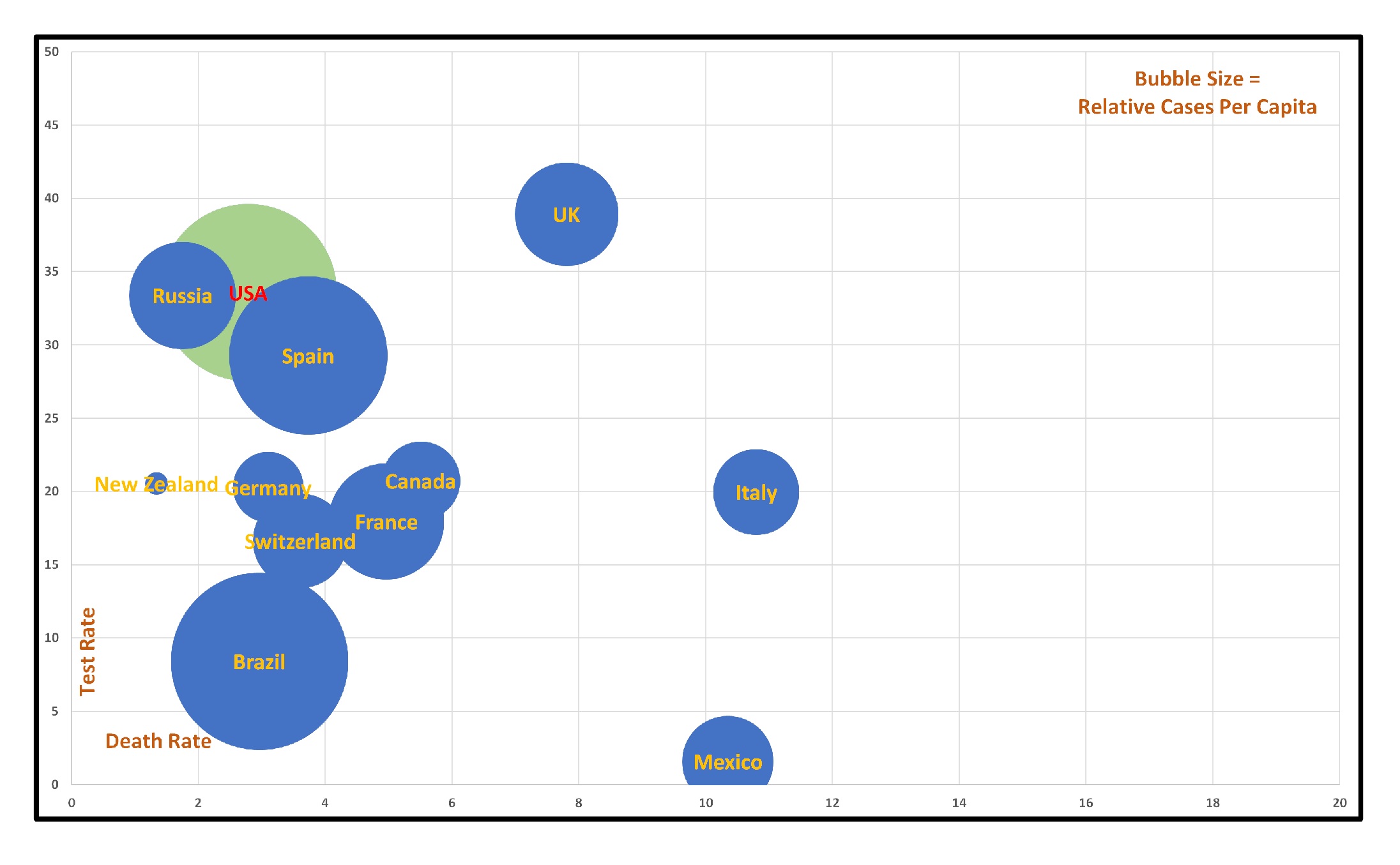
I still like my bubble chart to visualize an answer to Question 1.  Here, I’m happy with a static point-in-time snapshot that concurrently shows per-capita cases, death rates, and test rates.  While the analytic will only be finalized in retrospect once the virus is contained, a time component isn’t really necessary to convey how the U.S. currently compares to the rest of the world.  That said, a July post contains a prior version of this chart.  Below is the chart as of 10/3.  Click on the graphic to display a larger version; hit the back button to return here.

I did remove Iceland from this update.  It turns out that Iceland is doing so well with COVID-19 that they threw off my visualization.  With a test rate of 86% (!) and a death rate of 0.3%, one can imagine their tiny dot to be positioned way upper left, above the chart.

The U.S. is finally doing relatively better with respect to testing and, like most countries, our death rate is decreasing.  However, we’re still  the worldwide leader with our per-capita case count – and that’s just embarrassing.  Given our national resources, it’s inexcusable that we’re not the country that breaks the analytic.

A visualization to answer Question 2 is trickier.  Here, given our non-existent national response and the rapidly changing rules and regulations at the state and local levels, the time component seemed more relevant.  I settled on weekly tracking of new cases per capita as the best metric to gauge relative progress while minimizing the impact of daily noise.  The number are visualized on a map of the U.S. with the darker state shades reflecting a higher per capita case count.  The following video compresses 33 weeks of the pandemic into about a minute:


From this perspective, it’s interesting to note that the original New York and Louisiana hotspots fairly quickly gave way to a spread across the entire country.  Despite Trump’s blather, COVID-19 isn’t party-aware – as evidenced by per-capita spikes in states as diverse as Arizona, Florida, Wisconsin, Iowa, and North Dakota.  The virus has ebbed and flowed throughout the U.S. and it is showing no signs of retreat.

2020 2nd Look – The Texas House

As promised in my previous post, I took a second (admittedly quick) look at the Texas State House races.  This chamber remains the best and only hope for Democrats to have any voice at all in Texas’ upcoming redistricting efforts.

The good news is that things have improved since my April analysis and I now see Democrats as favored to add seats in 2020.   The bad news is that Democrats still need to fill an inside straight flush on the river to take control.  It’s doable.  It’s just not likely.

Democrats are slightly favored to keep all of their current seats and flip four Republican seats.  Another four Republican seats could go either way. Unfortunately, even if Democrats lose none of their current D seats and sweep all eight R seats that Republicans aren’t favored to win, they would still be one seat shy of the nine flips necessary to barely win the chamber.  Thus, in the table below, I’ve identified three Lean R seats that appear to be the best opportunities for Democrats to grab that additional seat.  <Click the table below for a larger version; hit the back button to return here.>

Money Matters

Along with many others, I am personally increasing my political contributions in direct response to the GOP’s blatant Supreme Court hypocrisy.  And, no, it’s not too late to contribute.

While early donations are better, late money can still help quite a bit.  An influx of last-minute cash can be used for additional TV ad buys, for last-minute digital targeting, and – perhaps most importantly – for get-out-the-vote efforts.

Every poll out there is based on being able to identify of a “likely voter” – a concept that is tough to get right in a perfect world but is laughably impossible in a world consumed by a pandemic, fires, hurricanes, derechos, social unrest, voter suppression, intense political polarization, and a surprise Supreme Court vacancy.  Since no one really knows who is going to actually vote, every single vote will be important in every race in every state, regardless of what any random poll says.

Since I’ve been asked, below are my personal donation targets in my personal order of importance.  Most of the links below use ActBlue to easily allow donations to multiple campaigns via a single online account.  (Hint: Create and log into your account before clicking on the ActBlue links below.)

The Presidency

Getting rid of Trump must be a first priority, so donations here are no-brainers:

The U.S. Senate

A close second priority is a Democratic majority in the U.S. Senate.  Biden can’t do a whole lot without a supportive Senate and we really need to get McConnell out of power if not out of the Senate altogether.

To help Senate Democrats, one could certainly donate to the DSCC or the Senate Majority PAC.  My concern is that their targeting isn’t optimal and that these folks are casting too wide a net – spending money on too many races.  On the other hand, it’s certainly easier to direct money to a single source that will distribute funds more-or-less appropriately.  Thus, my pick for an independent Senate-focused fund would be:

That said, my personal preference is to donate directly to just enough of the right Democratic Senate campaigns.  I discussed the state of the Senate races in my previous post, but in summary, here’s the Senate campaigns to which I’d donate first:

If you feel so inclined, here are some other Senate campaigns that are worthy of consideration:

The Texas House

I live in Texas and a Democratic win of the Texas State House is important to me.  It’s a long shot, but it is doable.  I need to update my prior analysis of the individual races and I’ll try to do that soon.  While I prefer contributing directly to campaigns, I’m fine with donating here for now:

The U.S. House

Democrats don’t appear to be in much danger of losing the U.S. House.  But again, it’s all about who actually turns out to vote and nothing should be taken for granted.  While I’d rather donate to individual campaigns, the DCCC does seem to have a relatively decent idea how to distribute money appropriately to guarantee another House majority.  Thus, I’ll just donate here this cycle:

Honorable Mention

I’m also a fan of many of the independently-produced commercials from this group of former Republicans:

So…

If you’re looking to pitch in anywhere, try to do so before September 30 – the FEC’s donation cut-off date for third quarter campaign finance reports.

2020 3rd Look – The Senate

Since I last wrote about the 2020 Senate races, much has changed and I suspect more changes are in store.  The full extent of the backlash over the GOP’s rush to fill Ruth Bader Ginsburg’s Supreme Court seat isn’t yet known.  At the moment, though, control of the chamber appears to be a toss-up.

Democrats need a net gain of three Senate seats if Biden/Harris wins or a net gain of four seats if Trump/Pence wins.  While I unfortunately need to assume that Democrats will lose the Alabama seat, all other Democratic incumbents now appear to be in pretty good shape.  Thus, Democrats need to flip five GOP seats to guarantee a Senate majority.

Based on my analysis, Democrats are currently favored to flip three seats that Lean D.  Another three seats are Toss-Ups and Democrats need to flip at least two of them.  Thus, these six races are where Democratic focus (i.e. money) could best be applied now.  I’ll expand on the money issue in my next post.

I’ve also identified an additional four races which I currently consider to be Stretch goals but which might also be deserving of some attention.  While these are longer shots, throwing money at Democrats running against such people as Mitch McConnell and Lindsay Graham just feels good.  I also suspect that some of these races may soon move into the Toss-Up category.

Beyond the above ten races, I note a few other races that some consider to be in-play, but that aren’t yet “practically” in-play from my perspective. Within this group, I’d love to suggest a stronger defense of the relatively safe Democratic seats and a stronger offense to take the relatively safe Republican seats.  However, money needs to be spent where it can do the most good.

The races are presented here in my current order of importance using the same structure and methodology as previously discussed.  Click on the table below to display a larger version; hit the back button to return here.

An Open Letter to GOP Senators

Dear Senate Republicans:

A true American icon has died.

Ruth Bader Ginsberg was a passionate and brilliant defender of our Constitution.  As only the second woman to ever serve as a Supreme Court justice, she leaves behind a 27-year record of both majority opinions and powerful dissents that will be quoted as long as our democracy lives.

I know RBG wasn’t your favorite jurist.  But she was sincere.  And she was funny.  And she was a good person.  She was great friends with Antonin Scalia – who probably was your favorite jurist – and they highly respected one another.  That should mean something to you.

While it’s sad that discussions have turned away so quickly from her amazing life and toward the nasty process of replacing her on the Court, it’s not unexpected.  Since we’re here, though, I’ll take a moment to discuss the politics.

I know that McConnell was crystal clear when he said immediately after Scalia’s death ten months before the 2016 presidential election:  “The American people should have a voice in the selection of their next Supreme Court Justice. Therefore, this vacancy should not be filled until we have a new president.”

I am also quite aware that McConnell has no problem at all flushing any pretense of principle down the drain in order to replace Ginsburg less than two months before the 2020 presidential election.  I just wish he’d be honest about a purely political power play.  His logical gymnastics to justify the switch are embarrassing.

I’ve already seen a ton of opinion pieces addressing all sorts of Senate process questions – how long does it take to get a nomination through the Senate, do you have time to do it before the election, can you do it after the election in a lame-duck session, would enough of you be willing to rush a vote, does the math change if Kelly beats McSally and he takes the Arizona Senate seat immediately since that’s a special election, etc.

I guess this inside baseball is moderately interesting, but I fully understand the bottom line:  At least 50 of you will fall in line behind Trump and McConnell, with a Pence tie-breaker if necessary, to do whatever you damn well want to do on whatever timeline you so choose.  You could technically seat Rudy Giuliani on the Supreme Court by the end of today if you wanted to.  You could seat a new justice an hour before a Biden inauguration.  And you would.  I know you would.  There’s nothing that can stop you.

In 2016, your decision to not even give Merrick Garland a hearing put the selection of a replacement for a very conservative Supreme Court justice firmly in the hands of the next President.  I still don’t understand why you didn’t give Garland a hearing and then just voted against him.  It would have produced exactly the same result without the political baggage.  In any case, however, the open seat was undoubtedly a factor in many voters’ choice of Trump over Clinton.  It’s even reasonable to contend that this was a deciding factor since a Clinton-appointed jurist would have surely swung the balance of the Supreme Court.

However, 2020 is not 2016 and this open seat is not the 2020 campaign “game changer” that some of you are calling it.  Or at least it’s not the game changer that you think it is.

You want to fill Ginsberg’s seat before the election?  Go ahead.  Make my day.  You’ll guarantee a 2020 blow-out loss for your party.  Replace the premier liberal on the Court with a conservative and both Democrats and independents will be galvanized to an extent that you can’t even imagine.  On the other hand, numerous Republicans will become complacent about voting for your party since they will have already won their solid conservative Supreme Court majority.

You want to fill the seat after the election in a lame-duck session if you lose either the White House or the Senate?  Dandy.  You’ll put a nail in your party’s coffin for decades.  2022 will be all about that vote.

Fill the seat before January and the voices of reason in the Democratic party will be silenced and the Senate filibuster will be tanked as soon as they have control.  You can all just go home since your votes won’t matter at all on anything.  Oh, and by the way, your Supreme Court majority will be short-lived when Democrats simply expand the Court.  Most Democrats don’t support an expansion but, if you force the issue, almost all of them will.

I rather hate giving you political advice, but you really have only one decent option.

You can indeed make the election about the Supreme Court – but only if there’s still an open seat.  Sure, only an idiot would have assumed that RBG’s seat would not have been vacated during the next President’s term anyway.  But let’s be candid here:  You have a lot of idiots in your party.  Making the election about filling an actual open seat probably helps you more than it helps Democrats.  It will bring out more voters in both parties – but my guess is that there are more Republican votes to be had in this scenario.

So here’s the possible outcomes of delaying a confirmation until January:

  1. It could help you win both the Presidency and the Senate – in which case you could then seat whomever you want.  You win.
  2. It could help you win either the Presidency or the Senate – in which case you could at least guarantee a moderate justice to replace a liberal.  You still win.
  3. It could have no impact and you could still lose both the Presidency and the Senate.  Democrats would get to name a liberal replacement for a liberal and the Supreme Court balance would be unchanged.  However, your 2022 campaign issue to take back the Senate would be delivered to you with a cherry on top.  You eventually win.

You’re welcome.

Of course, I fully expect all of you to tell me what I can do with my advice.  You want to take your opponent’s Queen even if it means you’ll lose the game.  Cool.  I’ll get back to mourning and save my “I told you so” for another day.

“Inconceivable!”

The cast of “The Princess Bride” is reuniting for a virtual table read of the script, followed by a cast Q&A, to raise money for the Democratic Party of Wisconsin.

Here’s just three reasons that I’ll be donating and tuning in:

  1. The 1987 movie is one of my all-time favorites.
  2. Wisconsin is a critical 2020 swing state with 10 Electoral College votes.
  3. Ted Cruz is big fan of the movie and absolutely HATES the idea of the fundraiser.

Donate any amount you want to sign up for the event and mark your calendars for 6pm CT on Sunday, September 13th!

Fezzik: “Why do you wear a mask?”
Westley: “I think everyone will be wearing them in the near future.”

No Surprises

I haven’t posted in a while and the pause has been enlightening.  Despite rhetoric from both parties and the media, it seems that nothing has really changed in the past several weeks.  Surprises are surprisingly few.

National poll numbers are still the media’s focus and they are still beyond irrelevant.  The swing states will still decide the Electoral College and that’s all that matters.  The margins are tight in most of these states and they will get tighter. Much tighter. There will be no blow-out.  No surprises here.

Biden chose Kamala Harris as his VP.  Yep.  I suggested a Biden/Harris ticket back in May of 2019.  It’s a good ticket, but it’s not a surprising ticket.

McConnell, Graham & Company are still making excuses for a last-minute Supreme Court confirmation hearing for Ruth Bader Ginsburg’s seat, despite their arguments against exactly that same action when Obama nominated Garland before the 2016 election, despite the fact that a lifetime appointment to our nation’s highest court deserves more than a political show vote, and despite the simple fact that Ginsburg is… wait for it… still alive.  A Triple Dick Move.  Impressive, but not surprising.

Trump has taken the natural advantage of being the incumbent President and has stretched it well beyond what anyone in either political party has ever done before.  Trump has unapologetically used the free media coverage afforded to White House “press briefings” to conduct taxpayer-funded substitutes for his campaign rallies.  He has even been so brazen as to use the White House as a partisan prop during the GOP convention.  This should surprise absolutely no one.

Trump continues to be quite content to misuse the full power of the Presidency to win re-election.  After the U.S. military essentially told him to pound sand when he threatened to send active duty troops into U.S. cities, Trump switched to using the Federal Protective Service within the DHS – significantly augmented by outside contractors (read: mercenary soldiers) – for the broad purpose of protecting federal interests.  In essence, Trump has claimed the right to deploy his own private Delta Force anywhere on American soil that he so desires, disregarding any objections from the associated state or local governments – which are, of course, exclusively under Democratic leadership. Trump hasn’t even attempted  to camouflage the purely partisan nature of the para-military deployments.  Will anyone be surprised when such forces are deployed to polling locations on election day?

Trump continues to stoke racial divides in the country, presumably because he thinks that’s his best path to victory in November.  Consider for a moment, in isolation, the President of the United States hailing as a hero a 17-year-old kid that drives 40 miles from his home to confront protesters in another town and ends up shooting three of them, killing two, with a military-style weapon that he could neither legally own nor carry at his age.  Now consider how different Trump’s reaction would have been if the teenage vigilante was black instead of white.  Surprised?  Yeah, me neither.

People are getting really tired of COVID-19.  It’s tough to sustain panic-mode for months at a time.  Unfortunately, COVID-19 isn’t at all tired of infecting people.  It hasn’t gone away.  The impacts of school re-openings and Labor Day activities have yet to be recorded and it won’t be pretty.  For those of us residing in states where Friday Night Lights is a way of life, it will be downright ugly.  Trump, of course, continues to be the voice of reason and caution that we’ve come to expect.  Exactly as we’ve come to expect.

  • Trump has personally involved his administration in talks to start the Big Ten football season (but not the other conferences).  Of course, it’s entirely coincidental that many of the Big Ten schools are in swing states.
  • Trump wants to rush FDA approval of a vaccine before the election despite a history of failures when vaccines were rushed into use.  [In 1955, the first polio vaccine was rushed and given to over 200,000 children before being pulled.  About 20% got some level of polio from the vaccine.  Hundreds were paralyzed.  Ten died.]
  • Trump claims that the 190K COVID-19 deaths in the U.S. are overstated since many of the dead had other health conditions – ignoring the fact that this group includes people with non-fatal conditions like diabetes, hypertension, and asthma.  It includes pregnant women.  It includes the entire elderly population.

Trump’s callousness toward suffering and death continues to be unsurprising.

The GOP is now the Party of Trump.  While that happened long ago, it’s now official.  The formal GOP platform takes no positions on any issues at all.  Zero.  Instead, the one-page document notes that “The RNC enthusiastically supports President Trump … therefore, be it resolved that Republican Party has and will continue to enthusiastically support the President’s America-first agenda.”  So.  They now want whatever Trump wants without even the pretense of any principles or any moral core.

The GOP once stood for something and the party elders knew how dangerous Trump was.  Now they just don’t care. For better or worse, all Republican politicians have now welded their careers to Trump and the time has passed for any of them to show independence.  Of course, for his part, Trump could not be less interested in the political fortunes of anyone other than himself.  This is the typical dynamic between a cult’s leader and its followers.  Everyone across the political spectrum should be mournful that a once proud political party has been reduced to sycophancy.  No one should be surprised.

The future GOP is also the Party of Trump.  The 2024 Republican hopefuls spent their 2020 convention speeches kissing Trump’s ass.  Pence, Haley, Don Jr., and Pompeo all displayed appropriate allegiance to the leader of their cult.  The latter was the first sitting Secretary of State to ever address a political convention and he iced that cake by doing it while on a taxpayer-funded trip abroad.  Damn.  The Republican Party is all in on a bluff and, unfortunately, that’s just not a surprise bet.

I fully expect a whole lot of additional crap to happen before the November elections.  I just doubt I’ll be surprised by any of it.

COVID-19 Analysis V

In this update to my COVID-19 analytics, now reflecting 7/10/2020 data, I’m revising my approach.  There are plenty of other sites that have clever and innovative ways of communicating the incredible extent to which we’re screwed.  For my part, I’ll try to focus my efforts on the potential impacts of COVID-19 on U.S. politics.

For now, here’s some big-picture visualizations that show how the U.S. is doing in comparison to other countries, how 2020 swing states are doing in comparison to other swing states, and how a few states and major metropolitan areas are progressing.  Click on any graphic below to display a larger version; hit the back button to return here.

COVID-19 Comparisons

The first two visualizations are bubble charts – which convey a lot of information in one chart.  For both, the size of each bubble is the relative size of the spread, adjusted as a percentage of population; the X axis reflects the death rate; the Y axis reflects the testing rate.

By Country

Trump is continually claiming victory over COVID-19, hoping that voters will just take his word for it.  In fact, the U.S. has the largest number of cases per capita in the world.  “America First” is a reality.  Our testing rate is slightly better than many countries, but given our resources, our level of testing is decidedly unimpressive.  We do have a relatively low death rate thus far, but again, it’s not the best.  As a country, we have no cause at all for celebration.  While there are plenty of other criteria upon which to judge the Trump administration, its COVID-19 response will be front and center in November.

By State

While New York still has the most cases, it is no longer the sole epicenter.  As we’ll see below, it will likely be eclipsed shortly.  All of the lighter blue bubbles are at least somewhat interesting in the 2020 political landscape and none have things under control.  Of note is that the low test rates of many swing states could well be masking even larger problems.

COVID-19 Progressions

While the prior visualizations are snapshots, the next two show progressions over time, with the national numbers as a reference.  These graphs plot rates of increase.  Thus, even rate drops are not necessarily great news.  If the rate itself is still significant, a drop means that things are getting worse a bit slower than before – but they are still getting worse every week.

By State

In future posts as we get closer to the election, I’ll look deeper into individual swing states.  For now, the take-away is that Florida and Texas are out of control with their weekly case rates currently increasing by 27% and 24%, respectively.  New York’s rate, on the other hand, is holding steady at only about 1%.  While both Texas and Florida are still stretch goals for Biden at the moment, winning the Electoral votes of either would all but lock up the election.

By Metropolitan Area

This graph digs a bit deeper into a few metropolitan areas in the above states with the national numbers as a reference.  It’s not pretty.

Primary data sources:  New York Times, COVID Tracking Project, Texas DSHS, Worldometer, US Census Bureau

Our Time

My last post prompted several readers to note (and I’m paraphrasing here) that they were surprised to read something from me that wasn’t accompanied by a large black cloud.  Damn.  While I readily admit that my Scotch glass is often half-empty, I hate being predictable.

To demonstrate that I haven’t always been the curmudgeon that I am today, I thought I’d share a post from a previous incarnation of this blog.  I wrote this in early 2008, not long after Barack Obama kicked off a political campaign that would eventually result in his first term as President.  I noted at the time that this was written to be given as a speech:

Although the words are mine, I attempted a style compatible with the verbal tone and cadence of Barack Obama — at least to my amateur ear and to the limits of my meager abilities – to honor the prospect of an American President whose command of the language of Shakespeare is superior to my own.

It’s still a speech I’d like to hear.


Posted: Monday, 2/18/08

There are those who would have us believe that we as Americans are defined by our differences. They would have us believe that the choice before us in the upcoming election is young or old, black or white, male or female.

They are mistaken.

Those are choices of the past, divisions of the past, politics of the past.

Those who believe that this election is about age would do well to remember that neither wisdom nor foolishness are bestowed based upon the year of one’s birth.

Those who believe that this election is about race would do well to remember that human eyes were designed by the Almighty to appreciate a full and vibrant spectrum of colors — colors that are themselves mere perceptions of the same light.

Those who believe that this election is about gender would do well to remember that neither man nor woman would survive even one generation without the other.

No. Our choice today is not about gender, race, or age. Neither is the choice today between north and south, east and west, urban and rural, conservative and liberal, nor even Democrat and Republican.

The choice today is between the past and the future.

America is most certainly the product of a grand heritage. We are greatly enriched by our past and we are gratefully indebted to our past. Indeed, there are many good people who sincerely believe that America needs to retreat into its past to find solutions to the problems of its present.

Again, they are mistaken.

We best honor our nation’s proud history not by repeating it, but by learning from it and by applying those lessons to our own unique time.

In the midst of the Civil War, Abraham Lincoln promised his America “a new birth of freedom, and that government of the people, by the people, for the people shall not perish from the earth.”

As our nation struggled through the Great Depression, Franklin Delano Roosevelt reminded his America that “the only thing we have to fear is fear itself.”

And even as the Cold War escalated, John F. Kennedy challenged his America with the words “ask not what your country can do for you; ask what you can do for your country.”

In this place and at this crucial moment in our nation’s history, it is now our time.

It is our time to ask ourselves what each and every one of us can do to build a better America.

It is our time to reject the politics of fear that threaten to paralyze a free and open American society.

It is our time to endow our America with a glorious rebirth of freedom that is worthy of the many sacrifices of those who came before us.

We are not naive. We know that the voices of our better angels can often be lost within a cacophony of old grudges and reflexive responses. But here we need not be bound by our recent history.

We are free to decide that accommodation is not always the equivalent of weakness.

We are free to agree that a compromise solution is often better than the originals.

We are free to creatively debate those with whom we disagree while neither impugning their motivations nor questioning their patriotism.

Change will not be easy; the past is well-entrenched. But our future demands a new beginning. And it is our time.

So let it be declared by all of America’s proud children and let it resonate throughout the world…

That America hereby reclaims its rightful role as the premier model of a fair, free, and inclusive society.

That America will never fear to act, but will also never act out of fear.

That America will be defined no longer by the ideas that divide us but by the ideals that unite us.

It is our time.

It is our time.

Doughy Optimism

Exactly 92 years ago today, an enterprising baker in Chillicothe, Missouri named Frank Bench sold the very first loaf of machine-cut bread using the brand new invention of one Otto F. Rohwedder.

Okay.  So?

Well, after yesterday’s post recounting our H1 2020 version of the signs of the Apocalypse, I thought I might share some soft, measured optimism with respect to H2 2020.

As of today, …

  • Democrats are polling ahead of Republicans in numerous contested House races.  If the elections were held today, House Democrats would not only hold onto their majority, they might well expand it.
  • Senate Democratic candidates are polling better than expected.  Democrats have a lead over the margin of error in enough states to claim a one-seat Senate majority.  Races in two additional states are currently polling even.
  • Biden is polling above Trump in enough swing states to win the Presidency.  If Biden carries every state in which he is now leading, he’d collect 333 Electoral votes – considerably more than the 270 he needs to win.  More importantly, if Biden carries every state in which he now leads by more than 6 points, he’d collect 297 Electoral votes – still enough to win with a decent cushion.

I’ll expand on the above in subsequent posts – and will undoubtedly throw some pessimistic shade here and there.  Hey.  I am who I am.

For the moment, though, I’m quite content to simply bask in the possibility of a Democratic trifecta in November.

And wouldn’t that just be the best thing since sliced bread?