For the five people on the Supreme Court who are unilaterally turning back our societal clock, I’ve resurrected a few real ad campaigns from decades past…
(Political Ramblings from a Little Left of Center)
For the five people on the Supreme Court who are unilaterally turning back our societal clock, I’ve resurrected a few real ad campaigns from decades past…
My father taught me that it was always best take a breath and calm down before responding in the moment out of anger. It was good advice and it still is. But, well, I’m absolutely livid. And I have this blog. Sorry, Dad. I did at least edit my first draft to remove (most of) the expletives.
Five justices of the Supreme Court just overturned Roe v. Wade and Casey v. Planned Parenthood, reversing a 50-year-old precedent. While it wasn’t a surprise, it was still a gut punch. As of today, roughly 40 million women no longer have the right of autonomy over their own bodies.
The majority‘s claims of states’ rights on the issue of abortion is a sham, particularly when the same jurists just signed another opinion – in the same week – telling states to take a hike by overruling long-standing state-level concealed-carry gun laws. Again unsurprisingly, the current Supreme Court majority has made it clear that they recognize states’ rights only when they feel like it.
On the issue of abortion itself, there was a middle ground – favored by Chief Justice Roberts – that would have weakened Roe & Casey but would not have overruled them. While not a perfect solutions for anyone, it would have been a reasonable compromise. This, however, was not nearly enough for the five justices.
Ignoring the essential judicial concept of stare decisis and completely discounting the fact that 80% of Americans were in favor of retaining Roe in some form, five people summarily imposed their will upon everyone else in the country.
And, as bad as the decision is, the downstream reality is actually much, much worse.
Make no mistake: This ruling was a purposeful middle-finger by five individuals to the Constitution, to their judicial oaths, and to the American populace. And this is just the beginning.
Alito has been an unapologetically angry jurist for decades, railing against any and all social or cultural changes that, in his mind, diminish the predominance of the straight white male with a gun that his version of the Founders so obviously wrote the Constitution to protect. Thomas and Kavanaugh are still pissed off that Democrats had the gall to even listen to women who felt harassed by them – and the two are positively orgasmic over any opportunity to remind their tormentors that they were confirmed anyway. Barrett, a Scalia wanna-be without the intellectual heft, has consistently shown her preference for deciding cases based upon her personal worldview and only then searching for legal justifications – or, more likely, simply latching onto the justifications of others. Gorsuch, another Scalia wanna-be, but with considerably more intellectual prowess, is generally more subtle with his Constitutional interpretations, but is still predisposed to invent justifications to impose his own version of morality upon others.
Thomas Jefferson himself understood that interpretations of the Constitution would need to be dynamic or could otherwise be likened to requiring a man to wear the same coat he wore as a child, disregarding any concept of growth. Scalia, on the other hand, championed the concept of originalism – favoring an interpretation of the Constitution based solely on the words as written. While a young Scalia was at least consistent in his philosophy, he modified his approach over time to suit his own preferences. In turn, the majority of current jurists have further morphed the concept of originalism into a pseudo-intellectual cloak to restrict government actions that they don’t personally favor and to enable government overreach when it suits their purposes.
Related to the issue of bodily autonomy as just trashed by the Court, there will now undoubtedly be countless new laws and rulings to restrict or eliminate access to medication abortions, access to contraceptives, interstate commerce for pregnancy-related medications, interstate travel to obtain reproductive medical care, third-party assistance to individuals who seek such care, a woman’s conduct during pregnancy, and even access to related information. The floodgates are now open for all manner of intrusive measures to make women considerably less than second-class citizens.
Women, however, are definitely not the only people impacted by this remarkably broad ruling. By limiting the application of the Constitution’s due process clause, a vast number of other Supreme Court rulings are now in question. And, lest anyone believe that to be an overly dramatic concern, Thomas took the time to make damn sure we didn’t miss it. In his concurring opinion, he specifically stated that this ruling should now be applied to overturn other Supreme Court decisions related to the right to privacy – which, apparently, no longer exists.
Note that “decisional privacy” has long been considered an implicit right derived from other rights that are explicitly enumerated in the Constitution. The number and scope of rulings based upon the right to privacy are truly massive and the potential impacts of overturning them could seriously transform American society.
A short list of rulings that are now directly on the table include decisions that allowed same-sex marriage, same-sex sex, consensual extramarital sex regardless of orientation, the use of contraceptives, marriage outside of one’s race, refusal of unwanted medical treatments, and the implementation of numerous data privacy laws related to healthcare records, online search histories, cell phone location data, etc.
Indirectly, the decision by the majority to easily disregard precedent upon precedent also signals their willingness to do so for other Supreme Court rulings unrelated to privacy. In their dissent, Justices Stephen Breyer, Sonia Sotomayor and Elena Kagan wrote that “the Court betrays its guiding principles” and that the decision “undermines the Court’s legitimacy”.
Or, to put it another way, the Supreme Court is now officially just another bunch of partisan hacks – but with lifetime appointments and unchecked power.
This is a sad day for America.
[Part 3 of 3]
During most election cycles, I remain only moderately aware of internal state races that aren’t in Texas. This time, however, I started looking at races in other states that could impact national elections. While it’s enormously sad that the conduct of democratic elections has become partisan, it is what it is. The prevalence of 2020 election-denying Republicans running in 2022 means that we must consider whether state officials might try to overturn a valid 2024 election in their states simply because they don’t like the result. This three-part series looks at State Legislatures, Governors, and Secretaries of State.
Secretaries of State
In many states, the Secretary of State (SoS) plays an important role in certifying election results in their respective states. The Republican strategy is simple: If we can’t win the game based on merit, let’s make sure we own the referees.
The SoS is appointed by the Governor in three big states (FL, PA, TX) and by the state legislature in one other state (NH) – adding another level of importance to some non-SoS races. Three states (AK, HI, UT) don’t have the office at all.
Of the rest, there are 27 SoS races in 2022, 14 currently held by Republicans and 13 by Democrats. Of those, I find 11 races to be of interest, listed here in (my) order of importance:
(Click for a larger image; use the back button to return.)
A few notes on the races above:
There is no sane possibility that the 2020 presidential election was stolen from Republicans. I understand that they didn’t like the result. I didn’t like the result in 2016 and that was actually a whole lot closer. Both, however, were valid elections. I thus consider anyone who still believes in wide-spread 2020 election fraud to be incredibly unqualified to hold any office that has the responsibility of running a democratic election.
I don’t want – nor would I accept – a Democratic SoS candidate who couldn’t set aside their own partisan preferences to run a fair election. Is it naïve to expect the same from Republicans? Yeah, I guess it is.
The “Dem Goal” column in the above table reflects my current opinion that national Democrats should focus on the first eight rows to maintain election interity in swing states. To that end, the Democratic Association of Secretaries of State seems to be a decent destination for a one-shot donation – even if its reach isn’t particularly targeted.
There are many stories in the news these days that irritate me. It’s not a particularly high bar. One story, however, struck a particularly raw nerve.
Back in 2016, the so-called “Religious Right” made a bargain with the devil to flush any pretense of spiritual convictions and offer their unqualified support for the former President – an individual who could not be remotely mistaken as having any moral compass whatsoever. In return, they asked for a Supreme Court majority that would overturn Roe. And their bargain appears to have paid off.
And now, rather than perhaps regretting the consequences of electing a wanna-be despot as the leader of the free world, they are now drooling over what other freedoms they could possibly trample under the blasphemous cover of religion by taking control of Congress and the White House in 2022 and 2024.
Ralph Reed’s “Faith & Freedom Coalition” held their annual conference last week in Nashville and the gathering was an insulting affront to both faith and freedom. The speaker list at this particular conference was a virtual Who’s Who of pandering snakes, self-appointed morality police, demagogues, and false prophets. Sadly, there are more far-right politicians who missed the conference itself but who nonetheless share these descriptions. Few of these people have shown adherence to anything resembling true faith nor, given their incessant attacks on the validity of the 2020 election, have they shown any regard for true freedom.
I flatly refuse to cede any moral high ground to any of them. While I believe that the majority of people who might tangentially align themselves therein are good people with generous hearts and the best of intentions, I also want to believe that they can recognize the dangers inherent in their leaders who use religion purely as a means to a political end. Not only do these leaders have no monopoly on morality, they are a corruption of morality.
Below is a collection of philosophical notes that I have hesitated time and again to turn into a post. It’s simply not a topic that I often discuss and is one that is full of landmines. While my experience suggests that my opinions are not at all uncommon, I’ll offer them here as my own – repeat: my own – vague understanding of a completely unorganized and purposely unnamed anathema to the “Religious Right”:
Please note again that my obvious disdain for the “Religious Right” is most certainly not directed at Christians, nor at evangelical Christians, nor at Republicans in general. For example, while I could fill a separate blog detailing my many issues with Mike Pence’s political views, I can still respect his general adherence to his own internal moral compass. Indeed, all true Christians, regardless of their political affiliation, share a basic moral compass by definition – as do all true Muslims, Hindus, Buddhists, Jews, etc. And a secular moral compass is no less valid than a religious one.
My issue is with those individuals who wield religion as a political hammer with little regard to the underlying tenets of said religion. Whatever may be one’s personal definition of Hell, I pray that it features a dark, windowless room where these people are eternally tortured by their own hypocrisy.
Since I seriously doubt that the vast majority of speakers and attendees at the above conference have actually read the Book which they so loudly gathered to ostensibly promote, I’ll close by offering them one brief excerpt:
And when thou prayest, thou shalt not be as the hypocrites are: for they love to pray standing in the synagogues and in the corners of the streets, that they may be seen of men. Verily I say unto you, They have their reward. But thou, when thou prayest, enter into thy closet, and when thou hast shut thy door, pray to thy Father which is in secret; and thy Father which seeth in secret shall reward thee openly.
– Matthew 6:5-6 (KJV)
[Part 2 of 3]
During most election cycles, I remain only moderately aware of internal state races that aren’t in Texas. This time, however, I started looking at races in other states that could impact national elections. While it’s enormously sad that the conduct of democratic elections has become partisan, it is what it is. The prevalence of 2020 election-denying Republicans running in 2022 means that we must consider whether state officials might try to overturn a valid 2024 election in their states simply because they don’t like the result. This three-part series looks at State Legislatures, Governors, and Secretaries of State.
Governors
Many Governors have the power to appoint at least a temporary replacement if one of their state’s U.S. Senate seats becomes vacant. In a split Senate, even one such appointment could swing control from one party to the other. More importantly, Governors often play a role in certifying election results in their states. In states where both legislative chambers are controlled by one party, Governors complete the “trifecta” of total state control. Many party candidates for Governor are still TBD, but even my very early research verified that political dysfunction in America is limited neither by geography nor by party.
Of the 36 Governors races in November, there are 17 that I currently find “interesting” from at least some perspective. They are ordered below by the likelihood of a Democratic win (although things will undoubtedly change before November):
(Click for a larger image; use the back button to return.)
A few brief notes on the races above:
The “Dem Goal” column reflects my current opinion of where national Democrats should spend their time and money. In order, they should:
For those residing in the above states, voting is critical. Unsurprisingly, money also helps. Contributing to individual campaigns is always an option, particularly in one’s home state. However, the Democratic Governor’s Association is a good choice for a one-shot donation to provide support across multiple races.
[Part 1 of 3]
During most election cycles, I remain only moderately aware of internal state races that aren’t in Texas. This time, however, I started looking at races in other states that could impact national elections. While it’s enormously sad that the conduct of democratic elections has become partisan, it is what it is. The prevalence of 2020 election-denying Republicans running in 2022 means that we must consider whether state officials might try to overturn a valid 2024 election in their states simply because they don’t like the result. This three-part series looks at State Legislatures, Governors, and Secretaries of State.
State Legislatures
Control of state legislatures is of paramount importance to the national goals of both parties. These are the bodies that can gerrymander control of the U.S. House at the expense of representative government,. These are the bodies that can turn “The Handmaid’s Tale” into a dystopian reality upon the demise of Roe. These are the bodies that can ban schoolbooks discussing race, sexuality, or inconvenient history. These are the bodies that can claim the power to ignore Presidential elections in their respective states and appoint their own electors to the Electoral College.
Republicans figured out the importance of state legislatures a long time ago and have literally spent decades playing the long game. Democrats have continually failed to provide any party focus or commit any significant national investments toward state-level legislative races. That dichotomy could easily prove fatal to Democrats sooner rather than later.
At the moment, Democrats control both chambers in 17 states; Republicans control both chambers in 30 states – including most of the national swing states. Oops.
So. If control of state legislatures is all that important, why have Democrats largely punted? Well, for the same reason that I’m going to punt: Because it’s hard. Really, really hard.
Across 50 states, there are 1,972 state senators and 5,411 state representatives. That’s just a whole lot of races. My brain hurts even thinking about the Herculean effort involved in cherry-picking the states and races in 2022 that are winnable and that could actually matter with respect to legislative control and 2024 election certifications. Back in 2020, I made an (ultimately futile) attempt to analyze just 30 competitive Texas House races. That was a ton of work to cover only 0.4% of the nationwide state legislature contests. Hence, my personal decision to punt.
That said, and with apologies to Monty Python, I can perhaps punt in a general direction. The Forward Majority Super PAC seems to have the right targeting approach. They claim to have identified short-term opportunities in Pennsylvania, Michigan, Arizona, and Virginia and longer-term opportunities in Georgia, North Carolina, and Texas. Furthermore, in a joint effort with The States Project , they are specifically targeting 40 state legislative seats in Arizona, Michigan, and Pennsylvania, hoping to win at least 25 of them in order to flip at least one chamber in each state from R to D in November. I don’t have the data to judge their choices, nor do I have any idea how good these folks are at execution. Still, I can certainly applaud the effort!
The recent school shooting in my home state of Texas encouraged me to review a post to my blog on gun control from early 2019. Unfortunately, after more than three years, the landscape is unchanged. My own viewpoints have slightly evolved but are still likely to piss off just about everyone on both the right AND the left. So be it. Perhaps a solution where no one is completely happy is the best we can do. Anyway, using my old post as I would use a first draft, here are my current thoughts.
I’ll start with a statement that is a tad presumptuous from someone whose entire legal education consists of two semesters of business law: I contend that the Supreme Court’s 2008 DC vs. Heller opinion was wrongly decided. In essence, that 5-4 decision ignored precedents and declared that the Second Amendment protected an individual’s right to possess any firearm, completely disjoint from service in a militia. Justice John Paul Stevens was quite eloquent in his dissent but, in essence, we both agree that the majority’s opinion was bullshit.
The Second Amendment consists of exactly one sentence that reads, in full:
A well regulated Militia, being necessary to the security of a free State, the right of the people to keep and bear Arms, shall not be infringed.
The right to bear arms is unrelated to a militia? Seriously? “Militia” is the subject of the introductory clause of the sentence! If the clauses are completely independent, the Amendment could well have read:
A future majority of Supreme Court Justices, being complete idiots, the right of the people to keep and bear Arms, shall not be infringed.
The Heller majority generally claimed to be strict constructionists who theoretically consider only the historical meaning of the words in question at the time the Constitution was written. While I don’t necessarily subscribe to that judicial philosophy, I can respect it if it is consistently applied. In this case, it is not.
Justice Antonin Scalia wrote for the majority that the Second Amendment was intended to protect “an individual right to possess a firearm unconnected with service in a militia.” If that was the indeed the case, why wasn’t this amendment a whole lot shorter? The Founding Fathers were mostly concerned with protecting states’ rights against an all-powerful federal government and the glaringly obvious intention of the Second Amendment was to enable each state to form and arm its own regulated militia. Furthermore, given that the most lethal firearm in 1787 was the musket, it is preposterous to extend any strict interpretation of the Second Amendment to include personal ownership of today’s automatic weapons of war.
Hence, from my perspective, the Second Amendment simply does not apply to this conversation.
That said, …
I also see nothing in the Constitution that disallows individual gun ownership. The libertarian in me sees few reasons for the federal government to simply dictate that Americans can’t own something that they want to own. I don’t personally understand why anyone needs an AR-15 unless they’re vacationing in eastern Ukraine. But, fine. I can respect someone else’s right to own one as long as it doesn’t infringe upon the rights of others.
Many on the left want very strict federal gun controls and a complete federal ban on automatic assault weapons. I contend that they’re wrong. They argue that other countries with strict gun ownership laws don’t have the number of mass shootings that we have in the U.S. and, unfortunately, that is quite correct. However, while extolling “the price of freedom” sounds trite and hollow in the aftermath of tragedies, there is truth in the argument that individual freedoms have always been paramount within the American implementation of democracy. Those on the left need to remember this fact even when the exercise of such freedom doesn’t support their worldview.
Many on the right want no gun controls whatsoever and they largely have their wish. I contend that they’re wrong. Reasonable gun regulations are both prudent and necessary. This is not a Constitutional issue. It’s a legislative issue and there are no “slippery slopes.” Firearm laws no more suppress gun ownership than speed limits suppress car ownership. Defining reasonable limitations on personal liberties for the public good is indeed a definitional job of government. Those on the right need to remember the valid purpose of government even when the exercise of such a purpose doesn’t support their worldview.
I firmly believe that some limited forms of legislative firearm regulations, with all levels of government playing a role, can preserve gun rights while better serving the public good.
The federal government should rightfully define and enforce a few minimal, common-sense laws at a national level, where consistency and interstate coordination are required. These include:
(1) Increase the minimum age for firearm purchases to 21.
(2) Require a valid license to purchase and/or possess any firearm.
(3) Require all firearms to be registered to their owner.
State and local governments should be able to define and enforce additional limitations as appropriate for their communities and electorate. If, for example, a state wants to ban concealed weapons and the possession of assault weapons, high-capacity magazines, and silencers within their borders, they should be free to do so.
Conversely, states and local governments should be free to impose no additional regulations beyond those implemented at the federal level. I personally believe that the open carry laws in my home state of Texas are ridiculously broad. I’m not thrilled that someone can legally brandish a weapon of war in front of a Chuck-E-Cheese. I’m not thrilled that someone can legally bring a gun into a classroom at the University of Texas despite the fact that the University’s administration, faculty, and students object. However, these are Texas problems, and our asinine laws should have no impact on how citizens of other states deal with guns within their own borders.
In my own utopia, assault weapons would be banned outright, open carry laws would be non-existent, and it would be harder to get a concealed carry permit than to get a pilot’s license. However, as uncomfortable as I am with the proliferation of guns in my country, I’m even more uncomfortable projecting my beliefs and preferences onto others – so long as my own rights are not sacrificed in the process.
Thus, my proposals above do not at all prohibit the purchase or possession of any firearm at the federal level. They merely limit the ownership of registered weapons to eligible, licensed adults who know how to use them. This approach is a sane balance between personal liberties and the common good, it doesn’t violate even the Heller interpretation of the Second Amendment, and yes, it would have likely prevented the tragedy in Uvalde.
Eventually, common sense must prevail. If the gun lobby’s political sheep continue to block even reasonable federal regulations that have no impact on gun ownership, they need to be voted out of office. We cannot continue to mourn children who are slaughtered due to the inaction of our elected officials.
Yeah, it’s been a while. There’s certainly no shortage of potential blog topics – upcoming elections, the probable demise of Roe, the war in Ukraine, the Jan 6 committee’s work, school shootings & gun control, the economic roller-coaster, etc., etc. – and I certainly have no shortage of strong opinions. So. No excuses. I’m just going to try again.
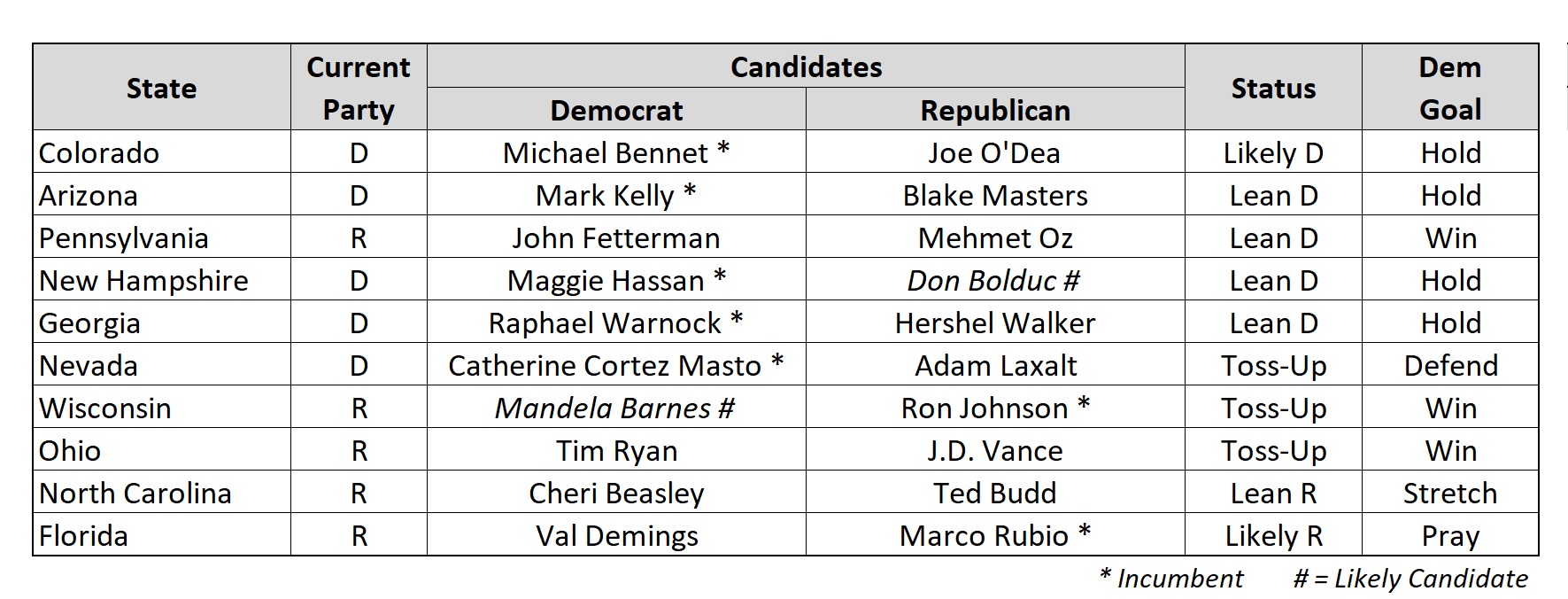
It’s still too early to handicap the 2022 Senate races given that the candidates haven’t all been finalized. However, since most professional political pundits seem so unreservedly certain of a Republican takeover of the Senate, I felt compelled to do my own research.
My contrarian bottom line: Democrats may have nothing resembling a lock on retaining Senate control, but neither are things all doom and gloom on their side of the aisle.
There are 35 Senate seats up for election in 2022 but, by my count, only 10 of them are at all competitive. Five are current Democratic seats; five are current Republican seats (three of which are being vacated by retiring R incumbents). If the November split of these 10 seats is also 50/50, Democrats will retain their paper-thin control of the Senate. But, of course, it’s not that simple.
Given my political preferences, I should state that my analysis is not simply wishful thinking. If it was, I’d also be predicting that Democrats have a remote chance to retain the House in November. I’m not and they don’t. Rather, I’m objectively looking at early Senate polls, state voting histories & trends, new state-specific voting restrictions, turnout projections, incumbency advantages, fundraising, etc. The most subjective components are candidate analyses – but even there I made an attempt to consider the perspectives of each state’s likely voters.
I did discount the conventional wisdom that the President’s party generally loses mid-term elections. While numerous House races may reflect that trend, I don’t see it as a major factor for these 10 Senate races. The outsize influence of the former President in this election makes him at least as much of a lightning rod as the current President. Since neither are particularly popular outside of their bases, I’m calling that variable a wash.
And, yes, I considered “showing my work” but my collection of spreadsheet tabs isn’t at all pretty and this post is already way too long.
Okay, enough prelude. Here’s my summary of the 10 races, ordered by the current likelihood of a Democratic win:
(Click for a larger image; use the back button to return.)
A few brief notes on the races above:
The “Dem Goal” column reflects my current opinion of where Democrats should spend their time & money. In order, they should:
Democrats can maintain the current 50/50 Senate split with 1-3 while 4-5 provide a cushion. 6 is mostly intended to keep Republicans busy elsewhere… but miracles do happen.
Of course, we still have almost six months before the election. Things will change. As of now, though, Democrats have a decent chance to retain control of the Senate and could even expand their majority. Unfortunately, they could also lose it.
One way to help is with money. Small amounts add up and there are numerous ways to donate. The Democratic Senatorial Campaign Committee and the Senate Majority PAC are possibilities, but both spread their money perhaps a bit too thin. The Swing Left PAC’s Senate fund seems to be targeting most of the right races and is a decent option for a one-shot donation – albeit with some overhead. The best option is to directly contribute to the individual campaigns of the Democrats noted above. Google a candidate’s name followed by “campaign” to donate via their campaign websites (likely using the ActBlue engine).
I was asked to update my COVID-19 progression video. Despite knowing it would be quite depressing, here ’tis:
The video shows he relative spread across the U.S., showing weekly new cases per capita by state. The darker the shade, the higher the per capita new case count. A low threshold of 0.05% is used to equate white with a controlled (even if non-zero) per capita infection rate in a given state.
The video now runs at 4X the prior speed so that the entire pandemic timeline is summarized in 30 seconds.
In case you missed the lede, the resurgence is real. We’re considerably worse off now than we were in August of last year.
This time, however, the damage is self-inflicted.
While there’s no shortage of published opinions on numerous voting-related topics, I’ve seen few attempts to address the “Big Picture” overlap of these topics in terms of the 2022 elections. Since that intersection is my current cause for political anxiety, I thought I’d give it a brief shot.
Background
Let’s start with one simple given: The 2020 Presidential election was not stolen by Democrats. Biden won by a 74-vote margin in the Electoral College and, incidentally, by over 7 million popular votes. The Trump campaign filed at least 86 court cases challenging the election results. They won zero. There is not a single indication of any incidence of fraud that would have even come close to impacting the election.
Nevertheless, Republicans have continued to cling to the myth that they really won and that cheating Democrats managed to commit what their cult leader continues to call the “crime of the century”.
Am I generalizing about “Republicans” here? No, I’m not. To be sure, a few sane Republicans still remain and most of my own Republicans friends (hopefully) fall into that category. However, numerous independent polls show that a huge majority of Republicans sincerely believe that Trump actually defeated Biden. A recent Yahoo News/YouGov poll showed that fully 2/3 of Republican voters believe the election was stolen! Thus, Republican politicians continue their parade to Mar-a-Lago to kiss Trump’s ring and blindly accept the ludicrous election conspiracy theories of a sore loser.
Census & Redistricting
The 2020 Census and the associated reapportionment of both Congressional seats and Electoral College votes absolutely favors Republicans. Seven seats will shift between the states and, based solely upon how each state voted for President in 2020, Republicans will net one additional seat. That, however, isn’t nearly the whole story.
Concurrent, once-a-decade Congressional redistricting will have a much larger impact. This will be the first such effort conducted subsequent to the 2013 Supreme Court opinion that negated the pre-clearance of state district maps by the Department of Justice. Since such pre-clearance helped to preclude obvious racial gerrymandering, all bets are off this time. States will be able to redraw districts however they wish and, again, Republicans will have a clear advantage.
A FiveThirtyEight analysis shows that Republicans will have total control to redraw 43% of Congressional districts while Democrats will have total control to redraw only 17%. (The remainder are split-party or non-party decisions.)
For those that don’t have a calculator handy, redistricting alone will give Republicans a 2.5X advantage. Ouch.
State Election Laws
Abandoning efforts to attract voters with their policies, Republicans everywhere have decided that it’d be much easier to simply disenfranchise those Americans that might vote against them.
As of this writing, the Brennan Center has identified around 400 bills that have been introduced by Republicans in 49 states to restrict voting access. 18 states have already passed 30 such laws… and Republicans are just getting started.
The laws are quite diverse but are all specifically – and transparently – designed to decrease Democratic turnout. The laws include limiting the number of voting locations, restricting mail-in voting, making early voting more difficult, imposing more stringent voter ID requirements, making faulty voter purges more likely, enabling poll watchers to more easily intimidate voters, criminalizing water distribution to voters in long lines, etc.
[ Now, before anyone complains (and you know who you are): No, I am not simply repeating claims made by “liberal” media outlets. While such articles may have caught my initial attention, I’ve made a point to actually read the poorly written bills passed (or pending with a high probability of passage) in various state legislatures. When you’ve done the same, we can talk. ]
Here’s just a few egregious examples in just a few states:
State Election Officials & Election Certifications
There’s another trend that is even more disturbing than the above.
Numerous Republican election officials in Georgia, Michigan, Arizona, Nevada, and Pennsylvania were willing to defend the results of the elections they ran in 2020 – even while lamenting the fact that their party didn’t win. However, such public servants with the convictions to do their jobs regardless of the political fallout appear to be a dying breed.
In numerous states, people who vocally championed overturning 2020 election results by pure political fiat are looking to take over the state offices where they could do exactly that in future elections. The top state election official is generally the Secretary of State and 26 of those seats are up for election in 2022. Current Republican Secretary of State candidates include:
In addition:
Far-right candidates will undoubtedly appear in many other states as we approach the 2022 elections.
In some cases, Republicans are going even further. For example, a provision in the new Georgia election law will give the Republican state legislature the power to directly intervene in the operation of local elections and even to unilaterally decertify any election results they don’t like.
With the presumed power to simply ignore or overturn any Democratic wins, Republicans won’t need to worry about changes to elections laws. In fact, they really won’t need to worry about elections.
Federal Election Laws
Since Republicans have mounted a frontal attack on voting rights at the state level, many Democrats are counting on a federal counter-attack. Reasonable legislation has certainly been proposed and has garnered significant media attention. After spending considerable time researching, summarizing, and opining upon these proposals (most notably the “For the People Act” and the “John Lewis Voting Rights Advancement Act”), I eventually deleted all of that text in favor of one simple conclusion:
State-level Democrats will get no federal help whatsoever with respect to election laws.
There is zero chance of any relevant election laws overcoming a Republican filibuster in the Senate and any Democratic pursuit of such legislation is nothing more than political theater that will waste considerable time, energy, and money.
2022 Impact
While all of the above will certainly have an impact on the 2024 Presidential election, the most immediate concerns are the 2022 elections in the U.S. House and the U.S. Senate. As we get closer to that election, I hope to attempt a more detailed analysis of the truly contested seats in both chambers. There will, however, be serious limitations to any predictive model given all of the changes to state election laws. All polls will likely be even more meaningless than before. That said, an overall conclusion is already abundantly obvious:
Democrats are screwed.
Republicans will redraw U.S. House districts to give their candidates a distinct advantage regardless of the wishes of the majority of a state’s voters. Republicans will continue to change election laws in competitive states to make it more difficult for Democratic-leaning constituents to vote. Republicans will block any federal efforts to protect voters’ rights. As a final backstop, numerous states will give their Republican legislatures – or a single Republican official – the power to overturn the results of any election that they still somehow manage to lose.
Damn.
My guess at the moment is that it will take a miracle for Democrats to retain control of the U.S. House in 2022. The game there will be to minimize the Republican margin of control to allow for a possible 2024 comeback. Control of the U.S. Senate in 2022 is tougher to predict – but it’s likely a toss-up.
What can Democrats do? Well, they first need to follow the old axiom of accepting the things they cannot change – and, unfortunately, that’s almost everything noted herein. Republicans may quite reasonably be relatively complacent on the ground in 2022 given the massive structural advantages that they are bestowing upon themselves. Thus, the only possible strategy for Democrats is to try to out-organize Republicans with voter registration, voter ID, and voter information initiatives.
Yeah, I know. After being silent on this blog for a long while, I come back with a thoroughly depressing post. Sorry ’bout that. My point is that Democrats need to quickly recognize that fairness is sadly irrelevant. The only path to retaining Democratic majorities is a very long, very rough, very expensive toll road.
Democrats need to stop complaining about it and start driving.