Today

Well, today is the day.  While it may sound over-wrought, I truly believe that Democracy itself is on the ballot.  There are so many 2020 election-deniers on the GOP ticket that this election’s primary issue is simple respect for the American experiment.

I’ll make one last comment on the status of the races…

While I stand by my data-driven predictive models, the data I didn’t have was any actual 2022 voter information.  While we obviously can’t count votes quite yet, what we CAN now do is model the early voting data.  Now, sure, no one knows how any given early voter voted.  However, other voter data is public information.  That data not only tells us how many people voted early, it can tell us exactly who voted and where they voted.  That data can then be modeled against previous individual voting histories and patterns (using public, state-specific information).  As an end-result, the enhanced early voting data can give us a remarkably accurate picture, in the aggregate, of how the parties are doing in comparison to each other and in comparison to past early voting results.  While such an analysis is WELL beyond the scope of this blog, there’s a site called TargetEarly that does a really excellent job of collecting and presenting this data.

I played with this data for quite a while.  Of course I did.  However, for those of you not so inclined, here’s just a few of my take-aways:

  • Things don’t look nearly as bleak for Democrats as most people think.
  • Nationally, Democrats are beating Republicans in early voting.
  • Nationally, Democrats are beating Republicans in early voting with larger margins than the last mid-term elections in 2018.
  • Democrats are beating Republicans in early voting in the Senate battleground states.
  • Younger voters are turning out for Democrats in considerably larger numbers than expected.

Since election day voting will likely favor Republicans, I have no clue whatsoever if the above early trends will hold.

Am I predicting a Democratic wave?  Nope.  I’m not even predicting a Democratic win.  There are way too many variables to make any definitive predictions.  I’m only saying that the narrative being pushed in the media that the GOP has this election in the bag is totally bogus.  Kudos to Republican strategists for pulling that off, though.

===

I’ve also been asked how I’ll be following the election results and my standard answer has been “Holding a bottle of good bourbon.”  I’m sticking with that but will expand on it just a bit…

  • Each state’s poll closing times and vote counting methodologies are unique.  Here’s a decent state-by-state guide that I’ll use (although I’ll use my own election models, thank you very much).
  • There will be tons of disinformation being constantly pushed out across the board today.  My own personal strategy will be to look at the raw state-by-state results in the races that I’m watching.  I’ll likely listen to a few of the data-geek reporters out there and will try to ignore all of the other talking heads.  In other words, I may pay attention to what some of the better play-by-play analysts are saying while completely tuning out the color commentators.  If I could find the election day equivalent of the ManningCast, now THAT I would watch.
  • Exit polls suck.  I’ll be ignoring them.  The media will be pumping these out by the half-hour well before the polls close in attempts to fill dead-air time.  These exit polls will show that people care about the economy and pundit after pundit will be immediately screaming how bad that is for Democrats.  What crap.  Of course people care about the economy.  Is that the only thing that matters to them?  No.  Is there any real data that shows voters believe either party is better at managing the economy?  No.  The data shows that voters think neither party can control the economy.  The data’s not wrong.
  • As in 2020, the reporting of election results will vary greatly from state to state.  Some states will report early votes first; many states will report election day votes first.  I’m going to try not to over-react either way.  If I decide to start predicting a state’s final results before all the votes are in, I’ll only consider those counties that have reported 100% of their votes… and then only compare those county’s results with how that county voted in 2018 and 2020.
  • There is nothing that is certain about today.  Well, okay there’s one thing.  There are states where local laws strangely don’t allow early ballots to even begin to be counted until after the polls close (e.g. PA).  If the GOP candidates lead before any early votes are considered, I absolutely guarantee that Republicans will prematurely declare victory.  They will immediately claim fraud if the early votes continue to be counted.  That’s the playbook.  They’ll declare victories all over the place separate from any reality.
  • Not a whole lot will be decided today.  There will be recounts.  There will be recounts of recounts.  There will be run-off elections. There will be court filings.  There will be at least some election-related violence… ‘cause that’s the world we live in now.

Buckle up.


2022 Campaign Ads

While it’s way too late now, I’ve been wanting to publish a list of the best mid-term Democratic campaign ads.  Here’s the thing, though:  It’s a very, very short list.  And, frankly, the GOP’s ads are even worse.  The ad agencies hired by both parties have mostly cranked out unremarkable pablum that I stopped watching well before the ads ended.  There have been very few ads that were memorable or informative or on-point … and even fewer that were all three.

I’m thus reduced to listing the four arenas where I would have focused my attention if had been running the Democratic campaigns – while providing some representative ads that I think hit the mark.  Some are (or easily could have been) generic ads that could have been run for multiple campaigns in different markets.

Respect for Democracy

I don’t know how to make people understand just how important it is that all candidates across the political spectrum respect election results.  I’m fine with recounts.  I’m fine with legal action in the courts, if appropriate.  However, there’s a point where candidates have to accept a loss.  The fact that the vast majority of Republican candidates this cycle are still 2020 election-deniers should scare the shit out of everyone.  While I realize that civics lessons don’t often make for great campaign ads, certainly some brilliant Mad Man or Woman can crack that code.  In the meantime, the best I have is this ad from the Republican Accountability Project:

Character

While positive ads about a given Democratic candidate are nice, Democrats should have stopped being nice long ago.  I’ve yet to see truly hard-hitting ads questioning the insanely flawed characters of many of their opponents.  For example, where were the ads targeting Hershel Walker’s blatant hypocrisy with respect to women’s rights, his lack of any relevant experience, or his outright stupidity?  Where were the ads targeting Mehmet Oz’s carpetbagger status, his dog-killing experiments, and the snake-oil salesman career that made him rich?

Sure, I saw some ads that attempted to address some of these topics.  They just weren’t very good.  By necessity, these type of ads need to specific to a campaign and their tone can be quite tough to get right.  Democrats can’t come off as assholes, but they do need to get their points across.  For these types of ads, a little humor goes a long way and often helps to give the ad a free online audience bump.

Here’s a decent ad for Catherine Cortez Masto (and against Adam Laxalt) which was also a pretty good use of a celebrity endorsement:

The Economy

Democrats shouldn’t have just run away from this topic and needed to talk more about their wins.  Unemployment is at record lows.  Democrats passed a massive infrastructure bill.  They implemented a tax credit that took child poverty to historic lows.  They made good on their promise to allow Medicare to negotiate drug prices.

Republicans have been quite vague about their economic plans but the plans they have touted are massively unpopular.  They voted against capping the price of insulin and they’ve floated numerous plans to cut and/or privatize Medicare and Social Security.

Of course, Democrats need to acknowledge rising costs.  However, they also need to remind voters that pure corporate greed and out-of-control profiteering is a major factor with respect to inflation.  Does anyone truly believe that Republicans are going to reign in big business?  Please.  Here’s an example of a decent economic ad:

Women’s Rights

This issue needed to be correctly framed and the Democratic MAGA (Mothers Against Greg Abbott) did a pretty good job in Texas of producing ads that stressed massive government overreach with respect to women’s rights.  Here are two examples:


To My GOP Readers

A serious note to my Republican subscribers:  I sincerely appreciate the fact that you’re willing to consider the opinions of someone who is often in an opposite political camp.  However, I have a request:  PLEASE do your 2022 research and make sure you can defend the candidates you choose to support.

To be blunt, the vast majority of your 2022 nominees across the board have explicitly stated that the 2020 election was stolen despite a total lack of any evidence.  They have made it abundantly clear that they will use whatever power they can grab now to declare Republican victories in future elections, regardless of the will of the voters.

I don’t understand how anyone of any political persuasion can support any candidate who cannot accept valid election results.  That is the cornerstone of American democracy.  And please don’t mention Hillary Clinton to me.  I don’t understand the reference.  She conceded the 2016 election the very next day.  It’s one thing to be unhappy about election results.  I’ve certainly had my fair share of unhappiness.  But with VERY few exceptions, Democratic candidates accept their election loses.  Republican candidates used to do so as well.  But they don’t any more.

In Arizona, Kari Lake (the GOP nominee for Governor), Mark Finchem (the GOP nominee for Secretary of State), and Blake Masters (the GOP nominee for Senate) are all 2020 election-deniers and have all explicitly said that they will only support the results of their 2022 elections if they agree with them.  That triple threat to democracy is sadly being repeated in several states.

In Michigan, Tudor Dixon (the GOP nominee for Governor) is a 2020 election-denier and has expressed unqualified support for the participants in the Capitol riot.  Kristina Karamo (the GOP nominee for Secretary of State) has stated that the 2020 election in MI was the result of “corrupt authoritarians” despite 250 different, independent audits that verified the results.

Tim Michels, the Wisconsin GOP nominee for Governor, just recently said that “Republicans will never lose another election in Wisconsin after I’m elected governor.”  While he actually said the quiet part out loud, his is by no means an isolated stance.

Ken Paxton (up for re-election as Texas’ Attorney General) even stepped out of his own state to file lawsuits on behalf of Texas against Georgia, Michigan, Pennsylvania and Wisconsin challenging their 2020 election results.

All of these are blatantly undemocratic positions.  And I could, unfortunately, easily go on.  And on.  And on.

We can have policy differences.  I seriously welcome these discussions, I desperately want to find a common middle ground, and I’m reluctantly willing to agree to disagree where our political perspectives diverge too far for compromise.  I have very strong opinions but I claim no divine knowledge of what is “right”.  I can accept the will of the majority in our American experiment while I work to change that majority opinion.  I expect the same from others.

If you can support attacks on democracy itself, you’re going to have to defend that position to me.

Final 2022 Election Analysis

Yeah, yeah.  I’ve been absent here.  While my daily intentions have been to post something, reality has intervened on a regular basis.  C’est la vie.

Anyway, with early voting for the mid-terms already in-progress, I felt the need to revisit the critical 2022 races.  Unfortunately, I had to dig a tad deeper than I’d expected.

The news has certainly been rife with apocalyptic declarations for Democrats everywhere. Polls are showing a steep decline in Democratic support. Pundits across the political spectrum are predicting a bloody red wave.  Democratic campaigns are sending out hourly emails that range from pride-free groveling to pre-emptive obituaries.  (I’m on WAY too many campaign email lists.)

While I more-than-half expected my fresh analysis to line up with these overwhelming sentiments, it turns out that the skeptical little voice in my head was onto something.

The news appears to be nothing more than a giant echo chamber, largely devoid of independent analysis.  Polls that have shown a massive Republican surge in recent weeks are largely Republican-funded.  Pundits are incented to push a tight race narrative to increase their viewership / subscriber counts.  Democratic campaigns seem to insanely believe that they’ll actually increase donations by repeatedly telling voters that they’re going to lose – which can quickly become a self-fulfilling prophecy.

WTF.

To be sure, even my data-driven methodology shows that Democrats have lost ground and, predictably, many races have tightened up as we approach Election Day.  While Democrats are in nothing resembling a commanding position, they’re only guaranteed to lose across the board if they continue to close out their campaigns like they’ve already lost their elections.  At this point, voters have made their choices.  There are no more swing voters.  Voters who haven’t yet picked a side simply aren’t likely to vote at all.  Elections will now be won or lost based solely on turnout and voters will have little motivation to cast ballots in races where the candidate appears to have given up.

Here are the high-level take-aways from my own analyses:

U.S. House

Nothing has really changed here since I first weighed in on 2022.  Republicans will take control of the House.  While I don’t see as massive of a “red wave” as others, the GOP will end up with a solid majority in this chamber.

U.S. Senate

Even the election analysts that I respect (e.g. 538, Cook, Sabato) seem to overweight “expert” opinions and non-independent polls (to varying degrees) in their evaluations of Senate races.  I’ll readily admit that my model was flawed if proven otherwise, but I still think Democrats have a very slight advantage here.  To retain control of the Senate, Democrats need to win the races where my analysis says they currently have a slight edge PLUS win one of three true toss-up races or one of two races where Republicans have a slight edge.

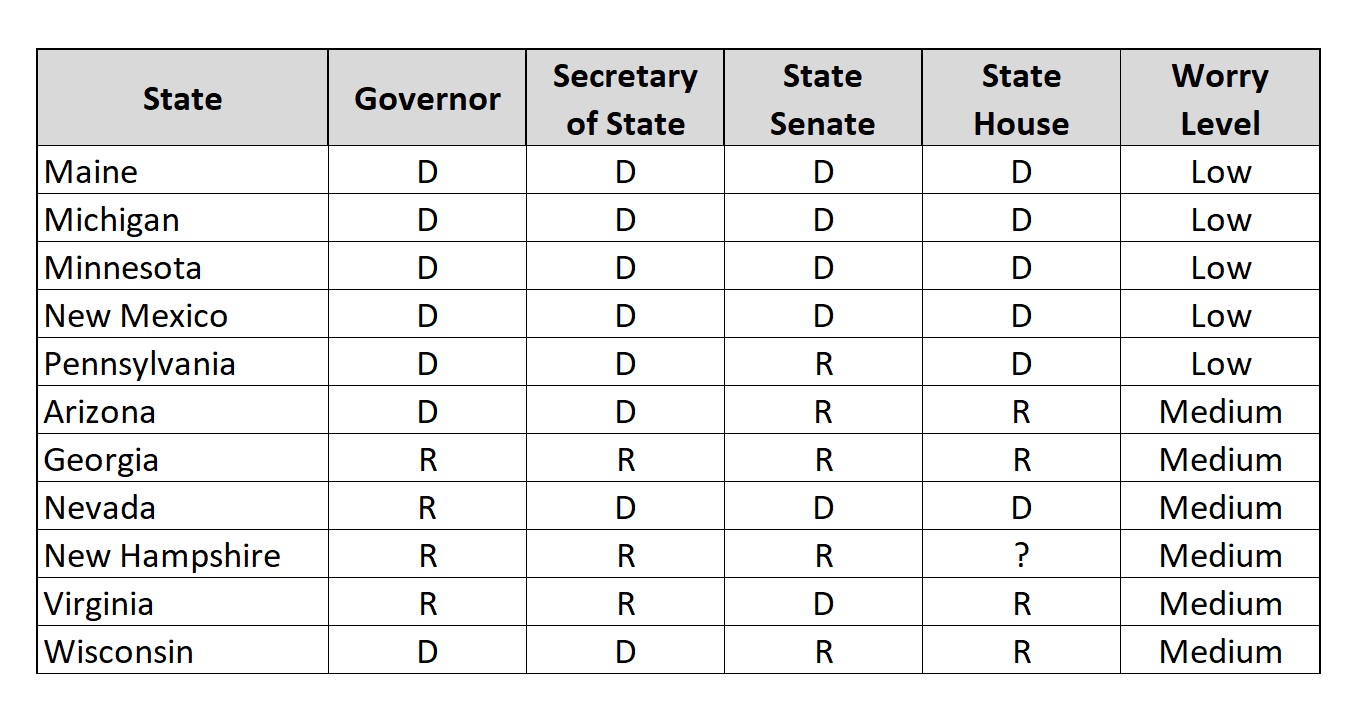
State Legislatures

While I still don’t have the time, data, or desire to do a deep dive into control of state legislatures, it nevertheless remains an important consideration.  Republican legislators in numerous swings states have been very public in their desires to appoint their own slate of Presidential Electors in 2024 regardless of who wins the popular vote in their respective states.  (And, before someone accuses me of being too partisan, there has been no similar talk from Democrats.  None.)  The Supreme Court even seems poised to bless this blatantly undemocratic power play.  In any case, my rough guess at the moment is that this cycle will see no major flips in the control of state legislatures for either party.

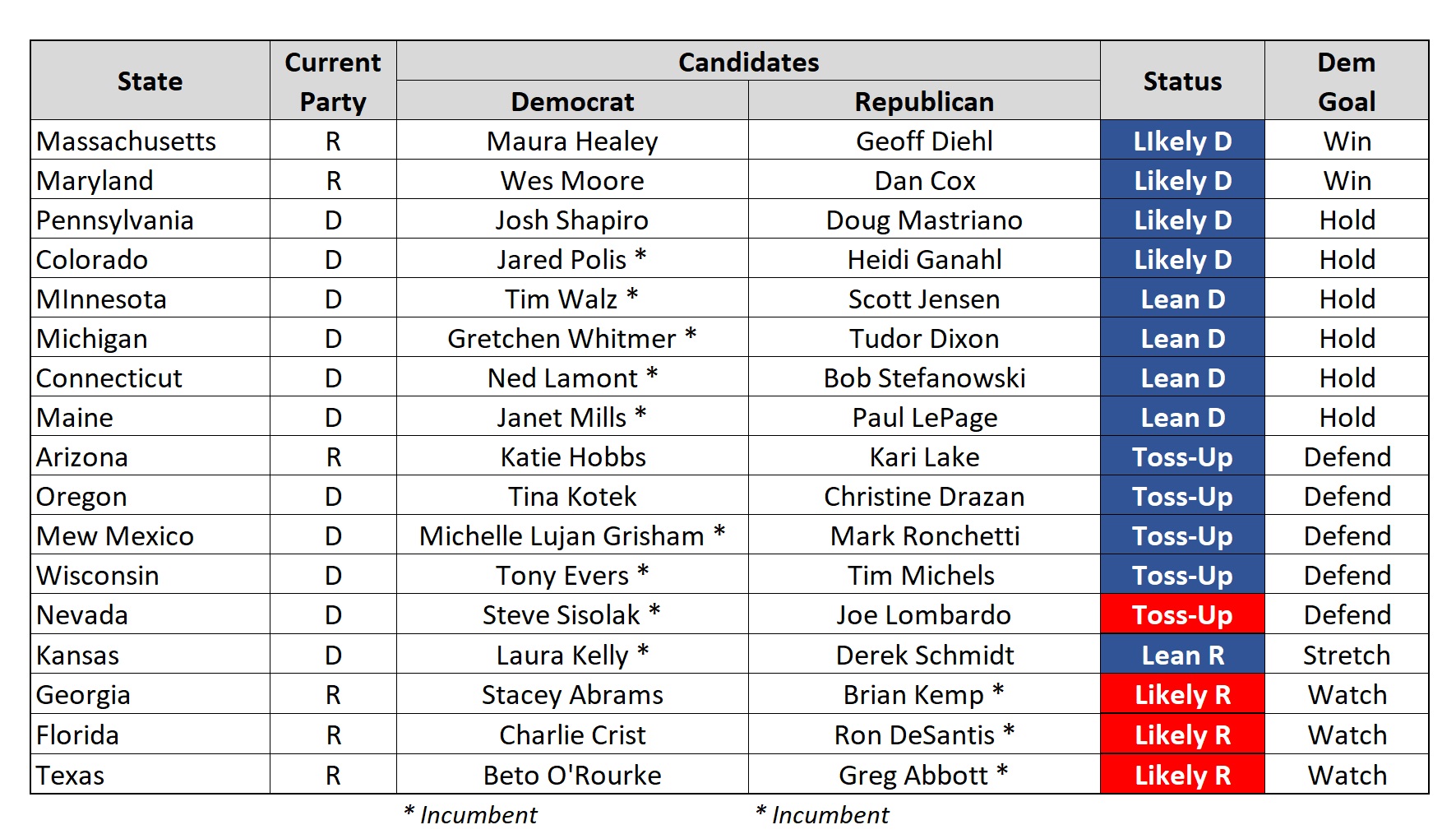
Governors

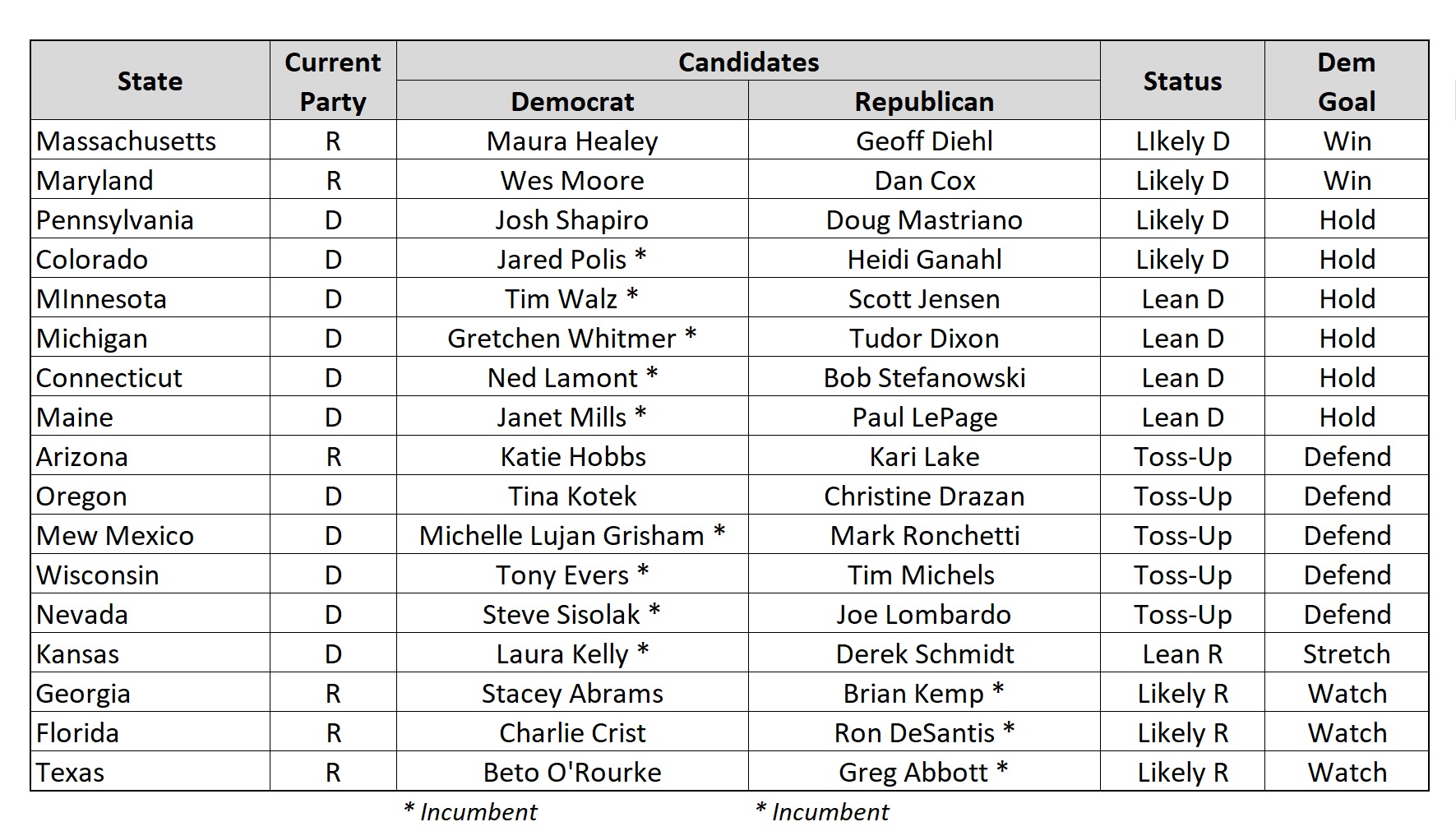
This is definitely a mixed bag but not necessarily the absolute disaster we’re being led to believe.  Still, there are way too many toss-up Governor races in 2024 swing states for comfort (AZ, WI, NV).  And there are another two races in 2024 swing states where Democrats have only a slight edge (MN, MI).  As with the state legislatures, I’m very nervous about Republican Governors trying to declare a GOP presidential victory in their states even if Democrats win the popular vote.  With very few exceptions, the GOP candidates for Governor are 2020 election deniers.

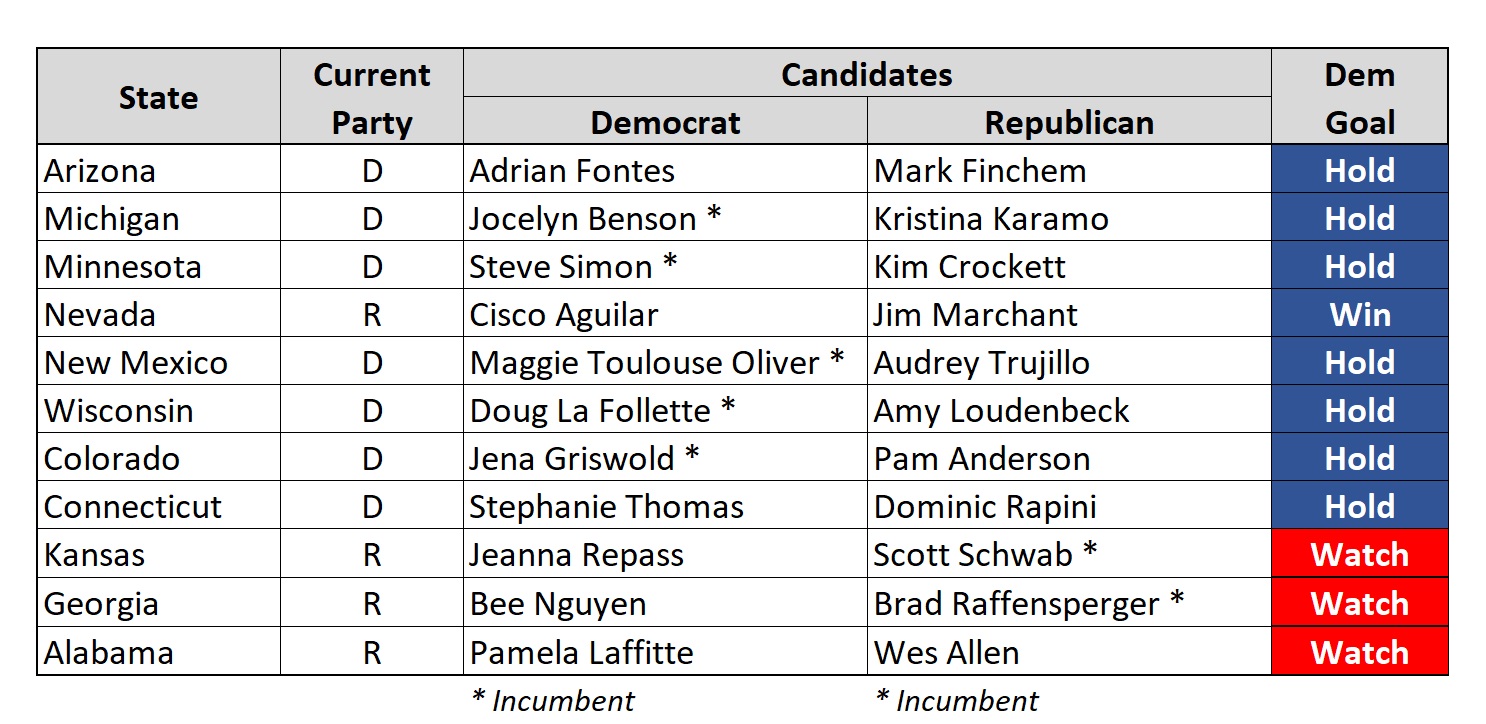
Secretaries of State

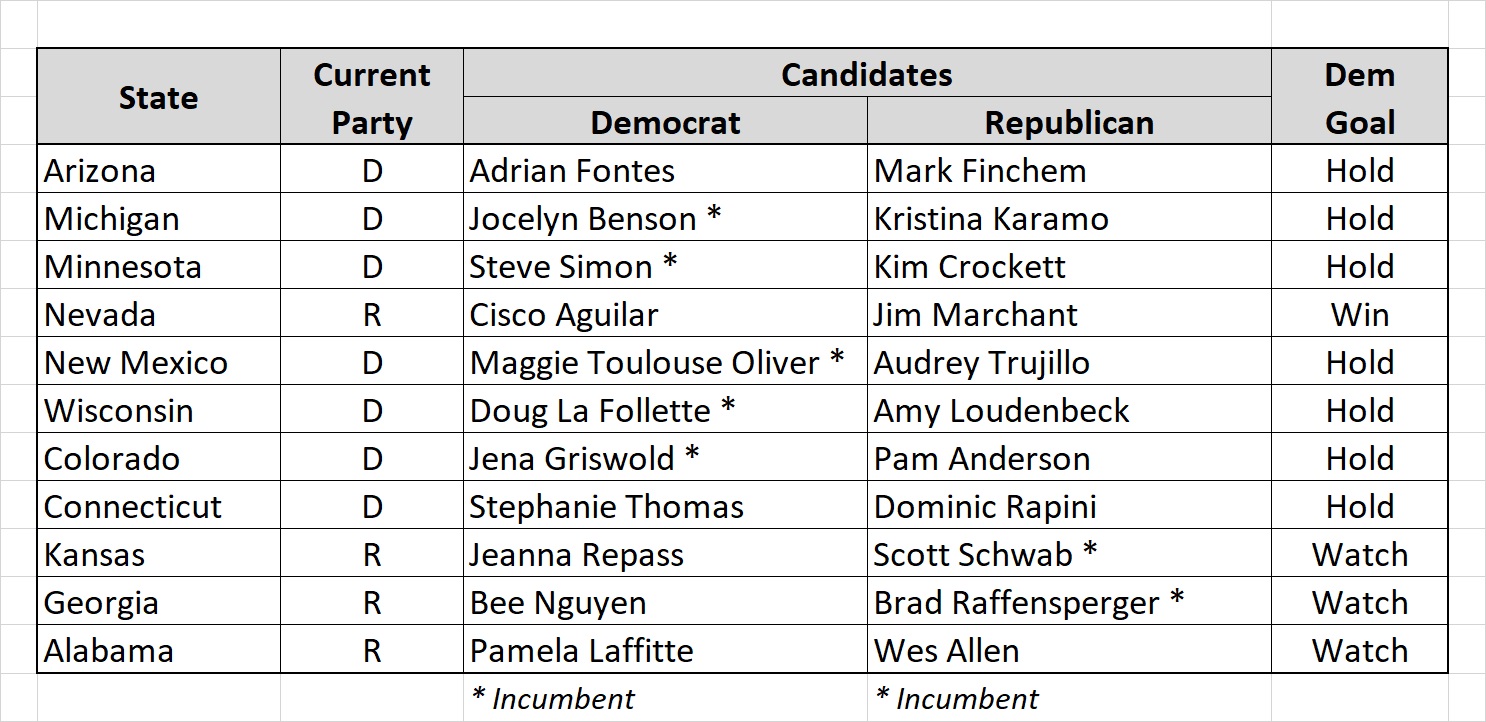
Despite many attempts to educate the public as to how these historically obscure offices can be used to single-handedly throw an election to a preferred party, these races are still met with significant voter apathy.  The vast majority of the GOP candidates for these positions are 2020 election deniers – which doesn’t bode at all well for democracy.  Unfortunately, since there isn’t a lot of good data readily available to handicap these races, I’ll simply list a few of the races that I’m following.

PLEASE PEOPLE:  If you haven’t already voted early, do so now.  While I understand the civic high that one can get by voting on Election Day, shit happens.  Vote early and give yourself a backup plan to make sure your voice is heard.

Artemis

I’d set aside this afternoon to gleefully sit in front of my TV with my laptop to follow the launch and first flight phases of Artemis I.  Alas, the launch was scrubbed yet again due to a fuel leak.  You’d think I’d learn.  Given my new-found time, I started reviewing numerous in-progress blog posts on several depressing political topics.  I’m now wondering whether the universe is providing Artemis as a not-so-subtle allegory for the current state of America…

  • Both claim to be shooting for the moon but neither can seem to get off the damn ground.
  • Despite institutional histories of remarkable innovations, neither are currently displaying exceptional advancements.
  • Both seem to be content repackaging the same old crap with new paint jobs.
  • Both are extremely powerful structures being brought down by dime store parts.
  • Both have many incompetent leaders who think the current state of affairs is normal.
  • Both are epic disappointments given their incredible potentials.
  • Both are massively wasteful of available resources.
  • Both have a history of marginalizing women. *
  • Both have an overly large orange component that is causing many of the current problems.
  • Both have major issues that are largely centered in Florida.
  • Both are seven letter words starting with “A”.
  • Both have a very good chance of blowing up.

Yeah.  I’ll be better by tomorrow.

___

* Back in 2009, former NASA Deputy Administrator Lori Garver strongly opposed the SLS program (the Artemis rocket) and instead favored increased funding for the then-nascent commercial space industry.

U.S. Senate Update

Since I last weighed in, Democrats have slightly increased their chances of maintaining their paper-thin Senate majority in November.  While it’s still too early to make definitive predictions, it is nice to see that a lot of election “experts” are catching up to my point of view and have at least stopped writing Democratic obituaries.

** trying not to break my arm while patting myself on the back **

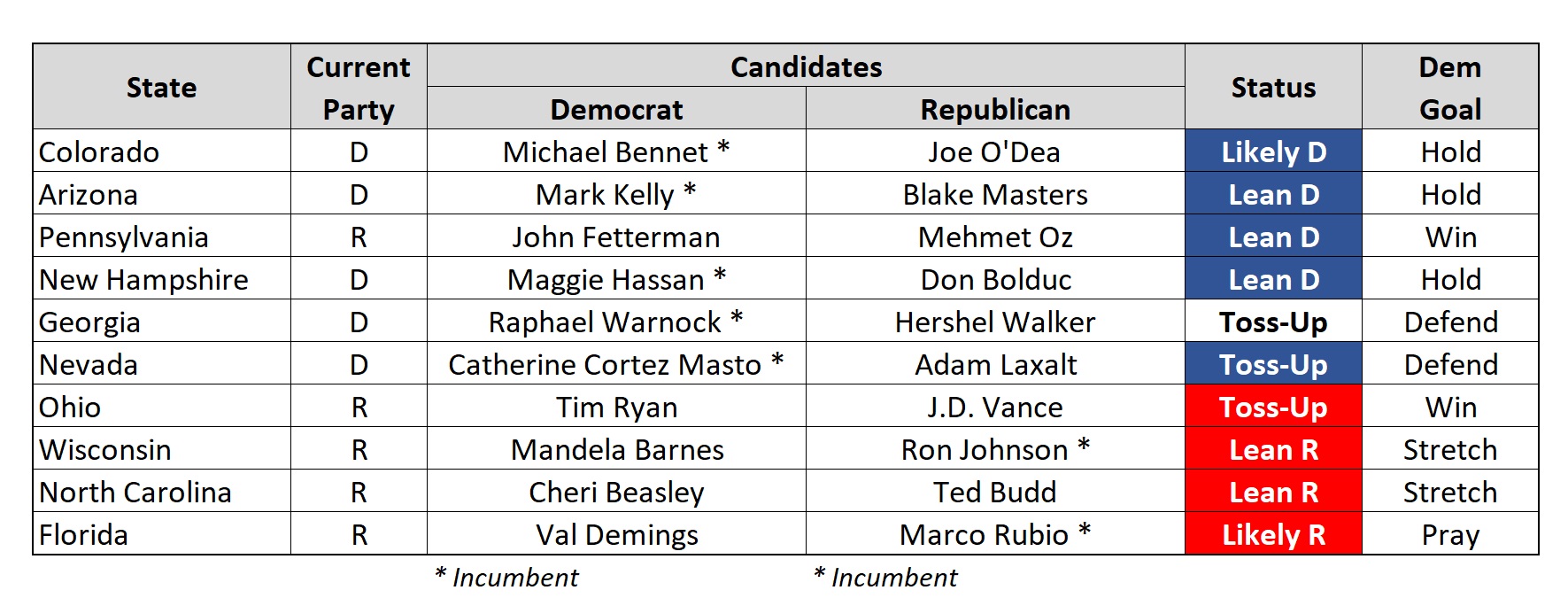
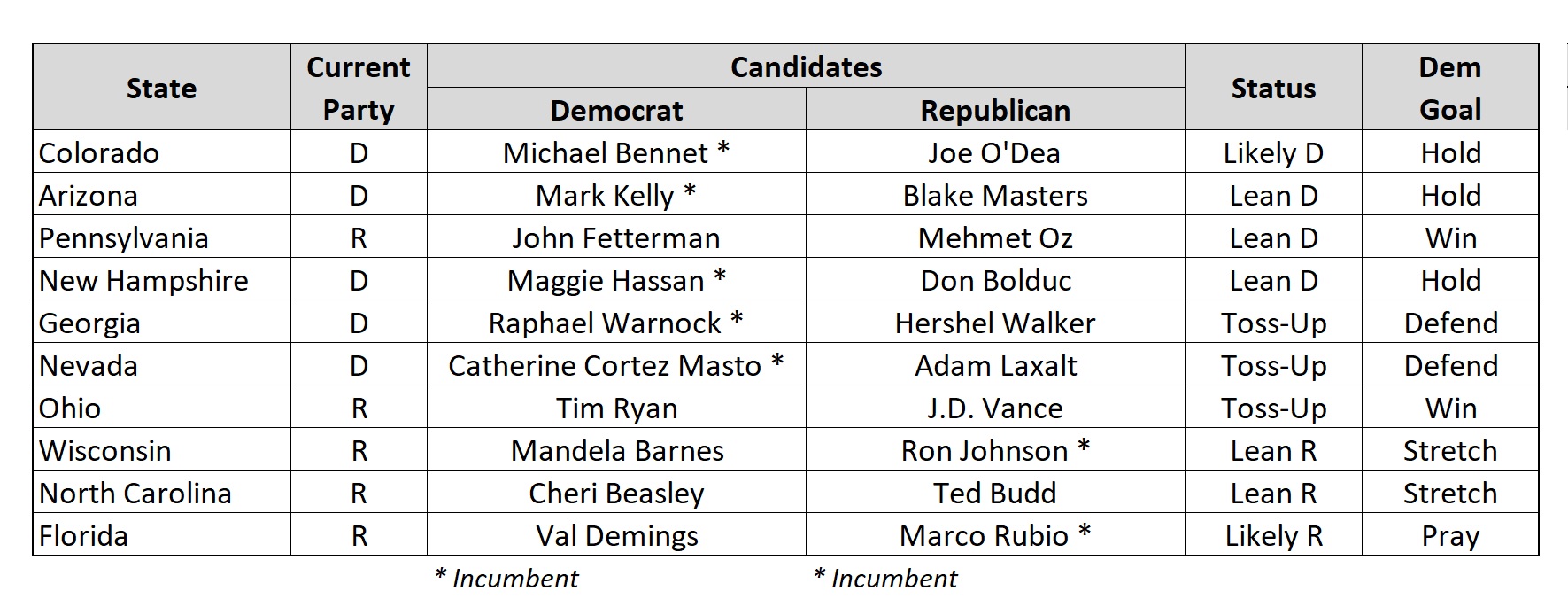
Here’s my updated take on the ten competitive Senate races:

(Click for a larger image; use the back button to return.)

Republicans have nominated (or are close to nominating) the most extreme candidates they possibly could (Masters in AZ, Oz in PA, Buldoc in NH) and/or have nominated inexperienced candidates who are running clueless campaigns (Oz in PA, Walker in GA, Vance in OH).  I hate to agree with Mitch McConnell, but “candidate quality” matters.  It also hasn’t helped that Sen. Rick Scott (R-FL) has been a laughably incompetent chairman of the National Republican Senatorial Committee.  In short, Republicans had a very good chance to lock up the Senate and they blew it.  Can’t say I didn’t see that coming.

However, before Democrats start celebrating….

  • A whole lot can happen between now and November.  Democrats need to keep working each and every race and pray that the economy doesn’t take a nose dive right before the elections.
  • Democrats need to take full advantage of this opportunity to slightly expand their majority now since 2024 won’t be at all pretty.  By my count, a whopping 10 Senate Democrats running for re-election in 2024 will be facing somewhere between Lean R and Toss-Up environments.  On the other side, ZERO Republican Senators up for re-election in 2024 will be facing anything worse than Lean R environments.  In other words, Democrats are very likely to see a net loss of at least a few seats in 2024.  Even if they over-perform this year, maintaining a majority in 2024 might be quite difficult.

See the contribution links at the end of my previous Senate post if you feel like pitching in.

COVID-19 Hospitalizations

I last updated my visualization of COVID-19 case progression in the U.S. about a year ago.  I stopped mostly because I no longer trusted the data.  Self-testing has rendered CDC case counts pretty useless since almost no one self-reports a positive self-test.  I considered using death counts instead, but that was both depressing and only marginally informative given the advances in treatments.

I settled instead on tracking hospitalizations since that number is likely accurate and would seem to be a fairly good indicator of just how bad things are.  If people are well enough to self-test, self-medicate, and isolate/recover at home, we can (at this point) call that a win and move on.  However, when people get sick enough to go to the hospital, that’s indicative of a broader problem.

The video below shows relative COVID-19 hospitalizations across the U.S. using weekly hospitalizations per capita by state.  The darker the shade, the higher the per capita hospitalization rate.  (The raw data was downloaded from the HHS healthdata.gov website.)


The relatively calm periods track fairly well to prior vaccine availability (both the original doses and the boosters) but those periods are followed by resurgences as COVID-19 mutates or people get over-confident or some combination of those and other factors.

In short, it ain’t over yet.

Ranked Choice Voting

I was recently asked my opinion on ranked choice voting (RCV).  While I think it’s a great idea, I wasn’t sure it was a great blog topic.  However, after some research and several conversations with friends, I’ve learned a few things:

  • Many people have never heard of RCV.
  • Some people have heard of RCV but dismiss it as too complicated.
  • Some people have heard of RCV but dismiss it as unfair.
  • Some people have heard of RCV but dismiss it as not good for them.

So, okay.  A blog post it is.  RCV isn’t complicated, it’s more fair than traditional elections, and the politicians who hate it aren’t the people we want in government.

From a voter’s perspective, RCV is about as simple as it gets:  Instead of voting for just one candidate in a given race, you rank the candidates in your order of preference, from first to last.  That’s it.

If there are two candidates on the ballot, RCV obviously produces exactly the same result as a traditional election.  The benefits come when there are more than two candidates.  In current U.S. elections, this mostly occurs in party primaries, in general elections that include third-party candidates, and in non-party contests.

While counting votes in an RCV election can seem a bit complex, it’s really not.  It’s just harder to explain than it is to do.  I’ve seen some dreadfully convoluted RCV explanations online, so I’ll give it a shot myself:

  1. First-choice votes are counted for each candidate.
  2. If a candidate has over 50% of the first-choice votes, that candidate wins.
  3. If there’s not a winner, the candidate with the lowest first-choice vote count is eliminated.
  4. On each ballot won by that eliminated candidate, the second choice becomes the first choice, the third becomes the second, etc.
  5. Repeat from (1).

Essentially, you just keep eliminating candidates with the least support until you’re left with a single candidate that has the strongest support amongst all voters.  Note that RCV doesn’t require a voter to rank all of the candidates; if someone wants to cast only their first-choice vote, that’s perfectly fine.

In short, RCV is an elegant way to conduct democratic elections.  Costly and time-consuming runoff elections become unnecessary.  The impact of “spoiler” candidates is greatly reduced.  People can choose to support a third-party candidate without being too concerned about throwing the election to someone they consider the worst choice on the ballot.  Negative campaigning becomes self-defeating as candidates strive to be the second choice of their opponents’ voters.  Extremists on both sides become marginalized.

RCV has been proven to work and has been well-received by voters who have used it.  It has been used in jurisdictions within Maine, Alaska, California, Colorado, Minnesota, New Mexico, Utah, and New York.  Over 11 million voters in 55 cities, counties, and states are planning to use RCV in their next elections.  This diversity of locales highlights the fact that RCV doesn’t favor or disfavor Democrats or Republicans; supporters and detractors are present in both of the major parties.

Despite voter popularity, many politicians have displayed outright hostility toward RCV.  Republican Governors in Florida and Tennessee, for example, have signed bills banned the use of RCV within their states.  Top Democratic officials in Nevada are currently trying to block RCV within their state.

Why?  While numerous reasons for resistance are often sited, there are really only two that aren’t blatant lies:

  • There’s a concern that the perceived complexity would lead to more votes being rejected.  For example, someone could rank two candidates as their first choice or rank the same candidate multiple times.  While this could well be true, RCV is no more problematic than someone trying to simultaneously cast multiple votes in a traditional election.  A well-designed RCV ballot (and certainly well-designed in-person voting software) could greatly mitigate RCV errors. Beyond that, well, I think I’m okay with ignoring the votes of anyone who doesn’t know how to rank things.
  • There’s a concern that the status quo would be disrupted.  And, yes, it definitely would.  Many politicians, in both parties, have a distinct preference for pluralities over majorities.  RCV favors the latter and therein lies the reason that RCV isn’t the way that we conduct all elections.

It is theoretically possible in an RCV election for a candidate to get 49% of the first-choice votes on the first count but still lose the election.  What that says is that 51% of all voters wanted ANYONE ELSE and the other candidate that eventually got to 51% was preferred by more people than the one who initially had a plurality but failed to garner any additional support.

This, however, isn’t the outcome that many party activists want.  They know that their politically active base, often led by extremists, may never expand to a majority.  They can, however, almost always win a plurality of votes.  And that’s where they want elections to stop.  They love spoiler candidates who split the votes of their opposition – because that opposition might constitute a majority.

Gee, that seems like a callous disregard for democracy, doesn’t it?  Well, of course it is.  These are professional politicians who are trying their best to hold onto power.  Protecting the control of their far-right and far-left constituents protects their jobs.  The cycle has to stop.

RCV is by no means a panacea.  However, if democracy is to survive, RCV could well be one of the lifelines.  Here are a couple of non-profits if you’re looking for more information or if you want to help:

Very Early 2024 Thoughts

Okay.  Fine.  I’ll post my two cents about 2024.

I remain convinced that Democrats first need to be concerned about Moore v. Harper, coming this Fall to a Supreme Court near you. I discussed this case within a previous post and I also posted my related suggestion for keeping the Court out of politics.  I also remain convinced that a lack of attention to this case could so kneecap Democrats that their choice for 2024 won’t matter.  Whoever it is will lose.

I’ll also be updating my posts on the 2022 races in the next few weeks as primary season ends.  These elections are really where Democrats need to focus their attention after protecting the election process itself.

But sure. Since it keeps coming up, let’s talk 2024.

First, I really need to ask all of the Democrats who are so massively disappointed in Biden for one reason or another:  Who the Hell did you think you were voting for?  No, Biden is not a starry-eyed progressive.  No, Biden is not a great communicator.  Yes, Biden is prone to gaffes.  Yes, the 79-year-old Biden seems a lot slower these days.  Biden was and is no one’s perfect candidate.  But please remember:  We nominated Biden in 2020 for exactly two reasons:  He was a decent person and he had the best shot at winning.  And, folks, he did win.  And he’s still a decent person.  Democrats need to back off and offer him a little support.

Is Biden the right choice to be at the top of the 2024 ticket?  It’s way too early to say he’s not.  He saved us from that other guy and I’m going to give him the right to make a claim at another term.  Of course he’s saying that he intends to run again.  He’d otherwise be a lame duck.  However, unlike his predecessor, he’s not stupid, he’s not delusional, and he’s not power-hungry.  He has no reason to run again unless he and his competent political advisors are convinced he’ll have a better chance of winning the White House than another Democrat.  And, despite what everyone else says, NO ONE knows how things are going to look going into 2024.

In mid-to-late 2023, we should ask a few questions:  Is Biden healthy?  Has another Democrat risen to be a top tier contender?  Has the economy improved?  Has war spread outside of Ukraine?  Are we deep in Pandemic Part II?  What new crisis has grabbed everyone’s attention?  Who’s likely to lead the Republican ticket?  Who controls the Senate?  Just how much has the Supreme Court weighted elections to favor Republicans?  When we can answer some of these questions, we can then decide who should lead the Democratic ticket.

For now, this an interesting academic exercise – evaluating a world that looks a lot like it does now but where Biden decides not to run again.  Cool.

So, right off the bat, I’m going to eliminate a TON of prominent possibilities that fall into three groups:

  1. Candidates whose negatives generally outweigh their positives and/or whose candidacy will excite almost no one.  This large set includes such names as Kamala Harris, Elizabeth Warren, Amy Klobuchar, Cory Booker, Bernie Sanders, Stacey Abrams, Hillary Clinton, etc.  A lot of these folks had their shot and they flamed out.  Name recognition is not always a good thing.
  2. Candidates who hail from solidly Democratic environments.  These people may know how to play to their base but they likely can’t connect with independents and disenchanted Republicans.  This set includes such names as CA Gov. Gavin Newsom, NJ Gov. Phil Murphy, NY Rep. Alexandria Ocasio-Cortez, etc.  With apologies to my progressive readers, purity leads to defeat and, personally, I’d rather win.
  3. Candidates who might be very interesting choices but who simply won’t run.  This set includes such names as Michelle Obama, Jon Stewart, Oprah Winfrey, Mark Cuban, Bill McRaven, etc.  While it’s fun to briefly consider some “what if” scenarios – particularly with respect to Michelle Obama – reality’s a bitch.  These folks just don’t want the job.

So who’s left?  It’s likely someone from left field.

In October of 1991, an unknown Democratic Governor announced his candidacy for President – just 13 months prior to the 1992 presidential election.  He then proceeded to lose 10 of the first 11 primaries/caucuses.  And yet, Bill Clinton eventually won both the Democratic nomination and the presidency.  At 28 months prior to the 2024 election, we don’t know crap.

Still, since I promised my opinion, here’s a list of seven names that I’m currently watching, in no particular order.  At the moment, there’s just not an obvious choice.  You may notice the list is heavy on Governors.  Not only do they have the appropriate executive experience, but the office has often proven to be a solid springboard for winning Presidential bids.

  • IL Gov. J.B. Pritzker.  At 57, Pritzker is somewhere between a young gun and an experienced politician.  He’s passionate and his unpolished big-guy persona exudes a no-nonsense “How ‘bout we just get shit done?” vibe.  While he’s up for re-election this year, he’s the prohibitive favorite and has definitely been concurrently laying the groundwork for a 2024 run if the opportunity arises.  Pritzker is the billionaire heir of the Hyatt Hotels fortune and, if the former guy is the Republican candidate, I really like this matchup.  Chicago is in the running to host the 2024 DNC convention – which would be a great way to launch him into a general election race.
  • MI Gov. Gretchen Whitmer.  As a 50-year-old female swing state Governor, Whitmer checks a whole lot of boxes.  She’s a sane moderate who has been willing to hold her ground when challenged from both her right and her left.  She’s also a decent, if not particularly inspiring, speaker who could likely improve with proper coaching.  If she wins her 2022 re-election bid (which is NOT a slam dunk), her 2024 stock rises.  If she loses, she’s off the list.
  • KY Gov. Andy Beshear.  Beshear’s 59% approval rating makes him the most popular Democratic Governor – which is doubly impressive given that KY is a deep red state.  He faces an off-year re-election in 2023 and Republicans will be gunning for him.  If he manages a win, his stock will rise as a future Democratic leader.  While he currently claims he won’t run for President in 2024, he could easily change his mind. And, at 44, he’s got time to wait for another cycle.
  • NC Gov. Roy Copper.  Copper has won repeatedly in a southern red state, demonstrating a cross-party appeal that’s pretty rare.  That alone makes him a contender.  However, while he’s smart and coherent, he’s just not very charismatic.  He looks like he’s going to try to sell you life insurance and, at 65, he’s not exactly the future of the Democratic party.
  • OH Sen. Sherrod Brown.  Brown is a popular Senator in a swing state with fans in both the progressive and moderate wings of the Democratic party.  However, he’s up for re-election in 2024 and, at 69, he’s probably more valuable overall running to keep his Senate seat.
  • Domestic Policy Advisor Susan Rice.  Few people have a better resumé than Susan Rice.  A Rhodes Scholar with a doctorate in international relations, she has held senior positions in three different Democratic administrations, including UN Ambassador, National Security Advisor, and Domestic Policy Advisor.  She’s never run for political office, though, and her academic, non-personal approach has given her a reputation for being unfriendly.  Still, with the right campaign staff supporting her, a 57-year-old, whip-smart, black woman at the top of the ticket could work.
  • Sec. of Transportation Pete Buttigieg.  Mayor Pete is definitely the best communicator on this list and, as another Rhodes Scholar, he could also challenge Rice as the smartest candidate.  Could he use a bit more experience?  Certainly.  And, as was true in 2020, I sadly still don’t believe that the country is quite ready to elect a gay President.  However, at only 40, he’s a major player on the Democratic bench and he deserves consideration.  For 2024, I think Buttigieg could be a good VP candidate and making a run at the top spot keeps his name in that mix.

One final note:  There’s a long-shot scenario worth mentioning in the context of 2024.  Liz Cheney is very likely going to lose her House Republican primary on 8/16.  However, anyone who’s watched her work on the January 6 committee knows she’s not likely to just fade away thereafter.  She knows she wouldn’t have a prayer of winning the Republican nomination for President so she won’t try that.  What she might do, though, is run as a third-party candidate if the former guy is the Republican nominee.  She’s stated that she will do everything in her power to keep him out of the White House and an independent run might just siphon off just enough Republican votes to tilt the swing states to the Democrat.

But, of course, if the Supreme Court rules that swing state legislatures can just ignore the popular vote and send their own people to the Electoral College, we’re back to where I started this post.

<sigh>

The “Lost” Secret Service Texts

Recently, the DHS Office of the Inspector General, the January 6 House committee, the National Archives, and likely the Department of Justice requested Secret Service text messages from around the time of the rioters’ attack on the US Capitol.  It’s a reasonable request.  Secret Service agents would have had front row seats to all relevant events from multiple perspectives.  While the Secret Service did provide copies of action reports written after the events (and subject to internal review), the agents’ texts were requested to provide real-time context to events as they were unfolding.

In response, the Secret Service produced exactly ONE text message.  Their excuse?  Text messages from January 5 and 6, 2021 were all erased as part of a device replacement program.  They claim that their agents were individually responsible for migrating their data… but they didn’t.

As a professional data analyst who has served hard time in multiple IT departments over a long career, I feel qualified to weigh in here:

Bullshit.

All government agencies are required by law to preserve all data related to government activities.  In addition, Congress sent a specific preservation demand to the Department of Homeland Security (the parent organization of the Secret Service) on January 16, 2021 for all data related to the events of January 6.

In any IT organization, preservation of data is paramount.  That responsibility is even more important when there are clear legal requirements for data protection and preservation.  No one who has ever set foot in any IT department would embark on any major systems upgrade without making multiple levels of backups of everything.  In no case would any IT organization leave sole responsibility for backups to its user base.  To any IT professional, that is simply a laughable concept.

The Secret Service says all of this resulted from a device replacement program.  Why weren’t all of the old and new devices in question immediately quarantined?  To truly “delete” data takes absolute intent, advanced device knowledge, and considerable effort.  If the old devices weren’t destroyed, they could still have contained at least some of the data in question.  Also, if any deletions were miraculously accidental, the data could well have been discoverable and recoverable via forensics analyses if conducted early enough.

Finally, no sane IT department would ever schedule any major systems upgrade to overlap with critical events happening within its parent organization.  Given all of the chaos surrounding the election certification process and given the Secret Service’s responsibility to guarantee the safety of people on all sides of that process, there is no way in Hell that any rational IT professional would decide to screw with their agents’ means of communication until things were relatively calm.

There are only two possibilities here.  Either every single member of the IT organization within the Department of Homeland Security is grossly incompetent or there is a massive cover-up within the Secret Service.  I’m comfortable placing a huge bet on the latter.  The Secret Service is supposed to be a non-partisan organization.  It cannot function as a political arm of either party.

In any case, a deep cleaning seems to be in order.