COVID-19 Year One

I’ve now been tracking the spread of COVID-19 in the U.S for 52 weeks.  A Year One update thus seemed appropriate.

The U.S. has seen ~30M COVID-19 cases with ~530K resultant deaths.

My latest video shows weekly new cases per capita by state to help visualize the relative spread across the U.S. over the past year.  The darker the shade, the higher the per capita new case count.  I use a low threshold of 0.05% to allow a white color to imply a controlled (if non-zero) per capita infection rate in a given state.


The U.S. has approved three COVID-19 vaccines, two of which are currently being distributed and both of which require two doses.  26M people have received both doses so about 8% of the U.S. population has been fully vaccinated.  Another 26M people have received their first dose.  (Two U.S. Vaccine Rollout links have been added to my COVID-19 links page.)

Overall, while things have improved since the holiday season peak, trends now appear to be headed in the wrong direction again.  Despite some state governments (such as Texas) declaring a very premature victory, I don’t have a good feeling about this.

Yogi Berra was absolutely right.  It ain’t over ’til it’s over.

U.S. Senate 2022

Of course it’s too early to handicap the 2022 Senate elections.  Things change and shit happens.  However, since a net gain of a single Senate seat in 2022 will give Republicans control of the chamber, it’s definitely not too early to start worrying about the landscape.

  • The Bad News:  Historically, the party that wins the White House has about a 70% chance of losing Senate seats in the subsequent mid-term election.
  • The Good News:  The current board very slightly favors Democrats in 2022.

Technically, there are 34 Senate seats on the 2022 table.  In reality, only nine of them are at all competitive at the moment.  I say “at the moment” because there are a ton of unknowns this far out.  The competitive landscape could be changed by:

  • Deaths or as-yet-unannounced retirements of incumbents.
  • Superstar or lackluster candidates from either party.
  • A 2022 state-of-the-union that is either outstanding or pathetic.
  • Trump-backed far-right candidates winning Republican primaries in competitive states who might be more vulnerable in the general election.  (Far-left candidates are less likely to be a factor in competitive states, but that’s also a possibility.)

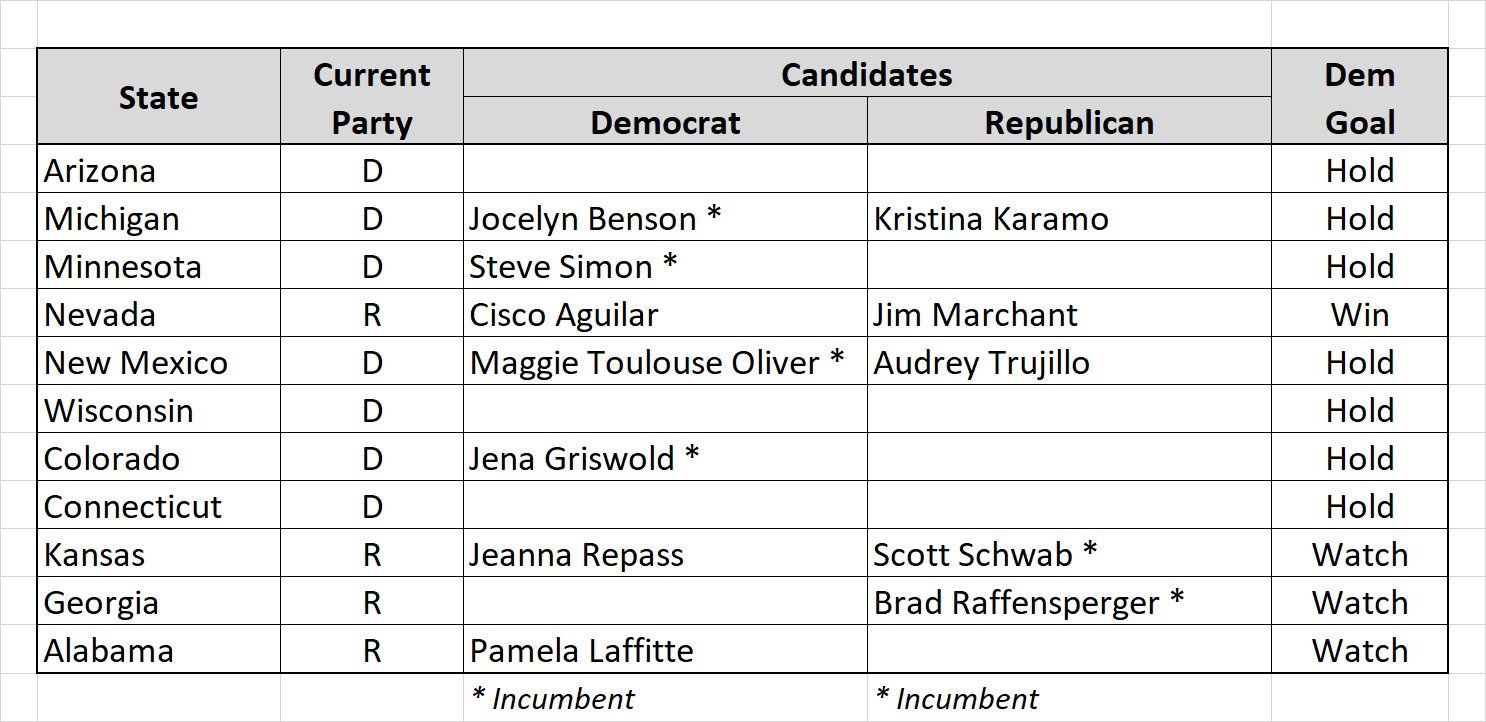
Here are the nine 2022 Senate races that I’m currently watching.

(Click for a larger image; use the back button to return.)

Status is my current analysis; Dem Goal is my current recommendation; the order reflects the order in which I’d throw money… if I was throwing money this early… which I’m not.

In summary, there are currently no easy pick-up opportunities for Republicans this cycle.  On the other hand, Republicans will be defending three seats that are definitely competitive.

FWIW, here’s my brief take on each of these races:

  • Arizona:  Sen. Kelly gets to defend the seat he just won in a special election.  Arizona is definitely a purple state but Kelly showed he was a good candidate.  Republican Gov. Ducey’s recent decision to not challenge Kelly helped Democrats a lot.
  • Georgia:  Ditto. Sen. Warnock also won a special election, Georgia is purple, and Warnock is good.
  • New Hampshire: While Biden won here by a wide margin, Sen. Hassan won her Senate seat in 2016 by only 0.1%.  If Republican Gov. Sununu or former Republican Sen. Ayotte run against her, this race could become more competitive.
  • Nevada:  Sen. Cortez Masto is currently favored to retain her seat, but if Republican Gov. Sandoval decides to run against her, this race becomes more competitive.
  • Pennsylvania:  Sen. Toomey’s retirement makes this race competitive.
  • North Carolina:  Sen. Burr’s retirement makes this race competitive.
  • Wisconsin:  Sen. Johnson isn’t very popular and is apparently considering retirement.  The race is competitive in either case.
  • Ohio:  Sen. Portman’s retirement makes this race competitive.  If Democratic Rep. Tim Ryan runs, this could move to a Toss Up.
  • Florida:  Sen. Rubio is heavily favored and, unless Democrats find a great candidate, this race could easily move off of my radar.


Impeachment II

I’ve been asked why I haven’t weighed in on the current impeachment hearing.  Hell, I’m barely following it.  We all know Trump is guilty of inciting an insurrection.  We all know that the Senate won’t find him guilty.

But fine.  Here’s my two cents…

This snippet from the opening statement of Trump’s defense team is worth noting up front:

“This trial will tear this country apart, perhaps like we’ve only seen once before in our history,”

I question the legal strategy behind defending your client against an incitement to insurrection by threatening an insurrection.  But, hey, that’s just me.

Based on the brief filed by Trump’s defense team, their planned arguments against conviction can be summarized by three positions statements:

  1. Position: Trump can’t be impeached because he is no longer in office.
    • Facts: The Constitution says “Judgment in Cases of Impeachment shall not extend further than to removal from Office, and disqualification to hold and enjoy any Office of honor, Trust or Profit under the United States”.
    • Conclusion:  If the only result of an impeachment was removal from office, this argument might be valid.  However, since there’s an additional possible consequence, this argument is crap.
  2. Position:  Trump was merely exercising his First Amendment right to free speech.
    • Facts: A Supreme Court opinion written in 1919 by Oliver Wendell Holmes famously ruled that free speech did not extend to “shouting fire in a theatre and causing a panic.”  The Court clarified that ruling in 1969 to explicitly ban such speech that is “directed to inciting or producing imminent lawless action and is likely to incite or produce such action.”
    • Conclusion:  Free speech has limits and this argument is crap.
  3. Position: Trump had no intention of interfering with the counting of Electoral votes.
    • Facts: Really?  Just roll tape.
    • Conclusion: Trump made it quite clear what he wanted and this argument is crap.

In short, there is no sane defense.  On the other hand, however, none of the above matters.  Not even a little bit.  As I posted when we went through this the first time:

The problem is that the impeachment of a President isn’t a legal issue.  It’s political. …  Senators are bound by no laws and can cast their votes as they individually deem fit with no ramifications whatsoever.  There is no judge that can direct them nor override even an obviously incorrect verdict.  There is no appeal. 

GOP Senators are perfectly free to just say: “I’m afraid that Trump will get mad at me and I won’t get re-elected if I vote to convict him.”

That is their Constitutional – albeit balls-free – prerogative.

I only wish they’d be honest about it.

Two Americas

I previously posted my skepticism that our nation could find any common ground upon which to unify.  Each day’s news verifies that opinion.

Some on the far-right are again making explicit calls for civil war as Democrats display the audacity to pursue the agenda upon which Biden was elected.  Conversely, some on the far-left expect their party’s razor-thin majority to produce a progressive’s wet dream, despite that not being the agenda upon which Biden was elected.

Since a Second Civil War doesn’t seem like a particularly good idea, I thought I’d give some brief thought to a less bloody separation.  While I’m certainly not claiming that an American divorce is anywhere in the neighborhood of a decent option, contemplation of the extreme shines some unfortunate light on the scope of our polarization problem.  I’ve already spent too many cycles on this than I should have, but it’s an interesting academic exercise.

Consider if you will….

A division of the United States into two independent nations: the Democratic States of America (DSA) and the Confederate Republic of America (CRA).

Below is my attempt to quickly define the separate entities based on the apparent majority opinions in both camps.

To simplify matters for this thought experiment, the separation would be along state lines – allowing existing state and local governments to function relatively unchanged within new federal frameworks.  Each state would optimally be able to chose the country to which they belong.  However, for my purposes, I’ll simply assign states to a country based largely on 2020 Presidential preferences – with the notable exception of granting Georgia to the CRA purely for geographical convenience.  Splitting the states into Biden and Trump camps (modulo Georgia) gives the CRA 26 states and the DSA 24 states.

Thus, the big picture looks like this:

(Click for a larger image; use the back button to return.)

American Union

First, acknowledging that an American breakup would make Brexit look like summer camp, we’d start with both countries belonging to an American Union (AU). The AU (an EU-lite) would initially be a short-lived entity with perhaps a three-year lifespan that could be shortened or extended only upon mutual agreement.  During the AU transition period, the AU would function as the U.S. federal government does today.  However, all AU laws, executive orders, and court rulings would be subject to veto by either the DSA or the CRA – making it imperative that the two countries finalize their divorce as quickly as possible.

All state borders would be open within the AU during the transition period.  People and corporations would be free to relocate to any state in the country of their choice during this time and there would be a temporary free-trade agreement between the two countries.  All military personnel would be free to serve the country of their choice by requesting duty station changes as appropriate.

The transition period would allow the two countries to finalize the details of their governments, ratify constitutions, and agree on a division of current U.S. resources.  For simplicity, all current federal resources that are not physically tied to a given state would be evenly split between the two countries (including nuclear weapons).  The national debt would also be evenly split.

Both countries could choose to join existing international entities (e.g. United Nations, NATO, and NAFTA) as each desires, but some bilateral treaties and trade agreements would also seem appropriate (e.g. an Open Sky agreement and cooperation in the space program). A free trade agreement would be optimal but likely elusive.  Some mutually-beneficial arrangement could also possibly give the CRA access to the Pacific in exchange for traversal rights through the CRA between the geographically separate parts of the DSA.  In any case, a permanent, severely downsized version of the AU could be considered as an umbrella for all bilateral agreements and Washington D.C. could become the AU’s home.

Democratic States of America

The DSA features a strong federal government.  Briefly, …

  • Federal Structure:  Elimination of the Electoral College with the President elected by popular vote.  The Senate remains as-is with two Senators per state but with a Constitutional 60% vote requirement for most legislation and judicial appointments.  The House concept remains but with districts drawn by independent commissions w/ set rules and with minimal Representatives decided by the smallest state (1) and apportioned accordingly to other states by population.  Supreme Court Justices are term-limited to 15 years, Senators to 12 years, and Representatives to 10 years.
  • Health Care:  Universal single-payer health care at the federal level with Medicare, Medicaid, and the ACA rolled in.
  • Education:  Free federally-directed public education through junior college or trade school; free 4-year college and graduate programs in return for military or public service.
  • Finance:  Retain U.S. financial systems with continuation of the Federal Reserve and international monetary involvement.
  • Federal Taxes:  Progressive personal income tax plus a wealth tax.  Capital gains are taxed as ordinary income.  Corporate tax rates are increased.
  • Gun Controls:  Extensive federal background checks with a federal registry and federal carry laws.  Personal ownership of some assault weapons is banned outright and some firearms require additional background checks with more restrictive carry laws.
  • Voting Rights: Federally-mandated, broad requirements for voter eligibility.
  • Immigration:  Path to citizenship for all undocumented immigrants.  DACA becomes established law.  Immigration welcome.
  • Abortion: Legal in the first trimester and legal thereafter for defined health reasons.
  • Environment:  Focus on renewable energy with strong environmental regulations.
  • Trade:  Globalist approach using multiple international free-trade agreements and a limited use of tariffs.
  • Foreign Affairs:  International approach with strong alliances. Almost all military operations are conducted through alliances.
  • Capital:  Denver.
  • Pre-Split Statistics:
    • # States = 24
    • U.S. Electoral Votes = 286
    • GDP = 13.8 Trillion
    • Population = 178 Million
    • White = 59%
    • College-Educated = 34%

Confederate Republic of America

The CRA features a weak federal government.  Briefly, …

  • Federal Structure:  Retention of the basic U.S. structure, leaving the Electoral College, Senate, House, and Judicial branch largely as-is.
  • Healthcare:  Rely on optional commercial individual health insurance managed at the state level.  Eliminate the ACA and Medicaid at the federal level.  Keep Medicare at the federal level, but move some current coverage to commercially available supplemental plans.
  • Education:  Give states total control of and responsibility for education within their borders with no federal involvement whatsoever.
  • Finance:  Eliminate the Federal Reserve and return to the gold standard.
  • Federal Taxes:  Flat personal income tax; no corporate tax.
  • Gun Controls:  No federal limitations or controls on firearm purchases.  Open and concealed carry privileges granted by any state are recognized throughout the CRA.
  • Voting Rights: States have full control over voter eligibility.
  • Immigration:  Deportation of all undocumented immigrants.  DACA repealed.  Border wall completed between Texas and Mexico.  Immigration discouraged.
  • Abortion:  Always illegal with no exceptions.
  • Environment:  Focus on fossil fuels with extremely limited environmental regulations.
  • Trade:  Protectionist approach using tariffs; limited international free-trade agreements.
  • Foreign Affairs:  Largely isolationist, America-first approach with weakened international ties.  Almost all military operations are conducted unilaterally.
  • Capital:  Dallas.
  • Pre-Split Statistics:
    • # States = 26
    • U.S. Electoral Votes = 252
    • GDP = 9.2 Trillion
    • Population = 153 Million
    • White = 63%
    • College-Educated = 28%

Brief Analysis

The DSA/CRA rabbit hole is ripe for further exploration but, for now, I’ll only make three interpretive statements:

  1. Even if we only considered real issues and not political personalities, the two countries would have wildly divergent views of just about everything   Half of Americans would likely prefer to live in the DSA; half would prefer the CRA.  A middle path may be possible for the United States, but the road to compromise will be difficult at best.
  2. Personally, I’d have to move.  I suspect that many of the residents of my blue pod in Austin would have to leave Texas and the CRA.
  3. It seems fairly obvious to me that the DSA would be the most sustainable independent country over time.  I’ll accept that other interpretations may be plausible (albeit wrong).  Perhaps I’ll write a future history novel someday.  Or not.


Unity?

Just as dolphins swim together in pods to protect each other from predators, people tend to gravitate toward those who share their worldviews in order to jointly defend against opposing perspectives.  My center-left viewpoint is well-represented within my pod and I admit to thoroughly enjoying the time I spend in my personal echo chamber.  However, I do have numerous good friends who swim in other political pods.

I find my friends on the far-left to be mostly well-intentioned if not particularly practical.  I try to remind myself that similar groups of people throughout history have championed worthy causes that shook the political norms of their day – causes such as women’s suffrage, civil rights, gay marriage, food safety laws, Medicare, and Social Security.  Still, I visibly wince at some of the “Big Block of Cheese” ideas that are advocated by today’s progressives.  (If you’re not a fan of The West Wing, you’ll just have to look it up.)

With many of my friends to my right, I unreservedly enjoy debating political issues and I can respect their sincere, informed positions even when we strongly disagree.  I have even been known to change my mind when confronted with sound arguments.  Not often, though.

With other friends further to the right, I desperately avoid political discussions altogether in attempts preserve the relationships.  Sometimes I think that the intrinsic problem is my inability to fully understand their perspectives.  Sometimes I think that the intrinsic problem is that they are blithering idiots.  It’s a work-in-progress.

I have, however, completely disconnected from almost everyone in the far-right pod.  (I try hard to maintain family exemptions, but that waiver is under constant review.)  Despite some redeeming qualities that initially welcomed these people into my pod-adjacent world, I find their political viewpoints reprehensible to the point of moral outrage.  I brand this group as predators who pose a clear danger to my pod.

The predator pod includes, but is definitely not limited to:

  • Those who participated in or approved of an open insurrection against the United States.  I reject the premise that there are anarchists on both political extremes as a false equivalency.  The far-right mob that stormed the Capitol self-identified as Trump supporters; the destructive rioters who took advantage of peaceful BLM protests weren’t wearing Biden hats.  Both groups were criminals; only one was politically aligned.
  • The 45 GOP United States Senators who just voted against holding an impeachment trial for a President who quite obviously incited an insurrection on national television.  They didn’t vote to clear him of the charge; they voted that the charge wasn’t worth considering.
  • A GOP United States Congresswoman who claims that the Parkland school shooting was a hoax designed to advance gun control laws.
  • The so-called “Christian Right” who makes a mockery of religion.  When confronted with their hypocrisy, I find it difficult to suppress a verbal cascade of obscenities.  While that would be an admittedly non-optimal strategy for winning a spiritual argument, the fact is that I find nothing at all spiritual about those who would hijack Christianity for amoral political purposes.

So.  Is there a point to this diatribe?

I try to make an honest, concerted effort to understand opposing political positions.  Nevertheless, I can quite happily write off an apparently large portion of the populace.  I have zero desire to engage with any of the political predators on the far-right.  Since I suspect others’ tolerance levels may be even more restrictive than my own, I am increasingly skeptical of our ability to find any common ground upon which to construct some semblance of national unity.  My post-election affair with optimism didn’t last long.

Do I have a suggestion for addressing our political polarization?  Nah.  I have no clue.  I just thought I’d share the little black cloud that is lingering above my pod today.

You’re welcome.

And thanks for all the fish.

The Filibuster

So much for bipartisanship.

As of this writing, the Senate can’t even agree on how to disagree.  They’re stuck on an organizing resolution that will set the structure of Senate committees given the 50/50 split in the chamber.  The obvious quick-route was to simply adopt the rules hammered out by Tom Daschle (D) and Trent Lott (R) the last time we had such a split two decades ago.  But no.  Of course not.

The complex specifics of the prior deal aren’t of great importance here.  In brief, it recognized that one party was “in charge” due to the Vice President’s tie-breaking vote while still acknowledging that both parties had equal numbers of elected Senators in the chamber.  The deal was fair.

This time around, Mitch McConnell (R) demanded that the legislative filibuster be formally enshrined within a modified version of the agreement to protect the 60-vote threshold for most legislation.  Chuck Schumer (D), in turn, told him to take a hike around NeverLand.  Both are wrong.

On one side, it is unreasonable for McConnell to expect Schumer to agree to something that McConnell didn’t agree to when he was the Majority Leader.  Sure, McConnell didn’t try to ditch the legislative filibuster despite Trump’s pushing him to do so.  Importantly, however, this wasn’t due to any perceived legal or ethical boundary.  McConnell didn’t do it simply because he didn’t have the votes within his own caucus to pass the rules change.  Period.  If he could have passed it, he would have.

On the other side, there is little reason – other than spite – for Schumer to refuse to recognize reality.  Schumer doesn’t have the votes in his own caucus to pass the rules change, either.

Both are missing the point.

Eliminating the filibuster is a bad idea.  It is not simply some arcane rule.  In fact, it provides an extremely important guardrail that must be preserved.  Otherwise, the Senate becomes just a smaller version of the House where the majority has absolute control and the minority has no reason to even show up.  The Senate is intended to be the more deliberative Congressional body with six-year terms for two Senators from each state and a 60-vote threshold to complete most of its work.  Agreement in the Senate isn’t supposed to be easy and the minority isn’t supposed to be irrelevant.  Democrats may be charge right now but that will change at some point.

Of course, in recent years, the filibuster has become the minority’s middle-finger to the majority and has been used – by both parties – to simply block all of the majority’s efforts purely for the sake of blocking them.  This “tyranny of the minority” is also wrong but it is undoubtedly at the core of McConnell’s game plan.

A fix is complicated but likely includes re-introducing earmarks.  The practice – which allowed discretionary funds to be directed to specific projects and entities bypassing normal bidding processes – was formally dropped about a decade ago.  The “reform” had good intentions but didn’t really stop the practice.  Lawmakers simply found other ways to specifically fund their pet projects and “pork” has never been more than 1% of the budget anyway.  All that the earmarks ban really did was to prevent the horse-trading that Congress needed to gather the necessary individual votes to pass broader bills.  Without earmarks, everything ended up being decided purely along party lines.  And that’s not working for anyone.

In any case, to get out of our current stalemate, Schumer and McConnell need to simply have a “gentlemen’s agreement” that the elimination of the filibuster is off the table for now.  That’s a simple recognition of fact and there’s no reason to make it more of the issue than it is.  Unless Republicans retreat to filibustering everything from the lunch menu forward, there are way too many institutionalist Democrats to allow a rules change along party lines.  However, the very distant threat of eliminating the filibuster might help the cause of compromise.

One can at least hope.

Goodbye & Good Riddance

With apologies to “The Wizard Of Oz”…

Ding-dong the con is gone!
Which damn con?
The con named Don.
Ding-dong the con named Don is gone!

Trump will be remembered as the absolute worst President in the history of our nation.  He will displace even James Buchanan, whose inept leadership set the stage for the Civil War.

It will, of course, take time to disinfect the White House – both literally and figuratively – and we are unfortunately still stuck with many of Trump’s acolytes.  To the bitter end, Senator Graham has remained a loyal lapdog, trying to shift blame for the attack on the U.S. Capitol away from his master in absentia.

But at least Trump himself no longer wields the power the President of the United States.  That privilege has now been passed to the better man who defeated him in a fair election.  I trust President Biden to be a worthy steward of American democracy; Trump was always in it only for himself.

Back in 2017, in a letter to Trump that I later posted to this blog, I called him a “puerile, narcissistic boor”.  In 2021, I’ll acknowledge the playground limits of Trump’s vocabulary and simply repeat one of his own favorite epithets:

Mr. Trump:  You’re a Loser.

… And your little dog, too.

COVID-19 Analysis VIII

As I watch the coverage of the Biden inauguration, I thought I’d take a look at the state of the pandemic in the United States which he will soon inherit.  His predecessor leaves him not only this quagmire but numerous others.

Our country has seen almost 25 million COVID-19 cases and over 400,000 resultant deaths.  My latest 48-second video shows weekly new cases per capita by state to help visualize the relative spread across the U.S. since the beginning of the pandemic.  The progressively darker shades reflect higher per capita new case counts.  I use a low threshold of 0.05% to allow a white color to imply a controlled, but non-zero per capita infection rate in a given state.  Complete eradication is outside of any reasonable planning horizon.


New York was, of course, the initial hotbed back in March of 2020.  Louisiana followed in short order.  April and May saw a spread to middle America – which didn’t get as much press since the reported numbers were absolute and not per-capita.  By summer, the spread was nationwide.  Florida and Texas became hotspots and their larger populations drove up the absolute numbers.  By fall, middle America was back at the forefront the pandemic’s worst per-capita numbers.  Winter saw bad per-capita numbers across the country.  California became a hotspot which again drove up the absolute numbers.

In short, the virus is all over the place.  Hotspots appear everywhere.  Weather doesn’t seem to have a huge impact and there is zero correlation with political affiliation.  The only thing we can say with certainty is that overall, the pandemic keeps getting worse.

While continued mitigation (masks, social distancing, crowd avoidance) makes sense to slow the acceleration, it does appear that only way out of this is the vaccine.

Unfortunately, I’ve been underwhelmed with the rollout thus far due.  Incompetence at all levels of government is inexcusable given the amount of time they’ve had to plan it.

As I said last time:  We have to do better.

The Future of the Supreme Court

As a brief respite from the myriad political issues related to Trump’s final days in office, I needed to consider the future for just a moment.  Specifically, I started looking at the future of the Supreme Court.  With a Democratic President and a (barely) Democratic Senate, one might expect Biden to have the opportunity to leave a lasting mark on the nation’s highest court.

Yeah, not so much.  I probably should have picked a different topic to distract me.  But here we are.

The unfortunate reality is that the recent Republican-forced seating of the far-right Amy Coney Barrett to replace liberal icon Ruth Bader Ginsburg cannot be easily tempered.

Six of the current members of the Court are under 70 and are unlikely to willingly leave the Court in the next decade.  Since there is nowhere near a majority of Congress inclined to expand the court, that leaves three possible vacancies within any reasonable planning horizon.

The only justice likely to retire anytime soon is Stephen Breyer.  At 82, he is by far the oldest current Supreme Court Justice and he has vaguely indicated that he might soon depart the bench.  However, as a liberal-leaning moderate, any Biden replacement for Breyer would have little impact on case outcomes.  (That’s not to say that Breyer wouldn’t be missed on the Court.  His pragmatic judicial philosophy has been an effective counterpoint to the textualists on the right.)

The next two oldest justices – Clarence Thomas (72) and Samuel Alito (70) – are wildly conservative.   In fact, since there is seldom any daylight between their judicial opinions and the prevailing far-right political positions of the Republican party, let’s just go ahead and call them partisan Republicans.  Replacing either of them with a more liberal justice would definitely impact the vote count on many rulings.  Replacing both of them would tilt the court itself – but that’s an unlikely scenario.

Neither Thomas nor Alito will voluntarily retire while a Democrat is in the White House.  Since all of the current Justices appear to be in good health, additional vacancies are unlikely even if Democrats manage to retain control of the Presidency and the Senate for eight years.

The probable best that Biden can do from a numbers perspective is to not make the math any worse than it currently is.  That said, Biden can still have an impact with the possible replacement for Breyer.  Two primary criteria for consideration seem appropriate to me and Biden has already announced a separate criteria.

The most obvious criteria is intellect.  While Breyer is a excellent jurist, he is not in the same heavyweight category in which Ginsburg resided.  Many of Ginsburg’s oral arguments and written opinions – even when in the minority – were transformative to American jurisprudence.  What the Supreme Court needs is an intellectual giant to lead the left as John Roberts leads the right.  (As an aside, while I often disagree with Roberts, I respect his intellect and accept that most of his rulings come from a sincere – if misguided – judicial philosophy and not from a purely political or personal point of view.)

In addition to a brilliant mind, any new justice must be relatively young.  While it would be tempting to nominate someone with considerable experience, it is more important to select someone who can defend their positions on the Supreme Court through multiple administrations.  Barrett is only 48 and could serve in the neighborhood of three decades.  God help us.

One assumes that intellect and youth are already in the job description for Biden’s possible Supreme Court pick.  However, his only announced criteria is an intention to nominate a black woman.  While I applaud the concept of diversity on the Court, I simply don’t believe that gender or race should be litmus tests for initial consideration.  Please hear me out before you send the email you just started.

For policy-oriented positions such as Congressional seats and Cabinet appointments, diversity should be a paramount concern.  Government needs to consider the impact of the laws they write from multiple perspectives and the “old, straight, white, Protestant male” point-of-view is already sufficiently represented.  Supreme Court justices, however, should not be determining policy or writing laws.  Their job, as Roberts once stated, is “to call balls and strikes and not to pitch or bat.”

As such, it would seem much more important to have competing judicial philosophies well-represented on the Court rather than to give much consideration at all to the Court’s demographics.  Would a black woman bring a different perspective than a white male?  Of course.  Both are humans with different life experiences.  However, if either the black woman or the white male are basing their rulings on their own worldviews, then she or he doesn’t belong on the Supreme Court.

While Liberal, Conservative, and Moderate are handy generic labels when discussing the makeup of the Supreme Court, judicial philosophies such as Originalist, Textualist, Intentionalist, Purposivist, Pragmatist, etc. are much more useful.  Since my layman’s interest in judicial philosophies doesn’t make me a Constitutional scholar, I’ll simply stick with the generic labels.  In any case, though, labels such as Black, Brown, White, Male, Female, Republican, and Democrat should be irrelevant in most instances.

I add the “in most instances” qualifier to account for the political aspects of Senate confirmation.  As the most recent example, President Obama made a tactical error with his final Supreme Court nomination.  While Merrick Garland was perceived to be a moderate pick that might be acceptable to Senate Republicans, it turned out that a complete Republican blockade of his consideration produced zero political fallout.  Imagine, however, if Obama had nominated a very qualified moderate black woman to the Court.  McConnell and Crew would have had a very tough time refusing to even give her a hearing and, if brought to a vote, she could well have been confirmed.

Certainly, all things being equal, it would be highly desirable to have a demographically diverse Court purely from the standpoint of outside perception.  I only contend that such diversity should be a secondary consideration.  However, since the pick is Biden’s to make, an initial “black woman” filter considerably narrows the potential candidate list.  The obvious first place to look for a Supreme Court candidate is within the federal appellate courts.  Unfortunately, there are only four black women currently on those courts and all are over 65.  Still, there are some good choices elsewhere:

  • Leondra Kruger (44):  California State Supreme Court Justice.  Former clerk for John Paul Stevens, assistant U.S. solicitor general who has argued multiple cases before the Supreme Court, & deputy assistant AG for the Office of Legal Counsel in the Obama administration.  Yale Law.  She is the most likely nominee but is perhaps just a bit too moderate for some given that Democrats should be able to confirm any liberal they want.
  • Ketanji Brown Jackson (50): Federal District Court Judge. Former clerk to Stephen Breyer, public defender, and Vice Chair of the U.S. Sentencing Commission.  Harvard Law.  She is currently the leading candidate to replace Garland on the D.C. federal appeals court after Garland is confirmed as Biden’s Attorney General.
  • Leslie Abrams Gardner (46): U.S. District Judge in Georgia.  Former Assistant U.S. Attorney.  Yale Law.  In addition to her own stellar reputation, she is the sister of Stacey Abrams, who had a large part in the 2020 Democratic wins in Georgia.
  • Melissa Murray (46):  NYU Law Professor.  Former clerk for Sonia Sotomayor.  Yale Law.
  • Elise Boddie (53):  Rutgers Law Professor.  Former Director of Litigation, NAACP Legal Defense Fund & Founder of The Inclusion Project.  Harvard Law.
  • Anita Hill (64):  Professor at Brandeis.  Yale Law.  Okay, sure, this isn’t going to happen.  But wouldn’t it just be a whole lot of fun to put her on the Supreme Court alongside Clarence Thomas?

My first choice, however, may be just a tad too old, isn’t a black woman, and likely wouldn’t take the job if it were offered.  Regardless, I’d love to see Biden nominate Barack Obama to the Supreme Court.  It’s been done before – William Howard Taft served as Chief Justice after his Presidency.  Obama is a Constitutional scholar with the ability to write opinions for the ages and a Justice Obama would be almost as entertaining as a Justice Hill.

What’s Next?

Last night’s Trump-incited mob takeover of the U.S. Capitol overshadowed some rather significant political bottom lines:

  • Joe Biden will be sworn in as President on January 20.
  • The dual Senate wins in Georgia will create a 50/50 split in that chamber.  Since VP Harris will be able to break any party-line votes, Democrats will have effective control of the Senate.
  • Democrats will retain control of the House with a 51.3% majority.

Thus, in less than two weeks, Democrats will have command – albeit a very fragile command – of both the Executive and Legislative branches of government.  More importantly, the Cult of Trump will command neither branch.

Cool.

As a result:

  • Biden will have a much easier time getting his cabinet picks approved.
  • Neither chamber will be wasting time and money pursuing idiotic election investigations for the sake of political theater.
  • Democrats will be able to fill judicial openings to make up a little ground on the Republican court-packing accomplished over the past four years.  (Note, by the way, that I will be just as critical of unqualified Democratic picks as I was of unqualified Republican picks.)

However, it’s not like Democrats will be able to run completely amok.

  • The Supreme Court will remain firmly conservative for the foreseeable future.  In fact, a few of the current Justices are well beyond a conservative judicial philosophy and are blatantly partisan Republicans.
  • Pelosi’s majority in the House is paper thin and Schumer will have nowhere near the control over Democratic Senators that McConnell had over Republican Senators.  While there will be some party-line votes in the new Congress, bipartisan solutions will at least be a possibility.
  • There are many institutionalist Democrats in the Senate.  There will be no elimination of the filibuster.  Republicans will retain an effective veto on all but confirmations and a few budget bills passed by reconciliation.
  • There are many moderate Democrats in both chambers.  There will be no wholesale majority move to the far left.  There will be no expansion of the Supreme Court.
  • Intra-party conflicts will impact the ability of Democrats to put a majority together on anything.  In addition, any death, resignation, serious illness, or simple absence could completely change the Congressional math.

In short, effective federal government will still be difficult at best and will require cooperation across the board.  I’ve decided to be cautiously optimistic for no reason whatsoever.  I’m just tired of being mad.

On the other hand, we must not forget that Trump is still the President at the moment and he can still wreck considerable havoc on our nation before he departs.

Thirteen days and counting…