A 2020 Platform – The Federal Budget

Continuing my 2020 Platform series, I thought I’d tackle the federal budget.  A difficult topic, you say?  No, not really.  As Trump likely said to Stormy, no matter what you do, you just can’t make this hard.

While no one in Washington appears to have ever balanced a checkbook, the rest of us understand the basics of managing to a budget.

We start with our account balance which tells us how much money we have or, conversely, how much we’re in debt.  We then compare our expenses against our income, taking into consideration the necessary reduction of any outstanding debt.  If the resultant budget says we’re spending more than we’re bringing in, we either need to spend less or make more.

Cool.  So we’re done here, right?

Well, we damn well should be!

Sure, sure.  Macro economic theory tells us that the federal government should increase spending during economic downturns and reduce spending when the economy recovers.  While that may seem counter-intuitive at first, it’s really no different than an individual taking out a student loan to get a better job and then using some of the additional salary to pay off the loan.  Simple.

Let’s break it down.

The Federal Deficit

I’ll start with the elephant in the room.  Seriously.  The elephant.

Republicans spent the entirety of the Obama administration whining incessantly about the rising deficit.

To be sure, while the U.S. had been running in the red since before WWII, the Obama administration made it worse.  Obama’s deficit spending (including a massive bipartisan stimulus package) was intentional and necessary to drive the economy through the financial crisis that hit the nation at the end of the Bush administration.

Still, the federal deficit was at almost $20 trillion when Obama left office.  TWENTY TRILLION.  A $20 trillion stack of $5 bills would stretch well past the moon.  Folks, that’s real money.  The Republicans were right.  The deficit was obviously a serious problem worthy of immediate action.  Since the economy was recovering nicely, it was time to start paying down the debt.

However, once in control, Trump & Company promptly changed their minds.  They passed substantial federal tax cuts that helped corporations and the rich.  Concurrently, the GOP-led government also dramatically increased federal spending.  Lo and behold, with less income and more expenses, the federal deficit continued to rise.  Imagine that!

The deficit surpassed $22 trillion in February of this year.  For those keeping score, that’s a 10% increase in just two years of Trump with no plans whatsoever to reverse the trend.  Current CBO projections put the deficit at around $34 trillion by 2029.

Some might thus call Republican lawmakers hypocrites.  I have another word in mind.

Federal Spending

I searched online for a graphic with a decent high-level breakdown of current federal spending but eventually settled on creating my own, summarizing raw CBO data.
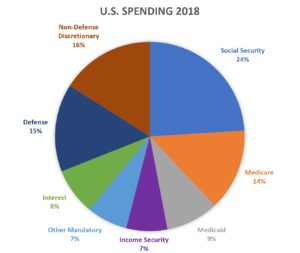
“Income Security” includes unemployment insurance, SNAP (food stamps), child nutrition programs, etc..  “Other Mandatory” includes federal retirement benefits (military & civilian), veterans programs, etc.

In 2018, our federal spending totaled $4.1 trillion.

It is first worth noting that 8% of that is just interest on our debt.  That’s $328 billion in just one year that bought us absolutely nothing.  Zilch.  Even worse, as anyone who has tried paying only the minimum monthly amount on a credit card knows, debt maintenance quickly gets worse over time.  As our deficit grows, our interest payment grows.  It’s not a pleasant trend.

The social safety nets and the military consume the lion’s share of our national budget and they each deserve their own blog posts.  My brief take here is that these are absolutely essential elements of our government and our national identity.  Can we improve on them and make them more efficient?  Of course we can.  But we are the leaders of the free world and we take care of our own.  These should be points of national pride and not something for which we should ever apologize.

We’re thus left with 16% of our budget for the “Non-Defense Discretionary” spending that pays for everything else in our massive governmental alphabet soup (IRS, CBP, FBI, CIA, TSA, FHWA, EPA, NASA, FEMA, NPS, USDA, FDA, NIH, DOE, FCC, SEC, HUD, USPS, etc., etc., etc.).

Sure, this is “discretionary” spending and we could certainly choose not to fund any of these agencies.  Think about that for a moment, though.  Only 16 cents out of every tax dollar funds what most people think of as “The Government”.  I contend that the vast majority of people across the political spectrum would agree, in isolation, that the vast majority of these agencies are rather necessary to our way of life.  Are there some expenses that mostly appeal to one party or the other?  Sure.  Could we be more efficient across the board?  Always.  But if anyone thinks that minor cuts or tweaks here and there will save more than a penny on the dollar at best, I would love to see the math.

Federal Income

My homeowners’ association wants a ton of improvements to our jointly owned property and simultaneously complains that our HOA fees are too high.  I get it. Everyone wants something for nothing.  Free is great!  The problem is that stuff ain’t free.  No one likes paying taxes but government services also aren’t free.

Here’s my high-level breakdown of federal income:
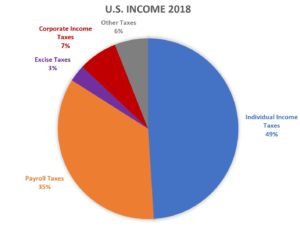
“Other Taxes” includes estate taxes, gift taxes, etc.

In 2018, our federal income totaled $3.3 trillion.  You might have noticed that this is $800 billion less than we spent.  Hence, the problem.

In general, a free market with robust competition will provide, over time, the best economic motivation for greater innovation, higher quality, and lower costs.  The resultant strong economy will increase the tax base (both individual and corporate) and thus increase government revenue at reasonable tax rates.  The government’s economic roles are to (a) set reasonable tax rates to pay for the services that the public needs/wants, (b) maintain a fair environment, and (c) encourage/discourage market behaviors that may impact society for better/worse.  Unfortunately, our government sucks at every one of these tasks.

The recent Republican tax cuts might have been okay had they had been better targeted and hadn’t increased the federal deficit quite so much.  There were zero economic reasons for the tax cuts to be so huge; that was pure politics.  Smaller tax cuts would have garnered bipartisan support and might have allowed us to at least start to address debt reduction.  But no.  The tax cuts were instead implemented at the literal expense of our long-term national financial stability.

Democrats aren’t immune to fiscal stupidity, either. The left’s recent calls to just raise tax rates on the rich makes for great political sound bites, but doesn’t solve the problem.  Most well-off Americans already pay a ton of taxes.  In 2018, the top 20% of tax filers received 53% of all pre-tax income and paid 68% of all federal taxes; the top 1% received 16% of all pre-tax income and paid 26% of all federal taxes.  So how about the uber-rich?  While that’s a valid issue, it won’t be addressed by merely increasing upper income tax rates.  These folks can just hire whole floors of accountants to game our massively complex tax code and avoid the declaration of any taxable income at all.  There isn’t a lot of difference between 37% of zero and 70% of zero.  One of the many likely reasons Trump wants to keep his tax returns private is that he hasn’t paid any income taxes in decades.

While often overlooked, economic incentives and disincentives (largely in the form of excise taxes, tax credits, and tax deductions) are extremely important parts of the federal income equation.

Federal excise taxes are implemented on some items, but such taxes account for only 3% of federal income.  On the flip side, there are a ton of tax give-aways that not only don’t help matters – they make matters much worse.

Ethanol is just one representative example.  U.S. taxpayers have to make up for over $7 billion in annual tax credits that the government grants to Ethanol producers.  Ethanol is a low-quality biofuel which various levels of governments mandate be blended into gasoline.  Since about 40% of U.S. corn is used to create Ethanol, consumers also have to pay more for edible corn and other corn-based food products.  Furthermore, since Ethanol-laced gasoline is less efficient that pure gasoline, consumers also have to buy more of the blended gas to get equivalent mileage.  So who exactly benefits here?  Iowa.  Iowa is the top corn-producing state in the U.S. and just so happens to be the first stop during the political primary season.  Strange coincidence, huh?

Our income problem boils down to this:  There is little political upside to raising taxes, simplifying the tax code, or reworking tax incentives.  Politicians are unfortunately motivated to spend every dime they can get their hands on to get elected and re-elected for as long as they can.  They are more than content to let future politicians and future generations deal with the debt they create.  They simply don’t see the deficit as their problem and, when their primary goal is re-election, they are sadly correct.  It’s not just their fault; it’s ours.

Suggestions

Future blog posts may well expand on some of these thoughts, but here’s just a few budget-related suggestions:

Implement Federal Term-Limits:  Addressing the federal deficit will require political courage.  Unfortunately, courage will never be in large supply among career politicians.  Voters might respect a candidate that says “I will raise your taxes and take away your favorite tax incentives” but that respect won’t equate to actual votes.  Term-limits won’t completely solve this problem, but they can’t hurt.  Elected officials are often more inclined to do the right thing when they’re not up for re-election.

Eliminate the Legislative Debt Ceiling:  Trying to control the deficit with an artificial “debt ceiling” is laughable and this political football just needs to go away.  The deficit is money we’ve already spent.  We can’t just put the kitchen sink on our national credit card and then not pay the bill.  I tried that in college.  It didn’t work well.

End Government Shutdowns:  Politicians need to stop shutting down the government when they can’t agree on spending bills.  Here’s a thought.  When the government shuts itself down, the folks that cause the shutdown don’t get paid.  This group would include every single federally-elected officeholder, all federal political appointees, and all of their senior staffs.  Importantly, this group of people would NEVER receive any back pay when the government inevitably reopens.  This only seems fair and I guarantee that it would eliminate all future shutdowns.

Simplify the Tax Code:  Our tax code is way too complex.  Significant tax revisions would be required to ensure that everyone, including the uber-rich, pays their “fair share” of taxes.  In 1913, the U.S. tax code was 27 pages.  It’s now over 6000 pages – and that doesn’t include a ton of IRS regulations and associated case law.  While simplification wouldn’t itself make the tax code more fair, it might make it more transparent.  If people had better insights into the real winners and losers in the tax code, perhaps it could better inform their votes.

Completely Rethink Tax Incentives/Disincentives:  To paraphrase Jim Croce, trying to direct the U.S. economy is akin to tugging on Superman’s cape.  It might get his attention; it might not; it might just piss him off.  That said, government can and should use tax policy to nudge things in preferred directions.  While some laws and regulations are obviously required, tax incentives and disincentives can provide better motivations to encourage behaviors that benefit society… or at least increase tax revenues on less desirable behaviors.  While we already do this, it’s not used nearly enough for the right reasons.  In my perfect world, we would:

  • Eliminate a ton of tax credits and deductions whose primary purpose is political.  The Ethanol tax credit is an obvious target, but there are certainly others.  The R&D tax credit, for example, encourages large companies to invest in research that makes them more money.  Do they really need a tax break for that?  If they do get one, the public at least needs to reap a large portion of the benefits.
  • Implement a massive purge of charities, churches, and business organizations that can claim tax-exempt status.  While there is a valid category of organizations that deserve a tax-exemption by serving a public good, taxpayers foot the bill for way too many organizations that fundamentally operate for private, political, or commercial purposes.
  • Increase tax incentives to encourage retirement savings, clean energy usage, and higher education.
  • Vastly expand the federal use of excise taxes.  If a prevailing government wants to discourage a social behavior, then tax the crap out of it.  Excise taxes on alcohol, tobacco, and firearms should be increased.  Gambling and marijuana should be legalized and the government should collect excise taxes on these as well.  Making things illegal adds law enforcement, court, and incarceration costs; making them legal and expensive adds tax revenue.  Do the math.

Look for Cost Savings:  As noted above, significant money likely won’t be found tweaking individual budget line items.  That doesn’t mean we shouldn’t look for cost savings, though.  Things can almost always be streamlined; fraud can almost always be reduced; some spending is almost always stupid.  As long as the act of finding various cost savings doesn’t cost more than the amount saved, we should definitely try.  We should even look into getting a better bang for our bucks in our social programs and the military – so long as we recognize these as core requirements worthy of our money.

Get Serious about Budget Neutrality:  Every spending proposal should be accompanied by a corresponding income proposal.  A ton of legislation claims it will be “budget neutral” by assuming purely magical economic benefits.  The CBO has historically done a decent job scoring such proposals when given a decent chance, but those scores are often ignored.  While keeping the CBO non-political is likely to be tough in the current environment, it is essential.

Increase Tax Rates:  Yes, I saved this for last.  I guess it’s pretty obvious that I’m not running for elective office since, in our current environment, this statement would be political suicide.  Note, however, that I’m not looking for an overnight solution.  Trying to quickly eliminate our federal deficit would ruin our economy and make the situation much worse.  All we need is a plan that moves us in the right direction.  Even if we implement most of the above suggestions, it simply won’t be enough.  At some point we’ll need to suck it up and agree to pay for all the things we buy and also start paying down the debt incurred on things we’ve already bought.  We can’t just keep passing along ever-increasing debt to future generations.  A good start for now would be to reduce the Trump tax cuts and direct the vast majority of the added federal revenue to deficit reduction.

2020 Democratic Ticket – Initial Pick

While I’m not often one to shoot from the hip, I’m going to make a way-too-early pick for a 2020 Democratic Presidential ticket.

I absolutely reserve the right to change my mind once we have better data.  And, of course, things will progress and they’ll progress in unforeseen directions.  There are already as many Democrats running for President in 2020 as in the prior eight presidential election seasons combined.  The debates will matter and it’s guaranteed that some major revelations and/or events will change the landscape multiple times before the Democratic National Convention in July of 2020.

As I’ve stated before, I’m solely interested in beating Trump/Pence.  Particularly given the bleak 2020 Senate picture, Democrats need to be laser-focused on evicting the current occupant of the White House.  While Democrats can and should have policy discussions, losers don’t get to set policies.  Thus, picking the 2020 Democratic ticket based on policy positions is just political masturbation.  It may feel great in the moment, but it’s not particularly useful and it can leave a huge mess.

That said, at the moment, here’s my ticket choice.  [ Drum roll, please… ]

Biden / Harris 2020

I previously discussed possible Democratic 2020 Electoral Strategies and I’m standing by that analysis.  Given those thoughts, the following is the rationale behind my ticket choices.

Joe Biden

Joe Biden seems a pretty obvious choice to lead the ticket to a win.  Biden can execute either the Middle America Strategy or The Old White Establishment Male Strategy or some combination thereof.  There is no other candidate that has such an obvious Electoral path to victory.

Biden is certainly qualified for the office.  During his quarter century in the Senate, he chaired both the Foreign Relations Committee and the Judiciary Committee.  During his eight years as Vice President, he largely functioned as a partner for President Obama.

Of course, Biden does have a few negatives – and feel free to read the word “negatives” with a serious eye roll.

Biden is not exactly a poster child for new leadership.  However, while his age, race, and gender will be an issue in the primary, it’s a wash in the general election.  Fence-sitters will hopefully prefer an old white male statesman over an old white male asshole, but the fact remains that both Biden and Trump are old white men.

Biden also isn’t a “progressive” in the 2020 sense of the word.  He’s a centrist.  While that word is anathema to a portion of the Democratic party, it would most definitely be a positive in the general election.

By far, though, Biden’s biggest negative is that Joe is Joe.

While very few people would think that Biden’s heart isn’t in the right place, his hands have been another matter.

Can Biden be creepy?  Sure.  But does anyone not have a friend or relative who is WAY too touchy-feely?  A line can most definitely be crossed where physical contact becomes assault or when a power relationship is in-play.  Short of that, though, there really is a difference.  While an unwanted invasion of one’s personal space can be extremely uncomfortable, such an act is neither criminal nor disqualifying.

As a brief aside, let me attempt to be clear before anyone hits “Send” on the email telling me that I’m a sexist idiot who just doesn’t get it.  Perhaps you’re right.  I can’t argue that I fully understand a woman’s perspective.  However, while I believe that the #MeToo movement has been a long-overdue force for good that illuminated the despicable actions of the likes of Harvey Weinstein and Louis C.K., the hashtag does not convey magical powers.  If #MeToo devolves to give anyone carte blanche to unilaterally destroy someone’s reputation for any perceived slight or annoyance or social error, then count me out.  The voices of those dealing with true sexual predators are diminished by such misuse.  Okay.  If you are still so inclined, flame away. ]

In any case, while CreepGate will undoubtedly play a role in the Democratic primary, it’s hard to imagine the GOP making this a successful general election issue.  Compared to Trump, Biden is Mother Teresa.

Could others fill Biden’s role on the ticket?  That’s doubtful at best.  Steve Bullock and John Hickenlooper could technically attempt the same strategies, but neither has national name recognition nor experience.  Both would have been much better Senate candidates and their personal ambitions helped put the Senate out of Democratic reach in 2020.  Thanks, guys.  No, at this juncture, the best hope for Democrats in 2020 is Joe Biden.

Kamala Harris

Picking the VP was a more interesting exercise.

To make this pick, I assumed that Biden is at the top of ticket and I hope that he waits until he has the nomination in hand before making a VP selection.  Things change.  While it’s certainly possible that someone who is not a current Presidential contender gets the VP nod, that seems rather unlikely given the large field.  (Of course, if Michelle Obama or the right retired military flag officer expresses any interest, I’ll rewrite this post.)

Thus, given what we now know, my initial pick is largely a matter of elimination:

  1. I first scratched all of the other old white men.  Some diversity is required against Trump/Pence and the field is strong enough to make the ticket more representative of the voting population along at least one axis.  I used Pence as the “old man” cutoff and he’s 59.
  2. I next scratched a ton of candidates that don’t yet have sufficient experience, leaving only people that have served as Senators or Governors.
  3. I then scratched all older women, using the same cutoff age I used for the men.  With the 76-year-old Biden at the top of a ticket, some younger blood would produce a healthier ticket.  This criteria eliminated only Elizabeth Warren.  It wasn’t personal.
  4. I next scratched all of the other East Coast candidates to provide some geographical balance to a ticket led by Biden.  This eliminated Cory Booker and Kirsten Gillibrand.
  5. For the final scratch criteria, I simply decided to eliminate all of the remaining men.  Giving Biden a female running mate seemed more than appropriate.  This eliminated Steve Bullock and Michael Bennet.

The above bloodbath left only Amy Klobuchar and Kamala Harris.  Neither are bad choices, each is qualified, and each has their own pluses and minuses.

Of the two, Klobuchar is the only one who could possibly execute a winning strategy on her own.  She’s won statewide multiple times in a Middle America swing state.  She remains a strong second choice in my book and, if she exceeds expectations in the primary season, I’ll reconsider my selection.  Klobuchar is, unfortunately, a bit too much like Biden.  They appeal to the same base and Klobuchar thus wouldn’t provide much balance to the ticket.  Furthermore, since her Senate seat would not be a Safe D seat in a special election, it might be best for her to stay put.

Cutting Klobuchar made Harris the last candidate standing.  And Harris does check several political boxes:

  • In addition to being a woman, Harris has a mixed-race heritage (Jamaican & Indian) and, at 54, can reasonably claim to be Gen X.  (And, yes, I realize that sentence is infuriatingly sexist, racist, and ageist.  Unfortunately, we live in a world where a resume isn’t the only thing that matters.)  Harris might energize some Obama voters who sat out 2016.
  • While Harris is a progressive, she’s both too progressive for the general electorate and not progressive enough for the far left.  That’s a good thing.  She might be able to balance Biden’s centrist approach just enough to placate the left without worrying independents too much.
  • Harris has only served as a Senator since 2016, which might let her claim both experience and DC outsider status.
  • The prosecutorial skills Harris honed in previous jobs should come in quite handy during debates.  A Harris/Pence VP debate would make for great TV.
  • Harris could provide an aggressive counterpoint to the ticket.  Biden could present himself as a sane, experienced centrist who knows what he’s doing while letting Harris function as the disruptor that shakes things up.

The Electoral Math

Referencing my take on the 2020 Electoral Landscape, Biden/Harris should be able to add all of the “Likely D” states to the “Safe D” states for a total of 233 Electoral votes.  The ticket should also be able to pull off wins in Pennsylvania, Michigan, and Wisconsin to bring the Electoral total to 279 – enough for the win.  To pad that a bit – and to make Trump/Pence play some defense – Biden/Harris could reasonably target Ohio, Iowa, Arizona, Georgia, and North Carolina as well.  That’s a grand total of 345 Electoral votes that the ticket would have a decent chance of winning.

So.  Biden/Harris 2020?  At least for now.

The Trump Derby

As an eager nation awaited his learned opinion, Trump finally weighed in on the Kentucky Derby controversy:

The Kentucky Derby decision was not a good one. It was a rough & tumble race on a wet and sloppy track, actually, a beautiful thing to watch. Only in these days of political correctness could such an overturn occur. The best horse did NOT win the Kentucky Derby – not even close!

– Donald J. Trump, May 5, 2019

I presume Maximum Security will soon be invited to the White House for a McDonald’s feast (okay, maybe a DQ feast) with burgers made entirely from cousins of Country House.  Loser.  Probably an immigrant.

I was originally going to opine that Trump could maybe find something better to do as, you know, the leader of the free world.  Upon reflection, though, I am now convinced that Trump should be encouraged to spend every waking moment tweeting his expert opinions on all of the major issues of our time.  Here’s just a few possible starting points that could keep him occupied:

  • The Night King was robbed. White walkers were good people. Sad! The AG should investigate Arya now! Cersei reminds me of Ivanka. She screwed her brother and that’s hot!
  • The Avengers are socialists. Thanos was right! Dusting half of the population is even better than a wall! He just didn’t dust the right half. Loser. Needed Trump.
  • If Aunt Becky gets convicted of a “crime” I’ll pardon her. The whole point of having money is to buy things poor people can’t! My Dad bought my Wharton degree. No big deal.
  • Steph Curry is so overrated. I’d have made that dunk. Easy. My dunks are the best. Nobody dunks better than me. Ask anyone.
  • Coke or Pepsi? The Trump 2020 campaign is in full swing. Who wants a Medal of Freedom?


2020 First Look – The Senate

Technically, the 2020 Senate map favors Democrats.  It just doesn’t favor them enough.

While it’s still very early and candidates are still unknown in many states, an initial look seems appropriate.  If Democrats manage to retake the White House, they’ll need a Democratic Senate to do much of anything.  If Democrats don’t beat Trump, a Democratic Senate could at least limit the damage.

Democrats need a net gain of 4 seats to take definitive control of the Senate (or a net gain of 3 seats if Democrats win at the top of the ticket).

In 2020, Republicans will defend 22 seats and Democrats will defend 12 seats.  By my count, however, only 14 seats are at all competitive – 9 Republican and 5 Democratic.  Since 12 of the 14 seats are in swing states, there will be massive synergy between the Presidential and Senate races.  A strong Democratic ticket could certainly help Democratic Senate candidates; a mediocre ticket will be a disaster all around.

Here’s my current Senate breakdown, more or less in order of a possible Democratic win:

The details aren’t at all good:

  • The seat most likely to flip is currently held by a Democrat.  It would take a minor miracle for Doug Jones to retain his Alabama Senate seat.  Democrats’ best bet is for Roy Moore to again be the Republican nominee and it’s doubtful Republicans will repeat that mistake.
  • Democrat Tom Udall isn’t running for re-election in New Mexico which puts that state more in-play than it needed to be.
  • Democrats failed to recruit 6 (SIX!) of the best potential candidates to unseat Republican Senators.  Beto O’Rourke passed in Texas, Stacey Abrams passed in Georgia, Tom Vilsack passed in Iowa, John Hickenlooper passed in Colorado, Susan Rice passed in Maine, and Kathleen Sebelius passed in Kansas.
  • Democrats have yet to field solid candidates in two of the most flippable races (Colorado and Maine).

Unfortunately, I could go on.

There is a bit of not-bad news:

  • Mark Kelly, former astronaut and husband of former Rep. Gabrielle Giffords, is running in Arizona.
  • Amy McGrath, possibly the best qualified candidate to lose in 2018, looks likely to run in Kentucky.
  • MJ Hegar, another well-qualified candidate that lost in 2018, is running in Texas.

To take control of the Senate, my initial analysis says that Democrats need to:

  • Successfully defend 4 of the 5 in-play seats that they currently occupy.
  • Flip all 3 toss up seats.
  • Flip 1 or 2 seats that currently favor the GOP (depending on who wins the White House).

That’d be an uphill climb with a great set of candidates.  Without superstars, it’ll be more like free soloing at night.  At this point, Democrats will be lucky to not lose even more Senate seats in 2020.

That’s just embarrassing.

A Targeted Campaign

In a previous post, I suggested that each of the 2020 candidates for president be required to state and defend the Electoral College math that they intend to use to win the general election.  It’s far too easy for a candidate to win the nomination with no prayer of winning the election.

Lo and behold, one candidate’s campaign manager made such a statement yesterday.  Unfortunately, it was Trump’s campaign manager.

Brad Parscale, who served as Trump’s digital media guru in 2016, shared that the Trump campaign will target all of the states that Trump took in 2016 and then additionally target Colorado, Nevada, New Hampshire, and New Mexico – with a stretch goal of adding Minnesota.  Those are five of the seven states I previously identified as only “Likely D”.  The five extra states combine for an extra 34 Electoral votes.

Sure enough, Trump does have a chance of winning in every state he’s targeting and no chance of winning in any of the 14 “Safe D” states.  Of course, Parscale hasn’t yet revealed a strategy for how they’ll win in these five new states.  He also skips over the hard task of repeat wins in the six 2020 “Toss Up” states and the slightly easier task of again winning the five “Likely R” states.  But that’s just political spin.  Parscale expects to lose some “Toss Up” states and he needs some cushion.  The math just isn’t that hard and it appears that Parscale knows it.

It sure would be nice if I could say the same thing about a Democratic campaign.

Mueller Revisited

Everyone has an opinion on the Mueller report.  I waited a bit to share mine since I wanted to seriously consider the content.

I did think it important to actually read the report.  Not the Attorney General’s summary.  Not pundit takes on any side.  The report itself.  It’s a long, hard read and it has significant redactions.  But it is fascinating.  Congress absolutely needs to see the unredacted version, but even what we have seems to make a few things abundantly clear:

  • Mueller was extremely conservative in his approach, but he did his job.
  • AG Barr’s “summary” of the Mueller report wasn’t just misleading.  It was wrong.  I fully expected Barr to spin things as best he could.  He’s a conservative Republican in the Trump administration.  However, I would have never expected him to be so patently partisan.  His previously solid reputation took a huge hit.
  • While the report found no legal basis for charges of criminal conspiracy against Trump, Mueller absolutely found evidence of corruption and collusion with Russia.  It’s just that none of what he found (beyond the numerous indictments already made) rose to the legal level of criminal charges beyond a reasonable doubt.  However, Mueller did lay out the case for further investigations based on the lesser standards required for impeachment or, more importantly, in the realm of public opinion.  Despite constant denials of Russian interference in the 2016 election, the Trump campaign was aware of such interference, saw no problem with it, and gladly accepted it.  Those actions may not have met the legal definition of criminal activity but that doesn’t mean it was acceptable behavior in a democracy.
  • Most importantly, the report did NOT clear Trump of obstruction of justice charges.  On the contrary, the only reason Mueller didn’t indict Trump for obstruction was Mueller’s strict adherence to a questionable DOJ policy that a sitting President can’t be indicted.  Mueller explicitly laid out the cases, though, for possible immediate action by Congress and/or for possible post-Presidency charges against Trump.  Nowhere did Mueller say or imply that he was deferring to the AG to make the call.

Trump now seems intent on denying Congress any access to members of his administration for the continued scrutiny outlined by Mueller.  However, since Trump’s folks already cooperated with Mueller, there is zero basis for claiming executive privilege at this point.  Trump is only forcing House Democrats to begin impeachment hearings.

While I’d personally prefer Congressional hearings short of impeachment, Democrats will have little choice if Trump persists in his obstruction.  I have to believe that even a conservative Supreme Court will have to unanimously support the explicit Constitutional power of the House to conduct impeachment proceedings.  In no case, however, should House Democrats allow the proceedings to move to a Senate trial prior to the 2020 elections.  The current Senate will never vote to remove Trump from office and Democrats are much better off with the optics of drawn-out House hearings.

It’s also a much better political strategy for Trump to be defeated in an election rather than being removed from office.  It would not only be better for our democracy; it would be infinitely more satisfying.

The 2020 Democratic Field

Depending on how you count, it looks like there’s going to be between 18 and 25 Democratic candidates for President in 2020.  We’re gonna need a bigger boat.

Commenting on the large field, a Republican-leaning friend sent me a link to this article:  Why are 2020 Democrats so weird?

Funny.  But true enough.

When the first candidate announcements came out, it did strike me that some of them were a bit strange.  I chalked that up to the odd ducks just needing the early press.  Unfortunately, as the list of candidates grew, things didn’t dramatically improve.  The field isn’t without considerable substance but it’s not an abundance of riches, either.  Where is the academic intellectual giant or the brilliant military mind or the popular business executive or the impressively theatrical orator?  So, okay.  Maybe the field is a little weird.

Of course, given the Republican opponent, weirdness is a matter of scale.  No Democrat will ever out-weird Donald Trump.

More importantly, though:  Does it really matter?  This won’t come a huge shock to anyone who reads my blog, but it’s worth repeating…

I simply don’t care if the Democratic candidate is weird or boringly ordinary.  I don’t care if the candidate is young or old, male or female, tall or short, gay or straight, black or brown or white or green.  While I have some strong policy preferences, absolutely nothing is a litmus test for my support and my vote.  I don’t care if the candidate is as dull as a spoon or, to paraphrase Lina Lamont, “a shimmering, glowing star in the political firmament.”

My sole concern is that whoever wins the Democratic nomination must be able to successfully execute a campaign strategy to win 270 Electoral votes in the general election.

In my perfect world, each candidate would need to declare a state-by-state strategy for winning the Electoral College.  Many would have a tough time defending their ability to win all of the states on their lists.  A candidate without control of the math necessary to win the general election is just a waste of oxygen.  And a lot of oxygen is going to be wasted.

Many candidates in the Democratic herd will be able to rack up huge polling numbers in states where anyone not named Trump could win in the general election.  Some candidates will be favored to win the Democratic primary in states where no Democrat could possibly win in the general election.  These states don’t matter.  They. Don’t. Matter.

Even people that know better sometimes miss the point.  FiveThirtyEight keeps track of what they call the “Endorsement Primary” which puts point values on the endorsements that candidates receive from “prominent members” of the Democratic party.  While it might be a clever way of determining who has the best intra-party buzz, it includes no weighting for endorsements in swing-states.  While Cory Booker currently “leads” this FiveThirtyEight construct, he has zero endorsements from anyone in a swing state.  Conversely, while FiveThirtyEight puts Amy Klobuchar in third place, every one of her endorsements comes from a swing state.  As the campaigns progress, and more endorsements are forthcoming, I might have to create my own version of this that includes only swing-state endorsements weighted by the associated Electoral vote count.

For Democrats to win, they’re going to have to recognize that swing-state performance in the general election is the only thing worth considering.  At the moment, unfortunately, it doesn’t even seem to be part of the conversation.  That must change.  The outcome is too important.  Our nation cannot survive another four years of Donald Trump.  Ruth Bader Ginsburg would be 92 at the end of Trump’s second term.  The oldest Supreme Court Justice to-date was the 90-year-old Oliver Wendell Holmes.  Just sayin’.

I’ve already weighed in on the Democratic Electoral Strategies that I believe have the best shot at winning and I don’t yet have any reason to change those opinions.  The point is that a Democratic win is still well within reach given the correct candidate.

So what candidate(s) can successfully execute one of the winning strategies?  I don’t know yet.  In the coming months, some candidates will run better campaigns than others; some candidates will break out of the pack via some random event; some candidates will do better than others in the debates; some candidates will seriously self-destruct; some candidates will allow the media to build them up and then destroy them.  And, most unfortunately, some potentially good candidates will be successfully marginalized by other, weaker candidates.

In the end, though, it’s a numbers game that screams for meaningful data analytics.  Such analytics require discrete polling data in each of the 18 swing-states.  And, again, it’s a bit too early.

While nationwide polls are abundant, they are actually less than useful.  Not only is overall popularity meaningless given the rules of the Electoral College, some of these polls are being used to push political narratives that simply don’t reflect reality.  My biggest worry is still that progressive activists in very Democratic states will nominate someone who has been forced so far to the left that they will be unable to win in enough swing-states.

The swing-state polls that do exist may not be particularly useful, either.  Without a specific Democratic candidate, current polls are forced to pit a generic Democrat against Trump.  In such polls, the generic candidate benefits from being “Not Trump” without having to deal with any candidate-specific baggage.  Thus, these polls will artificially favor the generic Democrat.  There will also be an issue of accuracy even once the field shrinks enough to allow match-up polls.  Sampling voters in a single state is considerably harder than conducting a national poll.  Given those difficulties, there might not be enough publicly-available state polls to mathematically eliminate the outliers.

I’ll keep looking, though, and will share whatever I gather.  In the meantime, I sincerely hope that someone in the DNC’s new DDEx with access to a lot more data is being paid to do this level of analysis.

But, then, I also sincerely hope that I win the lottery.  Weird, huh?

The Mueller Findings

Mueller is finished.  Cool.  So now what?

While I never thought Mueller would indict Trump himself for collusion, I’ll admit that I really wanted to see Trump’s sons indicted.  It’d be fascinating to read the details of the report in that regard – particularly since the public information alone concerning the Trump Tower meeting would seem to meet the legal standard for collusion.  Unfortunately, I suspect that level of detail will never be made available to the public.

In retrospect, however, there is one very good argument to be made for not indicting Don Jr. or Eric.  Frankly, neither of them are nearly bright enough to have substantially colluded with anyone to do any real damage.  They may have been unwittingly courted and used by Russian actors but, sadly, being stupid isn’t itself a crime.

Mueller’s decision to punt on any obstruction of justice charges is the thing that I find most odd.  Again, there would seem to be more than enough proof of obstruction in just the public record.  While I’m loathe to agree with Rudy Giuliani about anything, I actually do in this one case.  Mueller’s decision not to make a prosecutorial call one way or the other in regards to obstruction certainly looks like a major cop-out – and Mueller doesn’t seem at all prone to timidity.

Certainly, the reason given for the Attorney General’s subsequent decision to forego any obstruction indictments is ludicrous.  Obstruction crimes are completely independent of any underlying crime and a lack of indictments after an investigation doesn’t make impeding that investigation okay.  If the AG didn’t want to issue indictments, he should have been smart enough not to use a legal rationale that even I can dismantle.

The full report would shed light in numerous arenas and no politically curated summary will ever be sufficient.  I do hope someone will decide that the country’s interests would be best served by the release of the full report – regardless of the content.  I’m just not holding my breath.

In the meantime, after constantly backing Mueller’s integrity and independence, Democrats have no choice now but to accept the outcome.  And they should.  They should demand the full report, but accept the findings reported to-date.  In addition to charging multiple people in Trump’s orbit with serious Russia-related crimes, Mueller did find a ton of evidence of Russian interference in the 2016 election (which had been denied by Trump).  Mueller did considerable good in any case.

Politically, though, Trump scored a huge win with the released summary.  Other large shoes might well drop, but there’s no denying that Trump got a significant boost from what we know thus far.  In fact, had the GOP handled things with just a bit of finesse, it could have been really bad for Democrats.  But, well, we’re talking Trump & Company.  Finesse isn’t a strong suit.

Rather than simply basking in the victory by claiming that the process worked and that Trump was cleared of the collusion he’d denied all along, Trump and the GOP went on the offensive on multiple fronts.  They’re going after any Democrat that backed the process, they’re threatening to open investigations about the investigations, they’re claiming Mueller colluded with Obama (for some strange reason), and – most surprisingly of all – they’re trying to completely change the narrative.

Rather than keep the focus on the report’s findings, Trump has shifted attention to the issue of healthcare and his very unpopular desire to eliminate coverage for pre-existing conditions.  His administration followed that by nominating someone widely believed to be unqualified to the Federal Reserve Board simply because the guy thinks Trump walks on water.  And then Betsy DeVos announced that the administration wants to eliminate funding for the Special Olympics.

Thanks, DT!!

Now the Democrats just have to be smart enough to let the narrative change.  But, again, I’m not holding my breath.

A 2020 Platform – Healthcare

The healthcare strategy in the Trump Administration’s recent 2020 budget proposal is a huge gift to Democrats.  Unfortunately, Democrats don’t appear eager to unwrap it.

The Trump proposal cuts Medicare by $800 billion and Medicaid by $1.5 trillion over the next 10 years.  That includes a cut of $100 billion to nursing homes and home health agencies that care for Medicare patients after a hospital stay.  in 2020, the National Cancer Institute gets cut by $900 million; other medical research gets cut by $1 billion more.  Wow.

Knowing that Trump campaigned in 2016 on a promise not to touch Medicare and Medicaid, his folks are currently on all the talk shows claiming that those budget numbers do indeed increase year-to-year.  While that’s technically true from a raw numbers perspective, when a budget doesn’t account for inflation or the growth of the covered population, it’s a cut.

Seemingly surprised when people notice that fact, Trump officials then randomly claim that massive savings will be realized by reducing fraud and waste (which will require more enforcement that will eat up much of the savings), reducing payments to providers (which will reduce the number and quality of providers), moving accountability to the states (which will only pass the buck on budget shortfalls), and/or anything else they can think of that might distract anyone paying even cursory attention.

The budget also endorses renewed efforts to repeal what’s left of the Affordable Care Act, despite the fact that the repeal effort failed back when Republicans controlled both houses of Congress.  Trump, however, still wants to blame ObamaCare for everything wrong with the world when, in practice, the ACA is now mostly just a guarantee of coverage for pre-existing conditions.  A repeal at this point would only mean that some people couldn’t even get expensive health insurance when 3/4 of the voting population favors requiring insurance companies to cover pre-existing conditions.

[ Here’s a thought experiment:  What do you think would happen if Congress put a repeal-and-replace bill on Trump’s desk that was EXACTLY the features of ObamaCare but renamed to TrumpCare?  Does anyone believe Trump wouldn’t claim it was a brilliant idea and sign it without hesitation?  Yeah.  I’m fine with that.  Obama would be fine with it, too. ]

The Trump budget is DOA in Congress, but the GOP is now stuck with either defending it or running afoul of Trump & Company.  Piss off Trump and put a giant target on your right side.  Piss off the AARP and write off the voters who are the most likely to actually vote.  Heh.

You’d think that Democrats could ride this to an easy win in 2020.  You’d be wrong.

Many Democrats seem enamored with some version of Medicare-For-All – essentially a move to a single-payer system either gradually or immediately.  The former is well-intentioned and may someday be a decent idea but, since 2/3 of the country doesn’t yet support it, it’s simply not worth the political capital to push it too hard in 2020.  The latter is just a horrible idea all around as it would quickly kill a trillion-dollar U.S. industry with devastating economic impacts.  And, oh yeah:  a comprehensive Medicare-For-All could cost in the neighborhood of $32 trillion over the next 10 years.  Yikes.

And yet, Progressives are quite vocally claiming that anyone on the left who dares to question Medicare-For-All is in bed with the healthcare industry.  And, okay, that may well account for some small portion of the opposition.  However, some of us would simply prefer to pursue policies that (a) have a chance to become law rather than rally chants and that (b) increase the chances of a Democratic win of the White House in 2020.  Most of us don’t impugn progressive motives no matter how ill-informed and naïve we may consider their positions.  We’d appreciate the same respect.  Thanks.  And have a nice day.

From my perspective, there’s plenty of sane, left-of-center ground that I’d love to see some Democratic presidential candidate(s) loudly claim.  A 2020 Platform for healthcare might include some of the following ideas:

ACA Protection:  Protect what’s left of the ACA.  Guarantee reasonably-priced insurance coverage for everyone, including people with pre-existing conditions.

ACA Expansion:  Improve and strengthen the ACA.  For example, reinstate the mandate that all individuals carry health insurance OR sign a binding agreement to forego ANY government-funded medical assistance.  Such an agreement would be clearly noted on all drivers licenses and other government-issued IDs.  This isn’t just about giving insurance companies a broad customer pool in order to reduce their coverage costs – although that’s a great side benefit.  Frankly, I don’t want to pay for anyone’s emergency medical care just because they decided they didn’t want to pay for health insurance.  Someone doesn’t like the individual mandate?  Call their bluff.  See if they’ll state a willingness to die if they’re in car wreck without health insurance or the ability to pay up-front.  If so, cool.  Their call.

Medicare Protection:  Medicare is a contract our country currently has with over 60 million Americans.  We also have a ton of baby-boomers who are quickly approaching eligibility and the contract must apply to them as well.  Healthcare for seniors must to be sacrosanct.  It’s good policy; it’s good politics; it’s the right thing to do.  Win; Win; Win.

Medicare Improvement:  Allow Medicare to negotiate prescription drug costs.  It’s insane that this isn’t already allowed.  The Empowering Medicare Seniors to Negotiate Drug Prices Act of 2019 is currently making its way through Congress.  Despite opposition from the pharmaceutical industry, this bipartisan bill needs to pass.  Now.

Medicare Expansion:  Allow people between the ages of 55 and 64 to optionally buy into Medicare at some reasonable cost.  The program is already there, it works, and it could use the cash influx from a healthier population than it currently serves.  It also removes a portion of the older population from the ACA marketplace thus helping to keep costs under control there as well.

Prepare for the Future:  Recognize that some version of a single-payer system might be a valid long-term goal.  Do the research.  Hold hearings.  Determine how to pay for it.  Get buy-in from the major players.  Convince the public.  And THEN introduce legislation.

Improve Healthcare:  Recognize the difference between healthcare and health insurance.  Most of the above is a discussion of health insurance – despite the fact that we all call it healthcare.  The interesting part of the semantic distinction is that government could have immediate impact enabling true healthCARE reform.  Screwing with just the insurance market is like focusing on optimizing a 911 service but forgetting that someone has to respond to the call.  Here’s just a few arenas where the government could help improve healthcare through education, regulations, and/or tax incentives:

  • Require healthcare providers to empower patients with more information.  Data is good.  It’s better all around to have fully informed patients who are heavily involved in the purpose and cost-effectiveness of their own care.  This includes readable care plans, cost transparency, bill simplification, and an easy means of evaluating alternatives.  For example, the cost of a simple colonoscopy can vary by 600% from one location to another.  There’s no reason why value shopping can’t apply to healthcare if consumers have easy access to the information.  Consider an Amazon for healthcare.
  • Encourage the creation and usage of low-cost healthcare alternatives.  Competition is good.  Mergers are currently rampant in the healthcare industry and many doctors are choosing to associate with hospitals rather than remain in private practice.  When there’s only one store in town, there’s only one price.  While there’s definitely a role for the personal physician who knows the patient and can customize care when needed, there’s also a role for a doc-in-a-box that can simply prescribe a Z-Pack for a minor infection.  Even within a doctor’s office, task shifting from doctors to nurse practitioners can dramatically reduce costs for some care needs.  Consider a Southwest Airlines for healthcare.
  • Encourage portable, consumer-owned health records enabling consumers to manage their own healthcare rather than simply outsource it to physicians.  Require providers to share all care data with consumers in common formats so that they can, in turn, share it with other providers as they see fit.
  • Encourage technology-based healthcare solutions ranging from digital therapeutics to e-health.  Technology can reduce costs while improving care.  Regulatory barriers need to fall; tax incentives should be considered.
  • Promote competition in the pharmaceutical industry.  Reduce barriers for the development of generic and biosimilar products and expedite their approval.
  • Increase funding of medical research.  There are major national health issues that require funding beyond what the market can reasonably afford.  In the long term, a healthier populace is the best way to reduce healthcare expenditures.  Cancer, Alzheimer’s, and HIV come to mind as deserving of government attention.  Of course, such funding needs to come with conditions that prevent pharmaceutical companies from claiming excessive profits when the underlying research is publicly funded.

My healthcare bottom lines for 2020 Democrats:  Be compassionate.  Be creative.  Don’t be stupid.

The Iowa Caucuses

As the 2020 Democratic Presidential candidate field solidifies, the nation begins to focus on… Iowa?

Since 1972, Iowa has been the first state in the nation to weigh in on the selection of Presidential candidates for both the Democratic and Republican parties.  While someone obviously needs to go first, Iowa is a remarkably lousy choice.

Rather than holding a primary election, several states use presidential preference caucuses.  Iowa is unfortunately one of them.  While the state’s caucus rules and processes for 2020 are still being tweaked, here’s the basic timeline and structure:

Starting even before the 2018 mid-term elections, potential 2020 Democratic candidates for President flocked to Iowa.  At first, the candidates mostly visited party leaders and influencers, with the candidates paying their respects, requesting campaign assistance, and seeking endorsements from the Iowa Powers-That-Be.  Consider the opening scene of The Godfather and you’re got the idea.

Now, the 2020 candidates are beginning to court Iowa voters – voters who have grown so self-important that they demand early and continuous personal attention from everyone.  The potential nominees, trailed by teams of eager reporters, will proceed to canvas the state where they will suck up to very small groups of Iowa voters in barns, cafes, drug stores, VFW halls, bowling alleys, and any other quaint venue they can find.  They will extol the virtues of old-school, hand-shaking, baby-kissing political campaigns as they trek from living rooms to town square gazebos.  They will take the obligatory photo from at least one of the Pizza Ranch locations across the state.  They will most definitely attend the Iowa State Fair this August where they will be impressed by the butter cow, judge the tallest corn stalk, and try to correctly eat something on a stick that doesn’t belong on a stick.

During the 2016 primary season, Hillary Clinton and Bernie Sanders combined for a total of 50 separate trips to Iowa and spent a total of 96 days in the state.  The platoon of 2020 Democratic candidates will put those numbers to shame.  The intense retail politics that Iowans expect will consume an inordinate amount of resources and time from all of the campaigns.  That’s just the way it is.

To finally make their choices, Iowans will gather in one of the 1,681 precinct locations to which they’ve been assigned at 7:00 PM on February 3, 2020.  There, they will listen to speeches, wander around, argue among themselves, and vote twice – with the first vote eliminating candidates that don’t meet a predefined percentage threshold.  Each individual precinct will have been tasked with selecting a given number of party convention delegates based on its population and each will eventually determine their delegate(s) based on the percentage of caucus votes that each candidate receives.

And that’s the short version.

Iowans claims that the above combination of retail politics and caucus voting structure represents true democracy in action.

No.  It does not.

The caucus system itself favors voters that have the schedule flexibility, physical stamina, and personal inclination to spend hours in a loud, crowded room on one specific date and time, endure boring speeches and pushy neighbors, and eventually cast votes.  If someone was designing a system to discourage participation in an election, this might be it.

The Iowa instance of this system is mostly a huge national gift to Iowa.  While the Iowa hotel, restaurant, and rental car industries certainly thrive from all of the candidate visits and media attention, Iowa is not exactly a microcosm of America.

41% of Iowans live in rural areas as opposed to 19% nationwide.  Ethanol subsides suddenly become a critical policy position for the candidates when there might be just one or two other issues of greater national importance.  Iowa is also 91% Caucasian.  While there are a few states with an even whiter population and Obama did win Iowa twice, the fact remains that the U.S. population is only 76% Caucasian.

We are already seeing Iowa polls for 2020.  A recent one puts Biden and Sanders even at 27% each with everyone else polling under 10%.  Interesting?  Not really.  Biden hasn’t even announced yet and the Iowa caucuses are still 11 months away.

But isn’t Iowa a swing state, you ask?  Yes, it is.  And Iowa’s eight Electoral votes could come in handy for Democrats.  There’s just one small problem.  Ignoring all incumbent Presidents seeking a second term (since that’s a different game), there have been nine competitive Democratic presidential preference caucuses in Iowa since 1972.  Five of the Iowa winners went on to win the Democratic nomination, including all of the last four.  While that’s a decent track record of predicting the Democratic nominee, exactly one of the Iowa winners in the past half-century has gone on to win the general election (Barack Obama).  On the other hand, two of the Iowa losers went on to win the general election (Jimmy Carter & Bill Clinton).  The Iowa caucuses could thus be deemed counter-predictive of a Presidential victory.  Dandy.

Is the Iowa process charming?  Sure.  With Iowans acting as proxies for the rest of America, the candidates’ performances in intimate settings are useful data points as the electorate gets to know the players.

Is the Iowa process a good means of kick-starting the selection of a winning candidate?   No.  The Iowa caucuses and the preceding circus are expensive, non-representative, counter-predictive anachronisms.  We’re unfortunately stuck with them for 2020.  But perhaps this time we can take the Iowa results with a grain of salt… or at least with a kernel of corn.