A 2020 Platform – Healthcare

The healthcare strategy in the Trump Administration’s recent 2020 budget proposal is a huge gift to Democrats.  Unfortunately, Democrats don’t appear eager to unwrap it.

The Trump proposal cuts Medicare by $800 billion and Medicaid by $1.5 trillion over the next 10 years.  That includes a cut of $100 billion to nursing homes and home health agencies that care for Medicare patients after a hospital stay.  in 2020, the National Cancer Institute gets cut by $900 million; other medical research gets cut by $1 billion more.  Wow.

Knowing that Trump campaigned in 2016 on a promise not to touch Medicare and Medicaid, his folks are currently on all the talk shows claiming that those budget numbers do indeed increase year-to-year.  While that’s technically true from a raw numbers perspective, when a budget doesn’t account for inflation or the growth of the covered population, it’s a cut.

Seemingly surprised when people notice that fact, Trump officials then randomly claim that massive savings will be realized by reducing fraud and waste (which will require more enforcement that will eat up much of the savings), reducing payments to providers (which will reduce the number and quality of providers), moving accountability to the states (which will only pass the buck on budget shortfalls), and/or anything else they can think of that might distract anyone paying even cursory attention.

The budget also endorses renewed efforts to repeal what’s left of the Affordable Care Act, despite the fact that the repeal effort failed back when Republicans controlled both houses of Congress.  Trump, however, still wants to blame ObamaCare for everything wrong with the world when, in practice, the ACA is now mostly just a guarantee of coverage for pre-existing conditions.  A repeal at this point would only mean that some people couldn’t even get expensive health insurance when 3/4 of the voting population favors requiring insurance companies to cover pre-existing conditions.

[ Here’s a thought experiment:  What do you think would happen if Congress put a repeal-and-replace bill on Trump’s desk that was EXACTLY the features of ObamaCare but renamed to TrumpCare?  Does anyone believe Trump wouldn’t claim it was a brilliant idea and sign it without hesitation?  Yeah.  I’m fine with that.  Obama would be fine with it, too. ]

The Trump budget is DOA in Congress, but the GOP is now stuck with either defending it or running afoul of Trump & Company.  Piss off Trump and put a giant target on your right side.  Piss off the AARP and write off the voters who are the most likely to actually vote.  Heh.

You’d think that Democrats could ride this to an easy win in 2020.  You’d be wrong.

Many Democrats seem enamored with some version of Medicare-For-All – essentially a move to a single-payer system either gradually or immediately.  The former is well-intentioned and may someday be a decent idea but, since 2/3 of the country doesn’t yet support it, it’s simply not worth the political capital to push it too hard in 2020.  The latter is just a horrible idea all around as it would quickly kill a trillion-dollar U.S. industry with devastating economic impacts.  And, oh yeah:  a comprehensive Medicare-For-All could cost in the neighborhood of $32 trillion over the next 10 years.  Yikes.

And yet, Progressives are quite vocally claiming that anyone on the left who dares to question Medicare-For-All is in bed with the healthcare industry.  And, okay, that may well account for some small portion of the opposition.  However, some of us would simply prefer to pursue policies that (a) have a chance to become law rather than rally chants and that (b) increase the chances of a Democratic win of the White House in 2020.  Most of us don’t impugn progressive motives no matter how ill-informed and naïve we may consider their positions.  We’d appreciate the same respect.  Thanks.  And have a nice day.

From my perspective, there’s plenty of sane, left-of-center ground that I’d love to see some Democratic presidential candidate(s) loudly claim.  A 2020 Platform for healthcare might include some of the following ideas:

ACA Protection:  Protect what’s left of the ACA.  Guarantee reasonably-priced insurance coverage for everyone, including people with pre-existing conditions.

ACA Expansion:  Improve and strengthen the ACA.  For example, reinstate the mandate that all individuals carry health insurance OR sign a binding agreement to forego ANY government-funded medical assistance.  Such an agreement would be clearly noted on all drivers licenses and other government-issued IDs.  This isn’t just about giving insurance companies a broad customer pool in order to reduce their coverage costs – although that’s a great side benefit.  Frankly, I don’t want to pay for anyone’s emergency medical care just because they decided they didn’t want to pay for health insurance.  Someone doesn’t like the individual mandate?  Call their bluff.  See if they’ll state a willingness to die if they’re in car wreck without health insurance or the ability to pay up-front.  If so, cool.  Their call.

Medicare Protection:  Medicare is a contract our country currently has with over 60 million Americans.  We also have a ton of baby-boomers who are quickly approaching eligibility and the contract must apply to them as well.  Healthcare for seniors must to be sacrosanct.  It’s good policy; it’s good politics; it’s the right thing to do.  Win; Win; Win.

Medicare Improvement:  Allow Medicare to negotiate prescription drug costs.  It’s insane that this isn’t already allowed.  The Empowering Medicare Seniors to Negotiate Drug Prices Act of 2019 is currently making its way through Congress.  Despite opposition from the pharmaceutical industry, this bipartisan bill needs to pass.  Now.

Medicare Expansion:  Allow people between the ages of 55 and 64 to optionally buy into Medicare at some reasonable cost.  The program is already there, it works, and it could use the cash influx from a healthier population than it currently serves.  It also removes a portion of the older population from the ACA marketplace thus helping to keep costs under control there as well.

Prepare for the Future:  Recognize that some version of a single-payer system might be a valid long-term goal.  Do the research.  Hold hearings.  Determine how to pay for it.  Get buy-in from the major players.  Convince the public.  And THEN introduce legislation.

Improve Healthcare:  Recognize the difference between healthcare and health insurance.  Most of the above is a discussion of health insurance – despite the fact that we all call it healthcare.  The interesting part of the semantic distinction is that government could have immediate impact enabling true healthCARE reform.  Screwing with just the insurance market is like focusing on optimizing a 911 service but forgetting that someone has to respond to the call.  Here’s just a few arenas where the government could help improve healthcare through education, regulations, and/or tax incentives:

  • Require healthcare providers to empower patients with more information.  Data is good.  It’s better all around to have fully informed patients who are heavily involved in the purpose and cost-effectiveness of their own care.  This includes readable care plans, cost transparency, bill simplification, and an easy means of evaluating alternatives.  For example, the cost of a simple colonoscopy can vary by 600% from one location to another.  There’s no reason why value shopping can’t apply to healthcare if consumers have easy access to the information.  Consider an Amazon for healthcare.
  • Encourage the creation and usage of low-cost healthcare alternatives.  Competition is good.  Mergers are currently rampant in the healthcare industry and many doctors are choosing to associate with hospitals rather than remain in private practice.  When there’s only one store in town, there’s only one price.  While there’s definitely a role for the personal physician who knows the patient and can customize care when needed, there’s also a role for a doc-in-a-box that can simply prescribe a Z-Pack for a minor infection.  Even within a doctor’s office, task shifting from doctors to nurse practitioners can dramatically reduce costs for some care needs.  Consider a Southwest Airlines for healthcare.
  • Encourage portable, consumer-owned health records enabling consumers to manage their own healthcare rather than simply outsource it to physicians.  Require providers to share all care data with consumers in common formats so that they can, in turn, share it with other providers as they see fit.
  • Encourage technology-based healthcare solutions ranging from digital therapeutics to e-health.  Technology can reduce costs while improving care.  Regulatory barriers need to fall; tax incentives should be considered.
  • Promote competition in the pharmaceutical industry.  Reduce barriers for the development of generic and biosimilar products and expedite their approval.
  • Increase funding of medical research.  There are major national health issues that require funding beyond what the market can reasonably afford.  In the long term, a healthier populace is the best way to reduce healthcare expenditures.  Cancer, Alzheimer’s, and HIV come to mind as deserving of government attention.  Of course, such funding needs to come with conditions that prevent pharmaceutical companies from claiming excessive profits when the underlying research is publicly funded.

My healthcare bottom lines for 2020 Democrats:  Be compassionate.  Be creative.  Don’t be stupid.

The Iowa Caucuses

As the 2020 Democratic Presidential candidate field solidifies, the nation begins to focus on… Iowa?

Since 1972, Iowa has been the first state in the nation to weigh in on the selection of Presidential candidates for both the Democratic and Republican parties.  While someone obviously needs to go first, Iowa is a remarkably lousy choice.

Rather than holding a primary election, several states use presidential preference caucuses.  Iowa is unfortunately one of them.  While the state’s caucus rules and processes for 2020 are still being tweaked, here’s the basic timeline and structure:

Starting even before the 2018 mid-term elections, potential 2020 Democratic candidates for President flocked to Iowa.  At first, the candidates mostly visited party leaders and influencers, with the candidates paying their respects, requesting campaign assistance, and seeking endorsements from the Iowa Powers-That-Be.  Consider the opening scene of The Godfather and you’re got the idea.

Now, the 2020 candidates are beginning to court Iowa voters – voters who have grown so self-important that they demand early and continuous personal attention from everyone.  The potential nominees, trailed by teams of eager reporters, will proceed to canvas the state where they will suck up to very small groups of Iowa voters in barns, cafes, drug stores, VFW halls, bowling alleys, and any other quaint venue they can find.  They will extol the virtues of old-school, hand-shaking, baby-kissing political campaigns as they trek from living rooms to town square gazebos.  They will take the obligatory photo from at least one of the Pizza Ranch locations across the state.  They will most definitely attend the Iowa State Fair this August where they will be impressed by the butter cow, judge the tallest corn stalk, and try to correctly eat something on a stick that doesn’t belong on a stick.

During the 2016 primary season, Hillary Clinton and Bernie Sanders combined for a total of 50 separate trips to Iowa and spent a total of 96 days in the state.  The platoon of 2020 Democratic candidates will put those numbers to shame.  The intense retail politics that Iowans expect will consume an inordinate amount of resources and time from all of the campaigns.  That’s just the way it is.

To finally make their choices, Iowans will gather in one of the 1,681 precinct locations to which they’ve been assigned at 7:00 PM on February 3, 2020.  There, they will listen to speeches, wander around, argue among themselves, and vote twice – with the first vote eliminating candidates that don’t meet a predefined percentage threshold.  Each individual precinct will have been tasked with selecting a given number of party convention delegates based on its population and each will eventually determine their delegate(s) based on the percentage of caucus votes that each candidate receives.

And that’s the short version.

Iowans claims that the above combination of retail politics and caucus voting structure represents true democracy in action.

No.  It does not.

The caucus system itself favors voters that have the schedule flexibility, physical stamina, and personal inclination to spend hours in a loud, crowded room on one specific date and time, endure boring speeches and pushy neighbors, and eventually cast votes.  If someone was designing a system to discourage participation in an election, this might be it.

The Iowa instance of this system is mostly a huge national gift to Iowa.  While the Iowa hotel, restaurant, and rental car industries certainly thrive from all of the candidate visits and media attention, Iowa is not exactly a microcosm of America.

41% of Iowans live in rural areas as opposed to 19% nationwide.  Ethanol subsides suddenly become a critical policy position for the candidates when there might be just one or two other issues of greater national importance.  Iowa is also 91% Caucasian.  While there are a few states with an even whiter population and Obama did win Iowa twice, the fact remains that the U.S. population is only 76% Caucasian.

We are already seeing Iowa polls for 2020.  A recent one puts Biden and Sanders even at 27% each with everyone else polling under 10%.  Interesting?  Not really.  Biden hasn’t even announced yet and the Iowa caucuses are still 11 months away.

But isn’t Iowa a swing state, you ask?  Yes, it is.  And Iowa’s eight Electoral votes could come in handy for Democrats.  There’s just one small problem.  Ignoring all incumbent Presidents seeking a second term (since that’s a different game), there have been nine competitive Democratic presidential preference caucuses in Iowa since 1972.  Five of the Iowa winners went on to win the Democratic nomination, including all of the last four.  While that’s a decent track record of predicting the Democratic nominee, exactly one of the Iowa winners in the past half-century has gone on to win the general election (Barack Obama).  On the other hand, two of the Iowa losers went on to win the general election (Jimmy Carter & Bill Clinton).  The Iowa caucuses could thus be deemed counter-predictive of a Presidential victory.  Dandy.

Is the Iowa process charming?  Sure.  With Iowans acting as proxies for the rest of America, the candidates’ performances in intimate settings are useful data points as the electorate gets to know the players.

Is the Iowa process a good means of kick-starting the selection of a winning candidate?   No.  The Iowa caucuses and the preceding circus are expensive, non-representative, counter-predictive anachronisms.  We’re unfortunately stuck with them for 2020.  But perhaps this time we can take the Iowa results with a grain of salt… or at least with a kernel of corn.

Beto

Beto O’Rourke announced today that he’s running for President.

Look.  I live in Texas.  I like the guy.  I contributed multiple times to his Senate campaign against Ted Cruz.  I certainly voted for him.  He came closer to winning than anyone initially expected.  He generated a ton of excitement in Texas and nationally.  He functioned as the de-facto top of the ticket in Texas helping to drive some minimal Democratic gains in a very red state.  He’s young, energetic, charismatic, a phenomenal fundraiser, and a natural politician.

But he lost.  He lost against one of the few politicians in the country that just might be even more unpopular than Donald Trump.  Yes, this is Texas and the fact that he ran a close race here against an incumbent Republican Senator is very impressive.  He came closer to winning than any Texas Democrat in the last 40 years.  But he lost.  To Ted Cruz.

If he couldn’t win against Cruz in Texas, his chances of winning nationally against Trump just aren’t good.  He served three terms as the congressman from a reliably Democratic district with a population of about 750,000.  Before that, the full extent of his political experience was serving six years on the El Paso City Council.  He’s just not ready for a national campaign.  Sure, the media loves him now.  Let’s see how long that lasts.

If O’Rourke had decided to run in 2020 against John Cornyn for the other Senate seat in Texas, he’d have had my enthusiastic support.

But as the Democratic nominee for President?  Not yet.  Not this cycle.

While he does have a long shot at winning the nomination given his popularity, I see no path to victory in the Electoral College.  He can’t reasonably execute any sane 2020 Electoral Strategy to get 270 votes.  While he could possibly define his own set of target states, it’d be tough to imagine a custom strategy that didn’t include his home state of Texas.  And he lost in Texas just last year.  To Ted Cruz.

If O’Rourke does somehow win the Democratic nomination, I’d definitely contribute to his general election campaign.  I’d most certainly vote for him over Trump.  If we want to win the Presidency, however, this likely isn’t our guy.  Could he come close?  Maybe.  But just like in the Texas Senate race, close doesn’t count.

Data Matters II

A quick follow-up to my Data Matters post:  Progress has been made but the jury is still out.

Last month, the DNC approved the creation of the Democratic Data Exchange (DDEx), a legally separate entity that looks a whole lot like the RNC’s successful data trust.  They also named Howard Dean to chair the effort.  Dean, a former DNC chair who is well-respected by state parties, seems to be an inspired choice to allay fears on both sides.  This is all good news.

The devil, as always, will be in the details – and there’s little to no public information about the underlying mechanics and capabilities of the DDEx.  Two random commentaries I’ve seen do concern me, though.

First, the agreement apparently allows state parties to withhold “certain data” which they can independently sell to campaigns.  While I understand the economics from a state party’s perspective, this could be a huge loophole.  If state parties decide to withhold a ton of their data, the DDEx will be useless.

Second, beyond a DNC press release saying that “campaigns will … become the beneficiaries of cutting-edge investments in voter-contact strategies,” there’s no public definition of what the DDEx will do with the data they gather.  If the DNC sees the DDEx as a shared digital Rolodex, they’ve entirely missed the point.  I would certainly hope that the DNC just doesn’t want to show their hand.  However, given that their historic approach to data is uninspiring at best, I’d really prefer to see a card or two.

Standardized augmentation of voter data is likely something best done in the shared repository.  A massive amount of raw data can be gathered about individuals by mining numerous online government databases, social networks, online media, dating apps, etc.  Additional commercial data can be purchased from numerous vendors.  That raw data can be run through numerous algorithms (e.g. an AI-based psychometric analysis) to build a remarkably accurate (and downright creepy) voter profile.  These profiles can be used for direct voter outreach and can be aggregated to build national, state, district, and neighborhood profiles.  In turn, these multi-level profiles can be fed into shared analytics to inform a campaign’s fund-raising strategies, advertising content and buys, state/district/voter targeting, campaign prioritization, inter-campaign coordination, etc.

None of this is easy, implementation time is short, and the DNC/DDEx hasn’t yet released anything that implies they’ve started searches for technical talent nor built a game plan beyond a press release.  I guess I just have to hope that Dean is on top of it.

While the 2020 elections won’t be won entirely with data analytics, they can certainly be lost without them.

A 2020 Platform – Gun Rights

This should be interesting.  My personal positions here are likely to piss off just about everyone on both the left AND the right.  So be it.  I’m choosing this as my first 2020 Platform post mostly since there’s been some recent Congressional activity in this arena.

I’ll start with a statement that might be just a tad presumptuous from someone whose entire legal education consists of two semesters of business law:  I contend that the Supreme Court’s 2008 DC vs. Heller opinion was wrongly decided.  In essence, that 5-4 decision ignored precedents and declared that the Second Amendment protected an individual’s right to possess a firearm, completely disjoint from service in a militia.  As Justice John Paul Stevens much more eloquently stated in his dissent, that’s just crap.

The Second Amendment reads, in full:

A well regulated Militia, being necessary to the security of a free State, the right of the people to keep and bear arms, shall not be infringed.

The Constitutional right to bear arms is unrelated to a militia?  It’s the introductory clause of the single sentence in the Amendment!  If the clauses are independent, the Amendment could well have read:

A future set of Supreme Court justices, being complete idiots, the right of the people to keep and bear arms, shall not be infringed.

Also, given that the most lethal firearm in 1787 was the musket, it is preposterous to assume that the Founding Fathers intended any interpretation of the Second Amendment to extend to today’s automatic weapons.  The Heller majority generally claimed to be strict constructionists.  So much for the consistent application of a judicial philosophy.

Thus, from my perspective, the Second Amendment simply does not apply to this conversation.

That said, …

I also see nothing in the Constitution that explicitly disallows individual gun ownership.  The libertarian in me sees little reason for the federal government to tell Americans that they can’t own something that they want to own.  I may not personally understand why someone needs an AK-47 unless they’re vacationing in Afghanistan, but okay.  As long as I’m not at risk, I really don’t give a damn.  AS LONG AS I’M NOT AT RISK.  I’ll respect others’ rights only as long as they don’t impact my rights.

Some on the left want very strict federal gun control.  They are wrong.  They argue that other countries with strict laws don’t have the mass shootings that we have in the U.S.  That is quite unfortunately correct.  However, while extolling “the price of freedom” sounds trite and hollow in the aftermath of tragedies, there is truth in the argument that individual freedoms have always been paramount in the American implementation of democracy.  Those on the left need to remember this fact even when the exercise of such freedom doesn’t support their worldview.

Some on the right want no gun controls whatsoever.  They are wrong.  There are no “slippery slopes.”  Does setting speed limits lead to the suppression of car ownership?  Of course not.  Defining reasonable limitations on personal liberties for the public good is indeed the whole job of government.  Those on the right need to remember the valid purposes of government even when the exercise of such a purpose doesn’t support their worldview.

The Bipartisan Background Checks Act of 2019 recently passed the House.  The legislation closes a glaring loophole by merely mandating that background checks be performed for all gun sales.  Under current law, a background check is already required for anyone purchasing a gun from a licensed gun dealer.  However, private gun sales and sales made at gun shows require no checks at all.  That’s just stupid.  This bill corrects the problem while exempting transfers between close relatives and the temporary loan of a firearm.

How could any reasonable person object to this sane adjustment to existing laws?  We require background checks on healthcare workers, lawyers, and public school teachers.  Shouldn’t the purchase of a lethal weapon require a similar validation, regardless of the source?

Sadly, despite the name, the House vote on the bill was largely along party lines (240 to 190) and Senate passage is doubtful at best.  The NRA is powerful enough to make this yet another example of why we can’t have nice things.

The federal government should rightfully own the laws related to reasonable background checks, waiting periods, and registration requirements where interstate coordination is obviously required.

Beyond that, however, most gun rights and limitations should largely be defined at the state and local level as appropriate for their communities.  This isn’t a Constitutional issue; it’s a legislative issue.

I am most definitely not personally in favor of the ridiculously broad concealed and open carry laws in my home state of Texas.  I can reluctantly accept that someone wants to own an AK-47 after passing a background check; I’m not thrilled that someone can legally brandish that weapon in front of a Chuck-E-Cheese.  I’m not thrilled that someone can legally bring a gun into a classroom at the University of Texas despite the fact that the University’s administration, faculty, and students object.  However, this is a Texas problem.  The federal government has no role here and our asinine Texas laws should have no impact on how citizens of other states want to deal with their guns.

I firmly believe that the public good can be served via some limited forms of legislated gun restrictions with all levels of government playing a role.  I’d personally like to see the level of that control tied to the destructive force of the weapon with the specifics left to state and local governments.  However, there is simply no rational reason why there is even a debate about universal background checks.

A 2020 Platform

I railed on the progressive agenda in a previous post so I thought I’d start to share “my” policy agenda for others to ridicule.

Don’t worry.  It’s not going to all be in one post.  Rather, I’ll try to devote occasional entries to one particular platform topic.

Disclaimers:  I do not have all the answers – nor any answers, for that matter.  I just have some thoughts and a few ideas, none of which are fully-formed legislative solutions.  I don’t expect anyone to agree with me on everything and I’d love to hear thoughtful contrarian ideas.  If the ideas are less than thoughtful, I reserve the right to mock them.

Given my self-described slightly-left-of-center preferences, I will contend that my positions could form the rough basis for a winning platform for Democrats executing one of the preferred 2020 Electoral Strategies.  Your mileage may vary.

Here’s my work-in-progress topic list, in no particular order and likely missing some important ones:

  • The Economy
  • Health Care
  • National Security
  • Foreign Policy
  • Immigration
  • Gun Rights
  • Reproductive Rights
  • Civil Rights
  • Marijuana Legalization
  • Transportation Infrastructure
  • Education
  • Retirement Security
  • Climate Change
  • Science & Technology
  • Government Reform

 Wow.  This could take a while…

The Progressive Agenda

This is getting out of hand.  The progressive movement is quickly becoming an albatross around the necks of Democrats in 2020.  Democrats most definitely do not need a far-left version of the right’s Freedom Caucus.

Don’t get me wrong.  It seems that many (not all) of those on the far left truly believe in their positions while many (not all) on the far right seem to be just political opportunists.  Yeah, yeah.  I’m obviously biased.  But if anyone truly thinks that a majority of far-right “Christian” politicians have actually read the Bible, I have a bridge I want to sell you.

As every Democratic politician in the country throws their hat in the 2020 ring, it seems that many of them are constantly trying to outflank their opponents from the left.  This has led to a flood of proposals that are radical by any sane standard.  Here’s just a sampling of “progressive” ideas that have been proposed in recent weeks:

  • Immediately implement a single-payer health insurance program
  • Eliminate the Senate filibuster
  • Provide universal child care
  • Tax the super-rich at a rate of 70%
  • Require the U.S. to be 100% carbon-free in 10 years

I could go on.  And each could be a separate blog topic if I felt these ideas deserved the attention.  They don’t.  A quick move to a single-payer system would effectively kill an industry with annual revenues just south of one trillion dollars; eliminating the filibuster would ensure that whichever party happens to be in power can completely ignore the minority and reshape American democracy entirely at their own discretion; etc.

There’s actually some decent ideas buried in these proposals, but they are largely lost in a morass of nonsense.  The more the Democratic Presidential candidates pander to the ultra-progressive crowd, the more ammunition they give Republicans.  The GOP has effectively ceded all middle ground; Trump has seen to that.  To win the White House, Democrats just need to hold their own turf AND give folks in the middle a reason to either vote for them or at least stay home.  The progressive agenda is anathema to that goal and it simply cannot be a litmus test for a Democratic Presidential candidate.  The stakes are way too high.

The enthusiasm of progressives is undeniable and their voices need to be heard.  The problem is their approach.  If they are serious about their objectives, they should initially concentrate on taking control of Congress — and even that path decreases Democrat’s chances of gaining legislative seats that could prove useful in limiting Republican damage.  However, progressives must at least understand that without Congressional backing of their agenda, an extremely progressive President – unelectable in the first place – would be largely useless if he/she somehow managed to actually win.

Most elections are decided in the center of the political spectrum.  Leaning to the left is more than okay and is quite reasonably expected; falling off the left side is insane.  There is much that Democrats need to restore in America after the Trump-led devastation.  There is likewise much progress to be made in the center on issues that enjoy massive popular support.  My vote?  Let’s do that.

The West Wing Weekly

Just giving a shout-out to an excellent podcast:  The West Wing Weekly.

For those of you who pine for the return of President Josiah Bartlet, this may be the next best thing.  (For those of you who don’t know who Jed Bartlet is, I have no clue why you’re reading my blog.)

Each weekly podcast episode is (mostly) a discussion of one episode of The West Wing – an award-winning political drama series from a couple of decades ago.  The podcast covers the episode itself, the behind-the-scenes production, and the real-world issues being addressed.  It’s a fascinating mix of politics and television as told through the series narratives of a phenomenal show.  I’ve been amazed how often both the show and the podcast are reflective of current events – from government shutdowns to Supreme Court confirmations to presidential pardons.

The two hosts are Hrishikesh Hirway and Joshua Malina.  Hrishi is a very knowledgeable fan of The West Wing and Josh played Will Bailey on the final four seasons of the show. The podcast runs sequentially through the TV series and brings on numerous cast members, guest stars, writers, directors, and other people associated with the show.  It also interviews guests who have lived the show’s issues in real life and people from politics and the arts whose lives were influenced by The West Wing.

The podcast is nostalgic without being fawning, enlightening without being pedantic, and fun without being silly (well, most of the time).  With all seven seasons of The West Wing available on Netflix, the podcast provides a great way to revisit the show from new perspectives.  The TV series itself more than stands up; it is still one of the very best television shows of all time.

While the podcast is already into Season Six, all of the previous episodes are still available.  I personally came across it well after it began and I spent some considerable time catching up.  I’ve found it to be a wonderful drive-time listen.  I skipped around quite a bit myself but that may have only worked since I was already very familiar with the story arcs of The West Wing.  Just see what works for you.

With over 130 podcast episodes to-date, there is no shortage of material.  Here’s a few episodes (okay, more than a few) that I’d suggest to-date of both the podcast and the show:

  • 1.01: Pilot
  • 1.03: A Proportional Response (with Dulé Hill)
  • 1.10: In Excelsis Deo (with Richard Schiff)
  • 1.15: Celestial Navigation (with Jay Carney)
  • 2.0A: Special Interim Session (with Aaron Sorkin)
  • 2.01: In the Shadow of Two Gunmen (with Thomas Schlamme, Bradley Whitford, and Michael O’Neill)
  • 2.04: In This White House (with Emily Procter and Ambassador Deborah Birx)
  • 2.10: Noël (with Bradley Whitford and Ellen Totleben)
  • 2.18: 17 People (with Richard Schiff, Emily Procter, Rebecca Walker, and more)
  • 2.21: 18th and Potomac (with Oliver Platt)
  • 2.22.1: Two Cathedrals (Part I, with Lawrence O’Donnell and Mary Graham)
  • 2.22.2: Two Cathedrals (Part II, with Aaron Sorkin and Kirsten Nelson)
  • 3.08: The Women of Qumar (with Allison Janney, Fmr UN Ambassador Sarah Mendelson, and Tim Ballard)
  • 3.09: Bartlet For America (with John Spencer)
  • 3.15: Dead Irish Writers (with Prime Minister Justin Trudeau)
  • 3.22: Posse Comitatus (Live with Aaron Sorkin, Allison Janney, and Melissa Fitzgerald)
  • 4.0A: President Bartlet Special (with Martin Sheen)
  • 4.06: Game On (with Rob Lowe, Bradley Whitford, and Joshua Malina)
  • 4.0B: Hamilton Special (with Lin-Manuel Miranda and Thomas Kail)
  • 4.20: Evidence of Things Not Seen (Live with Richard Schiff and Marlee Matlin)
  • 5.12: Slow News Day (with Eli Attie and Nancy Altman)
  • 6.02: The Birnam Wood (with Fmr. Ambassador Jacob Walles)
  • 6.07: A Change Is Gonna Come (Live with Mary McCormack and Roman Mars)
  • 6.08: In the Room (with Penn & Teller)

Enjoy!

2020 Electoral Strategies

Let’s talk 2020.  I need to contemplate the paradise of a Trump-free future for just a little while.

I said back in August that it was too early to talk about the 2020 Democratic Presidential candidates… and it’s still too early.  However, since everyone with a pulse is starting to announce, it does seems appropriate to discuss some candidates in the context of their possible campaign strategies.  While the actual ticket is obviously important, it needs to be able to execute an Electoral College strategy that makes sense.

So, yeah, this is a very long post.  Believe it or not, my first draft was WAY longer and this is the edited version.

Setting the Stage

In a previous post, I defined the 2020 Electoral Landscape as I see it, providing a baseline to discuss possible Democratic strategies to elect the next President.  (For the moment, I’m just going to ignore the possible impact of a strong third-party candidate since Howard Schultz is already imploding.)

Unfortunately for American democracy, my analysis says that 32 states (plus DC) are pretty much “in the bag” for one party or the other from a 2020 Electoral standpoint.   Thus, the strategies herein will concentrate mostly on the 18 states where the outcome is not predetermined.

Because of the way the Electoral College works, the Democratic ticket does NOT need to:

  • … overly excite voters in the “Safe D” states.  Getting more than 50%+1 of any state’s popular vote is useless.
  • … dedicate any resources in the “Safe R” states.  If there’s no reasonable path to 50%+1, time and money are best spent elsewhere.
  • … win all 18 in-play states.  Spreading limited resources too thin would be disastrous.

Bernie Sanders said this week that the campaign was “not only about defeating Donald Trump.”  He’s just wrong.  That must be the overriding goal and it requires 270 Electoral votes.  NOTHING ELSE MATTERS.

Despite the name of this blog, I’m largely putting politics aside for this analysis.  Given the Republican opponent, the bar for a “better” Democrat is pretty damn low.  Democrats need someone who is sane and intelligent with an easy sense of humor and an ability to communicate well.  While he or she can’t piss off the Democratic base and will need to raise a massive amount of money, the candidate doesn’t necessarily need to pander to anyone, either.  At the moment, though, this isn’t about politics or policy; it’s about numbers.

The Trump Strategy

From a Republican strategy standpoint, my working assumption is more of the same from TrumpLand.  Trump did throw conventional wisdom out of the proverbial window in 2016 and it is certainly possible that he could bend reality yet again in 2020.  However, I give that possibility a low probability since Trump has shown little inclination to change his basic approach over the past two years.  It will be Trump and more Trump from the GOP.  The Republican party’s faith in Trump will either propel them to a second Presidential term or it will be their Achilles’ heel.  We’ll see.

It is important to note that only two presidents elected since the Great Depression have lost a second bid – Jimmy Carter and George H.W. Bush.  Regardless of strategy, an incumbent President has a major advantage – even if his name is Donald Trump.

Possible Cornerstone Democratic Strategies

Below are a few possible ways, in no particular order, that the more flexible Democrats can combat a Trump-focused Republican strategy.  Since we assume 182 “D” Electoral votes are a given, Democrats need a strategy to get 88 more.  While any of these strategies could work under perfect conditions, some of them stand a better chance of success than others.  The candidates listed with each strategy are preliminary and are also in no particular order.  Some candidates may well be able to execute multiple approaches, but it’s important to focus on one cornerstone strategy rather than just conduct a random walk through the states.  See 2016.

The Progressive Left Strategy

Whether or not the “progressive” agenda is a good thing is completely beside the point (although that’ll be a future blog topic).  From a numbers perspective, this quite possible Democratic strategy would take a very hard road.  Democrats need to give Republicans and Independents a reason to either vote for the Democrat or to at least stay home on election day.  While far-left progressives can certainly raise money and fire up that wing of the party, they will also fire up Republicans.  This strategy thus provides no obvious advantage in the swing states.

A strong progressive Democrat would win by huge margins in states they were going to win anyway, they’d likely win the popular vote, and they’d lose the Electoral College.  Been there; done that; quite literally have the t-shirt.  Can we please try to win this time?

Candidates include:  Bernie Sanders, Elizabeth Warren, Pete Buttigieg

The Old White Establishment Male Strategy

This approach would feature a centrist establishment politician that may not inspire anyone but probably doesn’t turn anyone off, either.  This strategy may be boring, but it can work.  There are two key components.  First nail down all of the “Lean D” states, adding 51 Electoral votes.  Second, concentrate on just enough of the true “Toss-Up” states to win – with the selection of states dependent on the candidate’s strengths.  For example, a combination of Pennsylvania, Arizona, and Iowa provides another 37 Electoral votes – which gives this candidate exactly enough to win.

Candidates include:  Joe Biden, Michael Bloomberg, Michael Bennett, John Hickenlooper, Bob Casey, Tim Kaine, Steve Bullock

The Young Turk Strategy

This strategy would largely be an attempt to recreate the 2008 Obama campaign.  Unfortunately, that strategy requires a millennial version of Barack Obama.  No one has yet to claim that mantle and I don’t yet see anyone that can even come close in political, personal, and policy skills.  Furthermore, while millennials may soon be the largest generation in the electorate, it’s unlikely that they will soon have any major impact.  They just don’t vote.  It’s highly unlikely that this strategy can win enough swing states to win the election.

Candidates include:  Beto O’Rourke, Julián Castro, Tulsi Gabbard, Pete Buttigieg, Joe Kennedy

The Minority Senator Strategy

I don’t really know what to call this strategy since I’m making it up to fit a few candidates that don’t fit elsewhere.  While they are each very different people, each is a middle-aged Senator from a “Safe D” state and none of them are white males.  These folks are neither progressive enough to fire up that wing nor centrist enough to have much appeal beyond traditional Democrats.  While any of these pretty smart politicians could win the primary if they get the right breaks, there’s just not a clear path for any of them to win the election since their appeal in the swing states is minimal.  Again, see 2016.

Candidates include:  Kamala Harris, Kirsten Gillibrand, Cory Booker

The Middle America Strategy

Despite the fact that progressives are getting most of the press, Democrats won the 2018 mid-terms by capturing the suburbs and turning the Midwest back their way.  Centrists won the day – particularly centrists that appealed to working middle-class Americans.  If Democrats can repeat this 2018 strategy in 2020, they can win.

While there are numerous states where this strategy can play, the easiest targets would be the (roughly) Great Lakes states that have traditionally been Democratic.  Minnesota, Wisconsin, Michigan, Pennsylvania, and Iowa add 62 Electoral votes.  The ticket can additionally target the 27 Electoral votes in Colorado, New Mexico, and Virginia for the win.  With the right candidates, the ticket could also target Nevada, Maine, New Hampshire, or Ohio to pad the Electoral margin.

Candidates include:  Sherrod Brown, Amy Klobuchar, Joe Biden, John Delaney, Steve Bullock

The Dixie Strategy

I’m mentioning this only since it’s been proposed by some Democratic pundits.  The pitch is that the right Democrat could win the South, including Florida, Georgia, North Carolina, Virginia, and Texas.  Wow.  Good luck with that.  This is such a crappy idea that I won’t even bother to run the numbers.

Candidates include:  Stacey Abrams, Beto O’Rourke, Julián Castro

The Military Strategy

This strategy highlights the tenuous grasp that Trump has on diplomacy and the usage of the military.  A retired U.S. Military Flag Officer would provide an awesome counterpoint (and I’d personally love to see a foreign policy debate between Trump and someone who has actually lived foreign policy).  Veterans make up 13 percent of the voting population and enjoy a high voter turnout.  In the 2016 presidential election, veterans had a 6% higher turnout than non-veterans and the rate is even higher in several 2020 swing states.

While the Trump administration originally had some high-ranking military players on-board with bipartisan appeal (H.R. McMaster, John Kelly, James Mattis), they’re all gone.  There’s really no one left to provide cover.  Additionally, the recent declaration of a money grab from military construction projects for a useless wall only adds ammunition to this strategy.

This candidate could lay claim to Virginia, New Mexico, Maine, New Hampshire, North Carolina, Colorado, and Texas to provide the necessary 88 Electoral votes.  Nevada, Arizona, and Georgia would also be in play.  Additionally, this candidate could inherit the advantages of the Old White Establishment Male Strategy described above.

Candidates include:  Bill McRaven, John Allen, James Stavridis, Stanley McChrystal, David Petraeus, Colin Powell

The Dark-Horse Strategy

This is the “fight fire with fire” strategy – featuring a celebrity and/or business personality to take on Trump in his own arena.  This is obviously a candidate-specific strategy as each would bring their own positives and negatives.  The approach is certainly quite risky and has no common Electoral math to support it.  Thus, for my purposes, it’s off the table.

Candidates include:  Oprah Winfrey, Tom Hanks, Dwayne Johnson, Mark Cuban, Michael Bloomberg, Sheryl Sandberg, Bob Iger

Supporting Democratic Strategies

While one of the above strategies will likely drive Democrats in 2020, the supporting strategies are quite important as well.

The VP Strategy

Given the Trump dynamic, the Vice Presidential race is even more unimportant than usual.  However, while no one will give a second thought to Pence, the Democratic VP nominee could be useful.  I suggest that Democrats retreat to “old school” VP selection criteria, in order of importance:

  1. Be perceived as being qualified to be President.
  2. Do no harm.
  3. Balance the top of the ticket by executing a second cornerstone strategy as best as possible from the #2 spot.
  4. Carry your in-play home state.

Note that Pence is actually a decent choice for Trump.  He continues to put Indiana solidly in the “R” column, as a former Governor he is perceived as being a capable executive and politician, and he otherwise stays in the background.  WAY in the background.  At the other extreme, Palin was a horrible choice for McCain.  While she did provide some balance from a youth/gender standpoint, she took the spotlight, she was perceived as incompetent, and Alaska wasn’t in-play.

The Senate Strategy

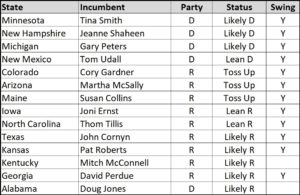
While the battle to control the Senate in 2020 is separately important, these statewide races have considerable impact on the Presidential race.  Not only do 13 of the 18 states that are in-play for the Presidential election also have Senate elections in 2020, a good set of Senate candidates across the board creates an enormous amount of synergy.  Even if the Senate candidate loses, a strong Senate campaign can still help the top of the ticket by forcing Republicans to divert resources.  This is still very much a work-in-progress (and a future blog topic).  In my perfect world, I do see a few Democrats that could mount strong 2020 challenges to incumbent Republican Senators:

  • Beto O’Rourke against John Cornyn (R-TX)
  • John Hickenlooper against Cory Gardner (R-CO)
  • Mark Kelly against Martha McSally (R-AZ)
  • Stacey Abrams against David Perdue (R-GA)
  • Tom Vilsack against Joni Ernst (R-IA)
  • Susan Rice against Susan Collins (R-ME)
  • Amy McGrath against Mitch McConnell (R-KY)

Some of these would be SO much fun to watch!

The Florida Strategy

Florida Democrats struggled in 2018 despite a nationwide trend in the other direction.  While Trump’s immigration policies have alienated many Hispanic voters in Florida, they still didn’t turn out in large numbers for Democrats.  That could change, but probably not by 2020.  Florida’s trend toward a more diverse and younger electorate also won’t happen anytime soon.  The right 2020 ticket might be competitive here, but even that would eat up resources.  There are no other 2020 statewide races in Florida and it is a massively expensive state in which to conduct a statewide campaign.  The risk/reward ratio just isn’t promising.

Given the large number of Electoral votes in Florida, candidates always want to focus here.  However, from a purely numbers perspective, the best 2020 Florida strategy may be to write it off.

Bottom Lines

To beat Trump in the Electoral College, the best strategies are The Middle America Strategy, The Old White Establishment Male Strategy, and The Military Strategy.  The top of the ticket must be able to successfully execute at least one of them.

For the VP spot, I’d suggest a wait-and-see approach.  My first instinct would be to stack the ticket with a VP that can execute one of the other three cornerstone strategies.  However, if a strong candidate using one of the other strategies emerges from the primary pack, then they should be the choice.

None of this will initially thrill young and/or progressive Democrats, but the numbers are the numbers.  Democrats need the win.  No agenda across the entire Democratic political spectrum has any chance of success under another four years of Trump.

National Emergency

I’ve spent considerable time looking into Trump’s “national emergency.”  As a U.S. citizen, I am now genuinely appalled and frightened.  I’m also quite disappointed that the media has largely missed the big picture here.  I guess that’s why I have a blog.

As everyone is now aware, Trump has decided to declare a national emergency to build his wall – ignoring the will of the American majority and the compromise immigration measure passed by both the Senate and the House.  There have since been no shortage of pundits weighing in from all sides with respect to the legality, advisability, and impact of such a declaration.  Again, they’ve mostly buried the lede.

I personally decided that I needed to search online for the appropriate laws so that I could read the original texts of the various national emergency statutes being cited.  Frankly, I’m now rather sorry that I did.  Not only could you easily fit a blue whale down this particular rabbit hole, I sincerely had no idea that anything approaching this was actually a law – or, more accurately, a massive matrix of laws.

Allow me to briefly summarize how this works.

The 1976 National Emergencies Act (NEA) gives any President the power to declare a national emergency while providing no guidelines as to what actually constitutes a national emergency.  It’s an emergency simply because a President says it is.  The authors of this brilliant piece of legislation did include a “check-and-balance” that allows Congress to override such a declaration by a simple majority vote in both the House and Senate.  However, they forgot that the override legislation itself was subject to a Presidential veto – which would then require a 2/3 vote in both chambers to override.  Seriously, they forgot.  Idiots.  The NEA also sunsets any national emergency declaration but, since it can just be declared again, the sunset is functionally useless.

Thus, in practice, a President could declare that a shortage of golf balls is an open-ended national emergency and it would take a 2/3 vote in both the House and the Senate to reverse it.  Dandy.

Once a President makes a functionally unilateral declaration of a national emergency, a plethora of completely separate laws can then be easily invoked that give the President a massive amount of unchecked power.  While the NEA does requires that the President list the various statutes granting the powers being invoked, it doesn’t require any defense of that invocation.  The President can just say “That one and that one.”

If you want a cold chill running up your spine, here’s a helpful list from the Brennan Center for Justice that summarizes 123 such powers – and that list appears to be incomplete.  The laws themselves can be very tough reads and tend to be quite vague – because vague is obviously what you want when you’re defining emergency executive powers.

Trump’s national emergency declaration is the 59th since 1976.  Previous declarations have included George W. Bush’s declaration in the wake of 9/11 and Barack Obama’s declaration during the H1N1 pandemic.  The vast majority of declarations have been used to simply impose sanctions on foreign entities.  Trump’s declaration, however, is the very first time the act has been used to override the explicit wishes of Congress.

The problem is that all of this seems to be completely legal.  Congress has abdicated many of their powers to any President that simply wants them.  It’s just that easy.  While previous Presidents of both parties have shown self-restraint in the use of national emergency declarations, the current office holder has no such inhibitions.  I’m only surprised that Trump and his staff haven’t yet grabbed even more power.  In the current political environment, I see few presidential acts that would incur the necessary 2/3 vote in both chambers of Congress to stop him.

Here’s just a few of the many powers that a President can claim after declaring a national emergency:

  • Redirect military construction funds
  • Suspend any part of the Clean Air Act
  • Prohibit or limit the export of crude oil or any agricultural good
  • Waive confidentiality requirements for public health services
  • Suspend prohibitions on chemical weapons and toxic waste disposal
  • Allow testing of biological and chemical agents on unwitting human subjects
  • Do pretty much anything to the Capitol grounds and structures
  • Take control of any airport that used to be on federally-owned land (including Austin’s airport)
  • Take possession of any privately owned vessel in U.S. waters
  • Assume broad authority to regulate all commercial transactions
  • Prohibit all economic transactions with any person, including a U.S. citizen
  • Order any unit or member of the Ready Reserve to active duty for up to two years
  • Keep people in military service without their consent
  • Appoint anyone to the rank of major general or rear admiral
  • Prosecute anyone that the government has “reason to believe” may obstruct defense activities
  • Deploy federal troops within the U.S. to put down an “insurrection”, as defined by the President
  • Grant and revoke broadcast station licenses
  • Assume control over all U.S. Internet traffic

At least a few of the above should evoke fear from everyone of any political persuasion.

The emergency construction authority cited by Trump to fund his wall allows him to redirect any budgeted military construction funds that aren’t already under contract.  While the new usage vaguely “requires the use of the armed forces,” that’s likely an easy bar to reach given that Trump has already deployed thousands of troops to our southern border.

There’s about $21 billion in unobligated military construction funds that Trump could tap.  Most of that money was allocated just last fall for DoD installations in 38 states and at least 14 overseas locations.  There’s a ton of projects, including numerous barracks, shipyards, runways, control towers, garages, etc., but here’s just few of the big ticket items:

  • Hospital construction in Landstuhl, Germany
  • Vehicle maintenance shop at Camp Arifjan, Kuwait
  • On-base schools in Japan and Germany
  • Family housing stateside and overseas
  • On-base school at Fort Campbell, Kentucky
  • F-35 hangars at Luke Air Force Base, Arizona and Camp Pendleton, California
  • Drydock repairs at Pearl Harbor, Hawaii
  • Special ops training facility in North Carolina
  • Training centers in Georgia and Florida

Note that all of the above have gone through a rigorous appropriations process and have been deemed by the DoD to be essential to force readiness.  For example, Landstuhl is the nearest treatment center for wounded soldiers coming from Iraq and Afghanistan.  And the Senate just last week heard horror stories from military families about the sorry state of housing in some areas.  If Trump steals hard-won construction money to please his political base, it’s not like the original military needs will simply go away.  The DoD will have to go back to Congress to replace the money in the next budget cycle.  In the meantime, the military will suffer.

My presumption is that Team Trump will cherry-pick projects in solidly Democratic states and will try to avoid projects in states with Republican Senators and in districts with Republican Representatives.  Thus, the Kentucky school is likely safe; the F-35 hanger in California is doubtful.  There’s simply no one to stop Trump from using his declaration for political benefit.  He can and he will.

A few Democrats seem to think there’s a legal battle to be won to overturn the declaration.  Some are hanging their hopes on a 1952 Supreme Court ruling that overrode a Truman emergency declaration.  However, that decision was reached prior to the passage of the NEA.  Yes, the fact that Trump took Air Force One for a golfing trip to Mar-A-Lago immediately after his emergency declaration tells us that this was a purely political emergency.  And, yes, Trump even admitted that “I didn’t need to do this.”  None of that is relevant.  Congress passed these laws and it’s not the court’s job to protect Congress from itself.

A few Republicans have expressed trepidation, but most of them don’t want to challenge Trump.  There’s certainly plenty of Republican votes to block any effort to overturn the declaration.  These Republicans are essentially saying that the Legislative branch is impotent if the Executive branch decides to flex its muscles.  So much for the Constitutional separation of powers.

Republicans are making a couple of huge political mistakes as well.

A vote to re-purpose military funds for the wall will be tough to defend in the next election cycle.  DoD MILCON budgets are a joke if they can be used as a presidential slush fund at the stroke of a pen.  Force readiness isn’t a political football.  And screw with military families at your own risk.

More politically important, though, an eventual Democratic successor to Trump will have a solid precedent upon which to declare gun violence or climate change to be a national emergency.  While those wouldn’t be any more reasonable than Trump’s declaration, they’d be just as legal.

Yes.  We most certainly do have a national emergency.  It’s just not the one that Trump declared.