Indictment

The Orange Guy was indicted today by a federal grand jury on four felony counts of conspiracy and obstruction related to his attempts to overturn the 2020 election results.

I’m getting on a plane in a few hours and don’t have the time to read the full indictment beforehand.  Thus, I’ll take the 45-page indictment with me as my travel entertainment.

I had planned to listen to a few NPR podcast episodes of “Wait, Wait, … Don’t Tell Me!” on the plane, but the indictment should be just as interesting.

For those of you who may not follow WWDTM (and I highly recommend it), it’s a smart comedic take on real news where you can test your news IQ against the panelists.  A recurring bit relays three news stories – none of which seems at all likely to be real.  Listeners try to pick the one weird story that is actually real news.

A former President of the United States has just been indicted for attempting a coup.

A few short years ago, I’d have never picked that as the true story.

Military Promotions

Unfortunately, I started this post quite a while back.  Since February, Sen. Tommy Tuberville (R-AL) has been single-handedly blocking all senior military promotions.

The details of the “senatorial hold” that Tuberville is using aren’t all that important.  Suffice it to say that the rules of the Senate give enormous power to every individual Senator – power that is seldom used by either party and power that has NEVER been used to block the historically bipartisan approvals of senior military promotions as requested by the Pentagon.

Tuberville disagrees with the military’s policy of granting leave and covering travel expenses for military personnel who cannot legally obtain an abortion in the state where they are stationed.  He strongly opposes abortion under any circumstances.  Others of us strongly believe that government should play no role in restricting a woman’s right to control her own body.  The Supreme Court weighed in to make it a state-level issue and, regardless of how either side feels about that decision, that’s the law.

The problem is that military personnel can’t control where they and their families are stationed.

My father was a career Army officer who served in WWII and in Korea.  As an Army Brat (using the term we proudly use to describe ourselves), I always understood that my family and I were as much in the Army as my father.  While we received benefits from that service, they came with obligations and sacrifices.  We moved often; sometimes to wonderful places, sometimes to places not so wonderful.  We moved where we were told.  Are military personnel to be penalized for being where they are told to be?

Beyond the political arguments, however, is the damage that is being done to the military.  There are currently over 270 personnel actions being blocked by Tuberville and numerous senior posts are unfilled.  For example, we don’t have a Marine Commandant, a member of the Joint Chiefs of Staff, for the first time since the Civil War.  Soon, we won’t have a Chairman of the Joint Chiefs.  Less experienced personnel are being forced to assume the duties of senior positions.  Military readiness is suffering, and military lives are being used to score political points.

Promotions are often necessary for personnel to assume certain leadership posts and those moves are also on hold.  Importantly, their family’s lives are on hold as well.  The military tries to move personnel between school years so as to not disrupt their children’s education.  So much for that.  A man who never served a day in the military is comfortable screwing over military personnel and their families for a political stunt.  There is simply no excuse for this crap.

So, what can be done?  Well, not much.  Procedural tools to get around Tuberville do exist, but they simply aren’t practical.

Alternatively, here’s a thought.

President Biden just this week reversed a decision made in the previous administration that would have moved the U.S. Space Command Headquarters to Huntsville, Alabama from its current location in Colorado Springs, Colorado.

Tuberville is, of course, positively apoplectic about the decision to deprive his state of the HQ.  While I truly believe that keeping Space Command in Colorado was independently the correct choice, I’ll admit to being awash in schadenfreude… and I think we should take things even further.

Huntsville is currently the home of the Army’s Redstone Arsenal.  It includes the Army’s Space and Missile Defense Command, which falls under Space Command.  It’s also the place where the U.S. dumped a ton of WWII chemical agents (both Allied and Axis), and considerable groundwater and soil contamination is still a problem.

So, I propose that Space Command leaves the contaminated base to Alabama and moves the Redstone Arsenal to Fort Carson, Colorado.  That puts it in close proximity to Peterson Space Force Base – the home of Space Command.  It also means that Army personnel at the relocated Redstone Arsenal would then be subject to Colorado law.

Let’s see how Alabama likes losing the money that comes with hosting a major military base.  Maybe they can influence their Senator.

Nuclear Dreams

“And remember, Florida’s easier than other places. You have the ocean and you have the sun. There’s something about that that works. But — you have the sun, too, but you don’t have the ocean. I can tell. You definitely don’t have the ocean. Maybe someday you’ll have the ocean, you never know.”

– The Orange Guy, Las Vegas, July ’23

OMG.  So THAT’S why he wants the nuclear codes!

The OG has long fancied himself as a real estate baron and now he thinks he’s Lex Luthor from the 1978 movie “Superman”.  The film’s plot centers around Luther buying a ton of desert land around Las Vegas before detonating an atomic bomb to reopen the San Andreas fault – plunging California into the ocean and making his property the new oceanfront.

Unfortunately for the Orange Guy, only his weight comes close to matching Luthor’s IQ.

TX AG Impeachment Rules

I finally finished reading the rules that were recently adopted by the Texas Senate for its impeachment trial of (suspended) Texas Attorney General Ken Paxton.  It’s a largely boring mixed bag.

I will give some credit to the Texas Senate rules committee for defining something that at least has the potential to be a real and moderately fair trial.  However, there are a few too many rules that could be easily abused.  Here’s my take on the most interesting ones:

  • Sen. Angela Paxton:  Angela Paxton, Ken Paxton’s wife, is also a sitting Texas Senator.  This unusual scenario was never going to be easy to resolve and it’s the one that’s been getting the most press.  The rules do forbid her from voting and from participating in deliberations during the trial.  That’s good.  However, the rules also pre-enter her vote as “Present” … which counts towards the total number of votes cast.  In essence, her “Present” vote will require 21 “Yes” votes to convict as opposed to 20.  That’s bad.  On the other hand, Angela Paxton is a duly-elected Senator.  Completely removing her from the impeachment process could be unconstitutional.  On this issue, I’ll give the rules committee a pass for finding a solution that pissed off everyone.
  • Senators as Witnesses:  Although at least one other Senator is a likely material witness against Paxton, the rules allow any Senator to simply refuse to testify at the impeachment trial.  Although I understand the inherent conflict between being both a witness and a juror, putting Senators above the law seems patently wrong.
  • Set Asides:  The rules immediately set aside four of the 20 articles of impeachment – mostly related to Paxton’s pending securities fraud case – and those articles won’t even be considered at the impeachment trial.  The rules say the Senate can come back to these articles later.  They won’t.
  • Motions to Dismiss:  The rules allow the Senate to simply dismiss any article of impeachment pre-trial, without debate, by a simple majority vote.  That’s complete crap.  Hopefully, the Senate will deny all motions to blindly dismiss any of the charges and will at least hear the facts of the case.
  • Private Deliberations:  While both sides will present their cases in public and all votes will be held in public, the Senate deliberations will be private.  I’d prefer that everything be open to the public, but I can appreciate an attempt to limit the political posturing that would result from open deliberations.
  • Lt. Gov. Dan Patrick:  The rules give the presiding officer a WHOLE LOT of unilateral, unchecked power.  Also, while the rules give Republican Lt. Gov. Dan Patrick the power to appoint an independent presiding officer (as he should), they also give him the power to appoint himself to that position.  Show of hands:  Who thinks that Patrick will willing give up power?
  • Paxton’s Post-Conviction Future:  If convicted on any article, Paxton will be removed as Attorney General.  However, the rules then require a separate vote to consider disqualifying Paxton from holding any future state office.  If overwhelming evidence forces a given Republican Senator to vote for conviction, a parallel vote against disqualification could provide some political cover.
  • Trial Timing:  The rules pushed the trial’s start date to September 5 from the August 28 date set by the House.  The Senate’s change is meaningless except as a giant middle finger to the House.  Nice start.

2024 House, Take 2

Since I already took an early – and rather depressing – look at the 2024 Senate races, I thought I’d next take a swing at the House. The analysis is much tougher on this side of the Hill, but the potential outcome seems a tad brighter for Democrats.

There are 435 voting representatives in the House.  By my count, due both to political polarization and partisan gerrymandering, 356 of those seats are currently party locked.  Bozo the Clown would win a general election for any of these seats if he had the appropriate (R) or (D) after his name.  Hence, the resident circus in Washington, DC.  That leaves only 79 seats that “could” be competitive in a given election cycle – which is sadly only about 18% of the House.

The current party split in the House is 222 Republicans and 212 Democrats (with one open seat in a solidly Democratic district).  To win control of the House in 2024, Democrats will need to net 5 additional seats.  While that outcome is certainly not a slam-dunk, it currently seems quite doable.

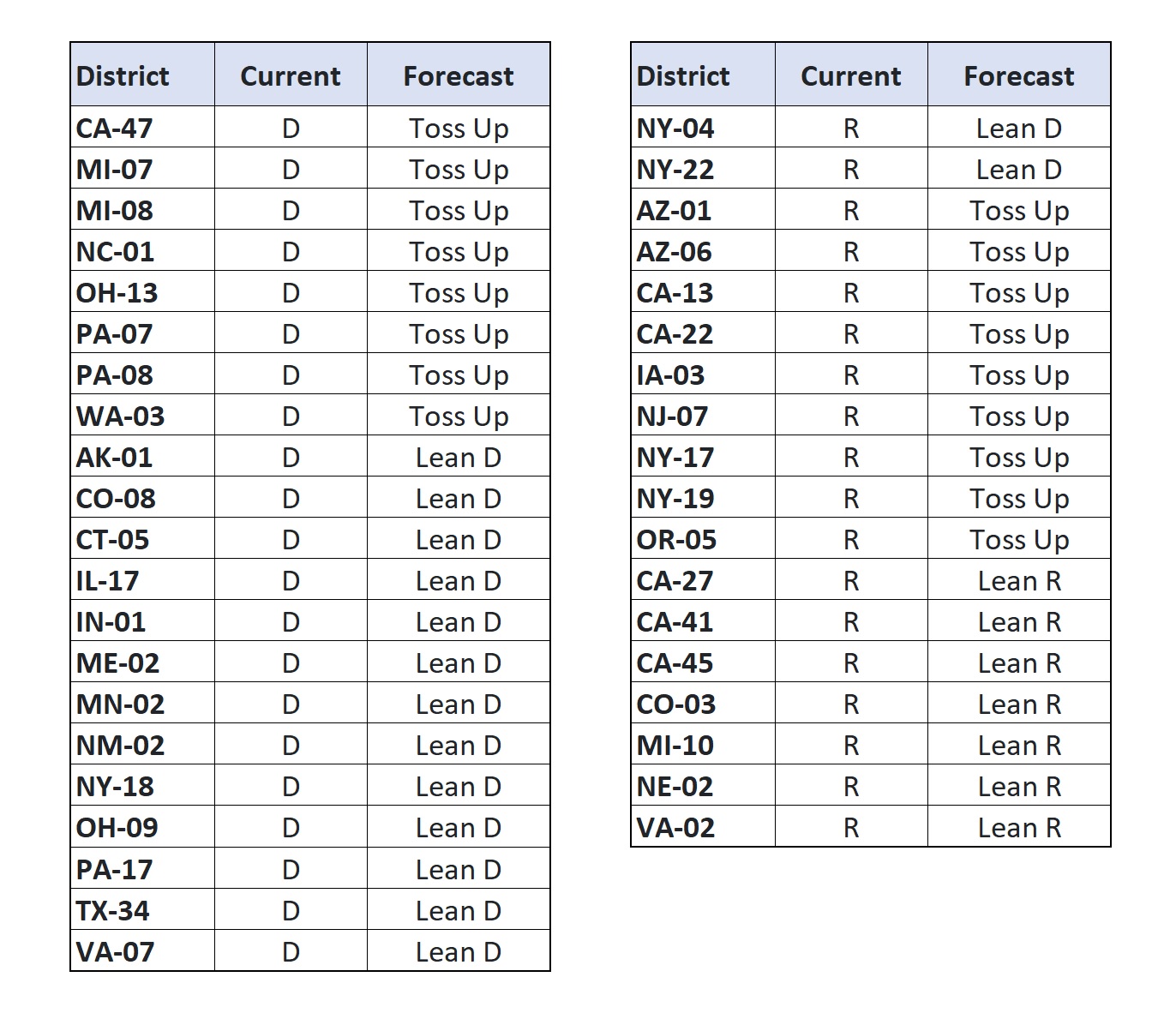
Below is an initial summary of my 2024 analysis of the competitive races in the U.S. House.  At the moment, the analysis is based on:

  • the DCCC’s list of D frontline seats that the party thinks could use the strongest defense (meaning $)
  • the DCCC’s list of R target seats (meaning $)
  • the NRCC’s list of D target seats (meaning $)
  • the number of elections won by the incumbent (or 0 for an open seat)
  • the margin of victory of the incumbent in 2022
  • weighted third-party analyses
  • whether or not the district was a crossover in 2022 (where the district voted for the opposite party in the 2020 presidential election)
  • miscellaneous race-specific considerations

In these elections, candidates will matter.  Once all of the match-ups are set, the priorities below may well change – particularly where we have decent polling data.  If I can easily get my hands on campaign financing data, I’ll also add in that consideration.

Redistricting Notes:

  • New York Democrats screwed themselves in 2022, with a favorable redistricting tossed out on procedural grounds.  It’s possible that map could be revived in time for the upcoming election – giving NY Democrats better odds all around.  However, since the old map still stands for now, that’s what I’m considering.
  • The recent (and surprising) 5-4 Supreme Court decision tossing out the racially-biased Alabama district map will force the state to redraw their map in a manner that will likely favor Democrats in two districts instead of one.  However, since the districts aren’t yet redrawn, it’s not currently considered.  While the SCOTUS decision could also impact maps in LA, AR, FL, GA, SC, NC, & TX, it’s questionable whether any other state maps could be tossed and redrawn in time for the upcoming election.  Thus, they are not currently considered.

I’ve assigned five Democratic priority levels to the 79 non-locked races.  The most important are the first two, which together include 26 critical races.

  • Priority 1:  13 current D seats that need the most protection. This set includes two open seats, seats where the Democrat won by 3% or less, and seats that are vulnerable for some other race-specific reason. 4 of the 13 are crossover seats – in districts that Biden lost in 2020.
  • Priority 2:  13 current R seats that are the most likely to flip.  This set includes seats where the Democrat lost by 2% or less and seats that are vulnerable for some other race-specific reason.  10 of the 13 are crossover seats – in districts that Biden won in 2020.  

Again, Democrats need to net 5 additional seats to take control of the House – and party flips are most likely to occur in the 26 races above.  If Democrats lose any Priority 1 seats, they’ll need to make it up in additional Priority 2 seats.

For completeness, my other three priority groups are as follows:

  • Priority 3:  17 current D seats that could use some protection.  This set can’t be ignored, but they are fairly safe D seats.  None of them are crossover seats.
  • Priority 4:  8 current R seats that could possibly flip.  If the Priority 2 pickups are looking good, this is the next set of targets.  5 of the 8 are crossover seats.
  • Priority 5:  28 seats (13 D, 15 R) that are other races to watch, but not obsess over.  It’s possible that these seats could flip to the opposing party, but they are likely to remain as they are.

As things progress, I’ll be updating this summary and changing priorities as appropriate.  If anyone’s interested, I may also post a deeper dive into the underlying analytics.

OG Thoughts

I keep getting asked why I’ve been silent about the Orange Guy’s federal indictment.  If I had anything new or clever to add to the conversation, I’d certainly speak up.  However, I can’t do much more than repeat what everyone already knows:

Yes, the indictment is more than damning.  But we already knew that he purposely took classified national security documents to his home and refused to return them when asked multiple times by various authorities.  He repeatedly admitted those facts in televised interviews.  That’s the prosecution’s case.  Period.  He himself signed the law that made such acts felonies and his own administration successfully prosecuted Espionage Act cases with those exact same facts.  The associated conspiracy, perjury, and obstruction charges also look provable, but the basic case is simply undeniable.  He’s guilty.

Yes, there is now a criminal case against him in federal court.  But it will drag on for a very long time – well past the 2024 elections. The judge running the show is the same judge that genuflected to him with respect to the documents retrieved via a valid search warrant.  It took a higher GOP-led court to definitively overrule her legally baseless decisions.  Once again, though, she’ll bend the law as much as she possibly can to try to help out.

No, the indictment didn’t hurt him with his base.  In fact, it helped.  Of course it did.  A slam dunk case for felony prosecution under the Espionage Act is now the center issue of his political campaign.  His cult is stronger than ever.

No, the indictment didn’t hurt him with many other Republican politicians.  In fact, it helped.  Of course it did.  Afraid of alienating OG’s base, people that know better are contorting themselves to ignore the facts and kiss his ass.  So much for the party of law and order.

Most of you have noticed that I haven’t used the Orange Guy’s name on this blog for over a year.  I’ll also note that the initial usage of OG was as an abbreviation of Original Gangster – which seems wildly appropriate for my usage.

My reason for avoiding the use of his name?  I’m just tired of hearing it.  So, so tired.  OG wants to be the center of attention and I’m loathe to contribute at all to that desire.  I’ll continue to reference OG herein as an unavoidable political construct, but I have no use at all for the individual.

To others who are still wasting their oxygen, might I suggest…

Stop it.  Just stop.  Stop.  STOP.  Just.  Stop.

2024 Senate, Take 2

It’s still way too early to make bold predictions with respect to the 2024 Senate races, but since I follow this stuff, I thought I’d share.

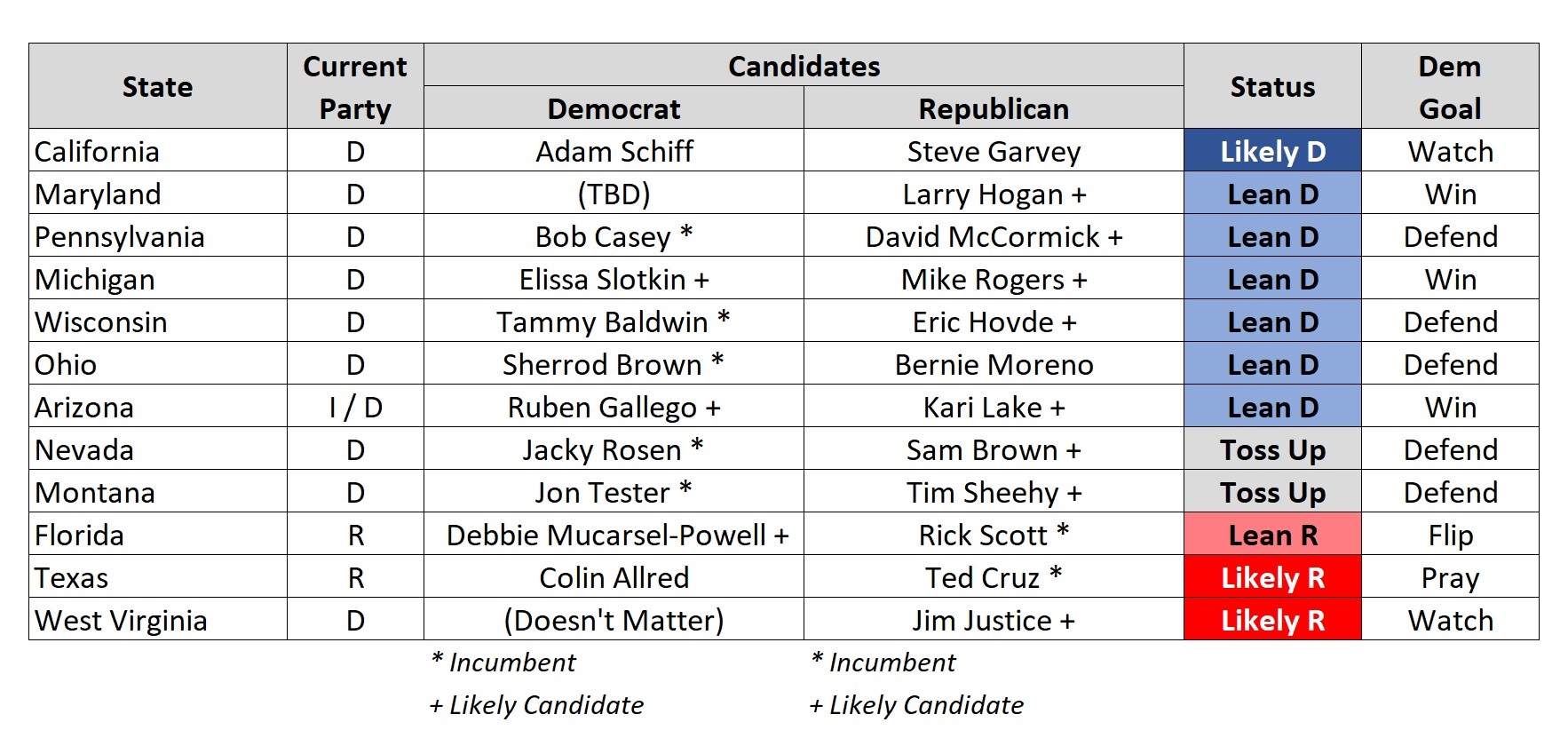
Of the 34 Senate seats up for election in 2024, I now count 12 seats that could possibly flip parties.  Of course, we’re still 8 months from the start of primary season and 1.5 years away from the general election.  Candidates matter, we don’t yet have a clear picture who will be running against who, and we don’t yet know what national issues will be center stage.  All that said, here’s my snapshot of the dozen races that I’m following:

The above table is sorted by the likelihood that the seat will be held by a Democrat in 2024.  I’ll first take a brief look at each state and then talk about the math and election strategies.

  • Maryland:  While MA will be a long shot for Republicans, it will be an open seat – which makes it in-play.  If popular Republican Gov. Larry Hogan changes his mind and runs, he’d likely be the immediate favorite.  Luckily for Democrats, Logan says he’s not interested in the Senate.  Democrats have tons of possible candidates – one of whom will win the general election unless an ugly primary turns off voters.  And we should never underestimate the ability of Democrats to screw themselves.
  • California:  As with MA, this will be an open seat in a blue state which Democrats could fumble.  In CA, all candidates run in a single “jungle” primary where the top two advance to the general election.  Democrats currently have three good candidates who all want to move up from the U.S. House – Adam Schiff, Katie Porter, and Barbara Lee.  Gov. Gavin Newsom might also run.  The only “name” possibility at the moment on the GOP side is Steve Garvey – the former first baseman for the LA Dodgers and San Diego Padres.  If the GOP could find two decent candidates to split the R votes while four or more Democrats split the D votes, it is conceivable that two Republicans could face off in the general election.  While it’s very unlikely that Democrats lose this seat, the jungle primary at least puts it on my watch list.
  • Wisconsin:  Current Democratic Sen. Tammy Baldwin is popular in WI but this purple state is never a sure thing.  The good news for Democrats is that there’s not an obvious Republican candidate to challenge her and the GOP primary is likely to be ugly.
  • Michigan:  This will be an open seat in a purple state.  U.S. Rep Elissa Slotkin is the likely Democratic candidate but a favorite has yet to emerge on the GOP side.  At this point, Slotkin’s fundraising abilities and an almost clear primary field make this her race to lose.
  • Pennsylvania:  Current Democratic Sen. Bob Casey is well-liked in PA and should win re-election.  However, the likely Republican nominee, David McCormick, is a former Army Ranger and hedge-fund CEO who will put up a good, well-funded fight.
  • Nevada:  First-term Democratic Sen. Jacky Rosen is in for a tough re-election contest in a purple state.  Republicans haven’t settled on a challenger yet, and Rosen could get lucky and draw a far-right nut job (e.g. Jim Marchant).  However, if Republicans nominate someone sane (e.g. former NV Sen. Dean Heller), they have a decent chance of beating Rosen.
  • Ohio:  Current Democratic Sen. Sherrod Brown has been the rare Democrat to win state-wide in red-leaning Ohio over the last decade.  Brown is popular in OH but a good GOP candidate would make this a competitive race.  As of yet, however, no Republican has yet risen to be the favorite to challenge Brown.
  • Arizona:  Once again, AZ will be very weird.  Current Independent Sen. Kyrsten Sinema was elected as a Democrat but bolted the party in 2022.  She still caucuses with Democrats (currently giving them a Senate majority) but she’d run in 2024 without the Democratic party’s backing.  She’s filed the necessary paperwork to run, but hasn’t yet declared her candidacy.  In any case, Democrats will run their own candidate – likely Ruben Gallego.  Republicans, on the other hand, have an asylum full of potential candidates (Kari Lake, Blake Masters, Andy Biggs, etc.) who would be entertaining if they weren’t so dangerous.  Sinema & Gallego could, unfortunately, split the D vote enough to swing the election to whatever Republican wins the primary.
  • Montana:  Current Democratic Sen. Jon Tester has survived since 2007 in deep-red Montana.  Since this is a home-state race for the GOP Senate campaign chair, it’ll get a lot of national party attention.  Tester’s brand is formidable but a lot will depend on who the GOP picks to challenge him in 2024.  Possibly the most worrisome possible opponent for Tester is retired Navy SEAL Tim Sheehy – who is wealthy enough to self-fund his campaign and who doesn’t come off as a far-right idiot.
  • West Virginia:  Current Democratic Sen. Joe Manchin has yet to declare for 2024.  If he doesn’t run, this seat is a safe R pickup.  Even if he does run, he’ll have a very tough re-election battle against likely GOP candidate Gov. Jim Justice.  Both men are popular in WV but the state is solid red.  While Manchin’s had surprise wins before, a repeat has to be considered a long-shot.
  • Texas:  As a Texan, I’d dearly love to declare the race against current Republican Sen. Ted Cruz as winnable by Democrats but, barring a miracle, it’s just not.  TX Democrats can’t even settle on a nominee.  U.S. Rep. Colin Allred is the likely candidate but state Sen. Roland Gutierrez will battle him to see who would lose to Cruz by the smallest margin.  Dandy.  Don’t get me wrong.  I’ll be writing a check to whoever wins the Democratic primary.  I’m just not holding my breath.
  • Florida:  Current Republican Sen. Rick Scott isn’t particularly well liked nor is he a particularly talented politician.  However, Scott is rich, he is the incumbent in an increasingly red state, and Democrats don’t really have a good candidate to run against him.  Boo.

Unfortunately,, the landscape has gotten worse for Democrats since my December weigh-in.  10 of the 12 seats above are currently part of the slim Democratic Senate majority.  Worse, the two seats held by Republican are very unlikely to flip.  Ouch.

To maintain their current Senate majority, Democrats need to defend 6 seats that are seriously at risk while winning 2 races with new candidates.  That’s 8 states where the national party will need to spend time and money.  They “could” lose one of the 8 seats if Democrats retain the White House in 2024, but even 7 wins is a very tough ask.  To make matter worse, Sen. Steve Daines (R-MT) appears to building a much more competent GOP Senate campaign organization than Sen. Rick Scott (R-FL) did in 2022.

While Democrats do need to make sure they don’t shoot themselves in the foot in MA and CA, there’s little reason to waste a ton of money in those states.  Likewise, while TX and FL would be really nice to win, Democrats simply can’t afford to throw money at two very expensive states unless the Democratic candidates can independently prove their races to be competitive.

My advice to Senate Democrats?  Confirm as many judges as you can now.  The odds of you retaining control of the Senate aren’t good.

AG Me With A Spoon

Being a Texan, I’ve been asked for my thoughts on Ken Paxton – our recently impeached and currently suspended Attorney General.

Well, he’s a dishonest, immoral, narcissistic jackass.

Clear enough?

But, okay, I’ll elaborate just a bit.

Paxton has been the TX AG since 2015 and was federally indicted that same year for obvious securities fraud in a case that has still not gone to trial due to Paxton’s delaying tactics.  However, despite his legal and moral issues, Paxton twice won re-election.  In 2018, Paxton’s opponent was Democrat Justin Nelson – a well-respected Professor of Constitutional Law at the UT Law School and a former clerk for U.S. Supreme Court Justice Sandra Day O’Connor.  Paxton, however, had a (R) after his name and, in Texas, that was good enough to secure a win.  Go figure.

While Paxton has been a reliable GOP attack dog, he has embarrassed our state for bringing excessively blatant partisan politics to an office that should be the chief legal officer for all of Texas.  While that partisanship wasn’t illegal, numerous other actions were.  The 20 impeachment counts included misuse of public resources, bribery, obstruction of justice, falsifying official records, conspiracy, and dereliction of duty.  These were not minor charges.

While his guilt is frankly not in question, I was actually quite surprised by the overwhelming vote in the GOP-controlled Texas House on the 20 impeachment counts.  Approximately 2/3 of the Republicans in the House voted with all of the Democrats to produce a 121-23 landslide in favor of the impeachment resolution.  Even the GOP members of the House who spoke against the resolution focused mostly on process issues and on Paxton’s conservative bona fides.  They seldom suggested that he was actually innocent of the charges.

Unlike impeachment at the federal level, Paxton was immediately suspended from his office pending a trial in the Texas Senate.

The Senate will vote on the rules for that trial on June 20.  These rules will be extremely important as they will draw the trial boundaries for evidence, testimony, and participation.  It remains to be seen how the rules will address such issues as possible conflicts of interest – including one State Senator who happens to be married to Paxton (!) and another State Senator who is a likely material witness.  Unfortunately, the Senate committee charged with drafting the rules has a 5-2 GOP tilt and is led by a known Paxton ally.  Fairness is not guaranteed.

The trial itself is scheduled to start on or before August 28.  And it will be interesting.

There are only 31 members of the Texas Senate – 19 Republicans and 12 Democrats – with a 2/3 majority required to convict Paxton and permanently remove him from office.  Assuming that all State Senators vote (and it’s unlikely that the rules will demand any recusals), 9 Republicans would need to join all of the Democrats to reach the 21-vote threshold for conviction.  That’s a high bar.

The State Senate’s verdict will sadly have little to do with the facts of the case.  As noted, there’s really no question that Paxton is guilty of most if not all of the impeachment counts and just one count would be quite sufficient for a conviction.

The problem is that the trial will not be conducted in a court of law.  It will be conducted in a court of politicians and the verdict will boil down to a purely political calculation on the part of the 19 Republican State Senators.

While Paxton isn’t particularly well-liked by many of his GOP brethren, even his detractors recognize his political leverage.  He already has the solid support of a few Texas Senators who would vote to acquit him right now with zero regard for any evidence that might be presented at the trial.  The remainder will have the cover of vocal support for Paxton from both U.S. Senator Ted Cruz (R) and the Orange Guy.

So, is there any chance of a conviction?  My Magic 8 Ball currently says, “Reply hazy, try again.”

It is unlikely that many Republican State Senators would dare vote to convict Paxton unless they were absolutely sure that he would be convicted.  If Paxton is returned to office, having a sitting AG as an enemy could be a political death sentence.  Paxton would make their lives miserable in the Texas Senate and he’d back their opponents in their next primary election.

The best chance we have to get rid of Paxton is if the trial drives public opinion so far against him that enough Republican State Senators will be more worried about voter backlash than about Paxton’s possible revenge.  That, however, implies that the rules committee defines a fair trial structure, that the case is perfectly presented as a slam-dunk for conviction, and that the public actually pays attention to the trial.

Hmm.  On a second reading, my Magic 8 Ball now says, “Outlook not so good.”

Strange World

In the latest of a long list of Florida vs. Disney stories, here’s a new one that’s unrelated to the Disney World drama.  A fifth-grade teacher in Florida is now being investigated by the FL Department of Education for showing a Disney movie to her class.

The movie in question is “Strange World” – an animated film about a family of explorers and some friends working through some interpersonal issues that threaten to derail their latest adventure.  The journey leads to lessons about the environment and the acceptance of others.  Standard Disney stuff.   But the film does feature a gay character – which, in Florida, is apparently much more problematic than school shootings.

It’s important to note that the film does not have the gay character bending another character over a rock.  The film, in fact, doesn’t highlight the gay relationship at all.  It’s not a plot point.  It’s just part of the story and I’m confident that the 10-year-olds in the class didn’t give that aspect a second thought until some adult made it an issue.

One could certainly argue that showing a 1-hour and 42-minute movie to a classroom of kids is a tad lazy.  The teacher claims the movie was shown as a “brain break” but it admittedly does scream: “Hey, I ran out of ideas.”

One could further argue that showing a bad movie was an even worse decision. “Strange World” lost $100M at the box office for good reason.  It’s nowhere near Disney’s best work and only gets a rating of 5.6 out of 10 on IMDB.  Ouch.

However, arguing that a teacher should be fired solely for showing a movie that happens to have a gay character seems to be massive overkill.

The school board member who initiated the investigation – and who has also been very active with book bans – said in a board meeting that such films “assist teachers in opening the door for conversations.”  Well, we can’t have that!  Conversations?  In a classroom?

Does Florida’s “Don’t Say Gay” bill really go this far?  Is Jane Austen’s “Pride and Prejudice” now banned from Florida schools as well?  It’s not a major plot point, but if you don’t think that Charlotte Lucas is a closet lesbian, I invite you to re-read the original work.

Today’s 10-year-olds are massively more aware of the world than I was at that age.  I didn’t have the internet.  I had three TV networks available until about 10pm on one family console TV and we made only rare family trips to the movie theater.  Still, I wasn’t an idiot about how the world worked.  My favorite cartoon at that age was “Roadrunner” and I enjoyed watching him consistently outsmart Wile E. Coyote – despite the latter’s extensive ability to have anything and everything immediately delivered to his cave by Acme.  [Hey… shouldn’t Jeff Bezos be paying Warner Brothers a royalty for that idea?]

I laughed every single time that the coyote raised his tiny parasol to protect himself from a large falling boulder.  While I always found the episodes to be very entertaining, I never once forgot – even before the age of 10 – that it was JUST A FUCKING CARTOON.  Well, okay, that’s an adult’s interpretation of a child’s reaction – but you get the idea.  I knew that no amount of boulders or explosives would kill the cartoon coyote and I didn’t think for a moment that the real world worked like that.  I didn’t give a damn about the social implications of hunger nor about the predator vs. prey dynamic nor about the bending of the laws of physics nor about the sex lives of the characters nor about how the hell the coyote managed to pay for all the Acme stuff.  It was just a cartoon.

Can we please just let kids be kids and, if they do have questions, try to give them reasonable answers that are appropriate for both their age and IQ?

I’m really tired of this crap.

A Douche Debate

A friend just texted me about a Florida woman who was arrested on Tuesday for throwing wine at Rep. Matt Gaetz (R-FL).  This is now the second time that Gaetz has been the public target of projectile liquids.

While I admittedly find both incidents quite humorous, I’m frankly torn with respect to the appropriateness of such actions.

On the one hand, I do have to acknowledge the obvious frustration that some Florida residents must feel being represented by someone a reprehensible as Matt Gaetz.  One could certainly argue that a symbolic cleansing was appropriate.

On the other hand, though, I find it rather difficult to accept such an obvious waste of good drinks.