Sen. Diane Feinstein

The long absence of Sen. Diane Feinstein (D-CA) from the Senate is having a demonstrably negative impact on the ability of Congress to do its job.  Given the paper-thin Democratic majority in the Senate, every single vote counts.  Thus, unless Sen. Feinstein can guarantee a permanent return to Congress this week, she needs to immediately resign.

Thus far, Sen. Feinstein has missed 78.2% of this session’s Senate votes.  By comparison, among currently serving Senators, the median number of missed votes is 2.3%.

Just this week, for example, the Senate voted 50-49 to tank an effort to control truck emissions.  Sen. Feinstein’s vote would have allowed VP Harris to break a tie and reverse the outcome.  The EPA estimated that the emissions rule would have, by 2045, saved 2,900 people from early death, prevented 18K children from developing asthma, and greatly reduced air pollution.  But, hey, the GOP and Sen. Manchin (D-WV) claim the regulations were too burdensome for the $900B trucking industry.  So, the trucks win.

Similar tight votes in the Senate are expected as the government tries to deal with the debt ceiling crisis.  Those votes will be just too important to miss.

Perhaps even more importantly, Sen. Feinstein’s absence from the Judiciary Committee has paralyzed Democratic efforts to advance federal judges for confirmation.  Without her vote, the committee is consistently split 10-10 along party lines and, according to Senate rules, a tie is a loss.  When Democrats increased their control of the Senate by one vote in 2022, being able to move nominees out of committees was one of the very few powers they gained.  Sen. Feinstein’s truancy has negated that power.

The online noise related to this issue implies both an underestimation of its importance and a misunderstanding of the only logical resolution.  Addressing a few misconceptions…

It is not heartless to expect her resignation.

While a case of shingles is the currently stated reason for Sen. Feinstein’s absence, there has been a noticeable decline in both her physical and mental health for quite some time.  We can simultaneously be concerned for her health at a personal level while not being blind to the considerable impact at a process level.

There were few complaints about her significant number of missed votes in the last session due to her late husband’s bout with cancer.  People have also been willing to accommodate her mental lapses when her voice and votes were mostly nice-to-haves.  This session, however, is different and her vote is now decisive.  The reasons why she can’t cast that vote must now be considered irrelevant.

It is not sexist to expect her resignation.

I’d have had exactly the same expectation of Sen. Fetterman (D-PA) if his Senate absence had been an equivalent voting issue and/or if it had dragged on for much longer than it did.  Former House Speaker Nancy Pelosi claims that people wouldn’t “go after a man who was sick in the Senate.”  That’s just crap.  No one cares about the gender of the person missing important votes.  The votes are being missed.  Pelosi should know better than to play the feminist card here.  There is nothing feminist about putting ego above duty.

It is not ageist to expect her resignation. 

Sure, at 89, Sen. Feinstein is the oldest sitting U.S. Senator.  That’s just not saying a whole lot.  Sen. Grassley (R-IA) is also 89; Sen.  McConnell (R-KY) is 81; Sen. Sanders (I-VT) is 81.  The California delegation to the House includes quite a few octogenarians as well.  Rep. Napolitano (D-CA) is 86; Rep. Waters (D-CA) is 84; Rep. Pelosi (D-CA) is 83.

By no measure could Congress be considered ageist.  Doubts about Sen. Feinstein’s cognitive and physical health have nothing to do with her age.

It is not disrespectful to expect her resignation.

Indeed, it is just the opposite.

Sen. Feinstein has had a long and accomplished career and is only tarnishing her substantial legacy by clinging to her Senate seat.  She was the first woman to be elected mayor of San Francisco, the first Jewish woman elected to the U.S. Senate, and the first woman to chair the Senate Intelligence Committee.  She authored the Respect for Marriage Act that guaranteed marriage equality.

Unfortunately, her impressive resume could soon be overshadowed, and she could be mostly remembered as the Senator who put her pride ahead of her constituents and her country.

It is not the GOP’s fault that her resignation is necessary.

Damn, that was hard to type.

Sen. Feinstein did attempt to temporarily relinquish her seat on the Judiciary Committee and let another Democrat fill in.  That would have at least mitigated some of the issues with her absence.  However, such an action requires the consent of a supermajority in the Senate and the GOP declined to grant her request.  Honestly, Democrats would have done exactly the same thing if the situation was reversed.  Those are the rules.  Granting a temporary committee assignment simply isn’t a standard practice and there was no reason whatsoever for Republicans to willingly open the judiciary floodgates.

If Sen. Feinstein DOES resign, we’ll then see if the GOP continues to abide by precedent and allows a truly vacant committee seat to be filled.  While there will likely be some objections, I suspect that there are just enough Republican institutionalists to allow it.  If not, there are nuclear options available to Democrats which neither side wants to trigger.

===

Sen. Feinstein can’t guarantee if or when or for how long she will return to the Senate.  It’s also unlikely that she’ll be able to fully participate even if she does return.  According to her financial disclosures, Sen. Feinstein is worth at least $58M.  That’s quite a good retirement nest egg.

For the good of California, for the good of the nation, and for the protection of her own legacy, Sen. Feinstein needs to graciously step aside to let Gov. Newsom (D-CA) appoint an immediate replacement and schedule a new election.

Catching Up

During my recent absence from this blog, I’ve been regularly asked why I haven’t weighed in on numerous issues.  I do sincerely appreciate that others might be interested in my humble thoughts – and I hope that this long post doesn’t negate that interest.

While I am certainly capable of unadulterated rants, I do prefer to present well-constructed opinions that consider alternative points of view.  I don’t claim to have all of the answers and I enjoy examining reasoned positions that are different from my own.

But here’s my problem.  It has become nigh impossible for me to identify any sanity whatsoever within a cacophony of crap from Republican politicians who, presumably, represent a large majority of Republicans.  There aren’t many alternative positions for me to consider; there are mostly manifestations of stupidity, bigotry, overreach, and ultra-partisanship.

If you think I’m over-reacting, consider the VERY abbreviated list below.  Each of these topics are worthy of separate blog posts and, in fact, several started out as such.  However, these paragraph summaries are hopefully a tad more readable than the series of individual rants that I’ve been drafting.

State Governments

Let’s start at the state level, where numerous GOP politicians are in heavy competition for Most Egregious Abandonment of Common Sense and Common Decency.  There is so much to choose from that I’m forced to cherry-pick just a few examples from just a few states – all of whom are gleefully poaching idiotic ideas from each other.

Texas

After an Austin jury listened to 40 witnesses and deliberated for 15 hours, they unanimously voted to convict an Army sergeant of the murder of a Black Lives Matter protester.  Less than one day later, without reviewing the trial transcripts, without consulting the family of the murder victim, and without even waiting for sentencing, Gov. Abbott (R-TX) announced that he would pardon the convicted killer “as swiftly as Texas law allows.”  Had Abbott bothered to do just a wee bit of research, he would have found that the killer stated on social media prior to the event that “I might have to kill a few people on my way to work” – which is about as clear an indication of pre-meditation as is possible – and even predicted that he could get away with it by claiming self-defense.  But Abbott wanted to stick it to the Democratic DA in Austin while pandering to his gun-happy GOP base.  The law and due process be damned.

Fully supported by the GOP-controlled state legislature, Texas had the most attempts of any state last year to ban books in public schools and libraries – ‘cause, yeah, book bans are always a sign of a vibrant democracy.  Go Texas!

While the Texas House has yet to weigh in on these bills, the Texas Senate has been quite busy this session passing legislation…

      • …  requiring that the Ten Commandments to be prominently displayed in every public-school classroom and that time be set aside each day for students to pray and read the Bible (supplied with taxpayer money).  Even Baptist organizations have objected, saying that parents, not public schools, should be responsible for the religious education of their children.  But no.  The Texas GOP knows best.
      • …  imposing a $10,000 fine on business owners who host drag shows that children might attend.  Legislating the boundaries of art is dangerous at best and is particularly impractical with respect to art that includes a cross-dressing component.  A straight reading (pun intended) of this purposefully vague bill could reasonably ban stage productions of As You Like It and Twelfth Night.  Movies such as Mrs. Doubtfire, Some Like It Hot, White Christmas, and South Pacific could be banned.  Productions of Peter Pan with a female Peter (think Cathy Rigby, Sandy Duncan, & Mary Martin) could be banned.  The Tony-award winning musicals La Cage Aux Folles and Hedwig and the Angry Inch would most certainly be banned.  Pride parades could be largely illegal.  For a political party that purports to champion parents’ rights, giving the government the power to randomly decide what instances of art are appropriate for their children is remarkably indefensible.
      • … requiring state universities to close their DEI offices – presumably because words like Diversity, Equity, and Inclusion are anathema to Republican politics.
      • … barring state universities from granting tenure to newly hired professors.  This bill is in direct response to a group of professors at the University of Texas who publicly defended their academic freedom and their ability to teach such radical concepts as racial justice.  While the faculty tenure system may have some flaws, there are already mechanisms in place that can hold tenured professors accountable for egregious conduct.  An elimination of tenure will completely kneecap Texas universities in their efforts to attract top research talent.  However, the Texas GOP is only interested in offering an education that reflects their own distorted worldview.

Tennessee

In response to a school shooting in Nashville that left six people dead, three Democratic Representatives staged a small rally on the floor of the Tennessee House in support of stricter gun controls.  The TN House, controlled by Republicans, had zero interest in that discussion and the three Representatives were indeed disruptive – implying that some punishment was likely appropriate.  However, in a major over-reaction, Republicans voted along party lines to expel two of the three from the legislature – an action taken only twice since the Civil War and each time with overwhelming bipartisan support.  Even more cringeworthy was the fact that the two expelled Representatives were young Black men; the one not expelled was an older White woman.  The action left around 140,000 TN residents unrepresented in districts with overwhelmingly minority populations.  Ouch.  The GOP couldn’t have been more obvious if they’d been wearing sheets.  Both men were fairly quickly restored to their jobs on a temporary basis by their local governments and both will most assuredly win the new elections that are now required by law.  Thus, the GOP did nothing except embarrass themselves and cost TN taxpayers about $2.4M to conduct four elections (at about $600K each for two primary elections and two general elections).  Nice job, guys!

Kansas

Kansas Republicans passed an extremely aggressive law banning transgender girls and women from any participation in kindergarten through college sports across the state.  Enforcement of the law allows for “sports physicals” to be conducted, presumably to allow state-sanctioned genital inspections of children.  While a grand total of three trans girls in Kansas have participated in school sports this year, the state legislature for some reason felt that this issue couldn’t be left in the hands of local school boards who could best assess individual cases within their own communities.

[As an aside, here’s a fun fact:  The ACLU is currently tracking a whopping 469 anti-LGBTQ bills making their way through various state legislatures.  While we can’t even talk about gun violence, we apparently have plenty of time to care about someone else’s sex life.]

Michigan

State Senate Republicans in Michigan recently voted against the repeal of a 1931 state law that bars an unmarried couple from living together.  Pope Francis encourages marriage but doesn’t demand it; the MI GOP, however, knows exactly how everyone should choose to live.

The state’s GOP chair has still not conceded her 2022 election loss for Secretary of State (she lost by 14 points), has compared Democrats to Nazis for their gun control efforts, has accused the media of being Nazis for promoting the mass killing of Republicans, has equated LGBTQ acceptance with pedophilia, and has claimed that Beyoncé is secretly recruiting Black Americans to Paganism through her music.  Just to repeat:  This is the Republican party leader in Michigan.

Mississippi

The GOP-controlled Mississippi legislature just expanded the Capitol Complex Improvement District in Jackson and increased the state’s control over the district, creating its own police force and its own court system with judges and attorneys appointed by the Republican state chief justice.  The problem is that the CCID is not just the Capitol grounds.  It also includes Jackson State University, Millsaps College, the University of Mississippi Medical Center, the Mississippi School for the Deaf, Mississippi Public Broadcasting, LeFleur’s Bluff State Park, the downtown area, many surrounding neighborhoods, and busy shopping and entertainment areas.  In short, it’s a rather large part of Jackson and, completely coincidentally, it’s where 85% of Jackson’s White population lives.  It might also be worth noting that more than 80% of Jackson residents are Black and 25% of residents live below the poverty line.  But, you know, the affluent White folks will be just fine now.  So, we’re good.  Right?

Florida

Not to be outdone by Texas, Gov. DeSantis (R-FL) not only announced similar wars on DEI programs and tenure at state universities, but also decided that it was his job to rewrite history itself.  Claiming without explanation that it was inaccurate, DeSantis blocked an Advanced Placement history course on African American studies.  The AP board caved and revised the course to suit DeSantis.  DeSantis also went on a rampage against teaching critical race theory – a college-level concept that examines systemic racism in our legal systems and national policies – that no one was teaching.  He also objected to math textbooks that he claimed taught “woke math”.  You just can’t make this shit up.  Instead, DeSantis wants Florida schools to teach white-washed American exceptionalism.  Seems to me that if you have to teach someone that you’re exceptional, you’re probably not.

Despite the fact that the Disney Coproration is the largest taxpayer in Florida, DeSantis set out to punish the company after an executive voiced an objection to Florida’s “Don’t Say Gay” bill.  That bill banned anything that DeSantis considered “woke” – such as the mere mention of LGBTQ individuals – in Florida schools.  DeSantis loudly claimed victory over Disney by taking control of the company’s self-governed municipal district – which provides standard services such as power, water, roads, emergency services, etc.  However, the day before the associated law was passed by the Florida legislature, the district’s existing board publicly and quite legally transferred most their relevant powers to the Disney corporation for the next 30 years.  In essence, DeSantis got played.  However, he graciously accepted his defeat in stride.  …  Yeah, right.  DeSantis immediately began plotting petty revenge – such as threatening to build a state prison next to DisneyWorld.  His hand-appointed Board of Sycophants also tried to void the prior board’s actions which, in turn, forced Disney to sue DeSantis in federal court.  This will be very messy and very expensive for FL taxpayers – all because a Disney exec said something that DeSantis didn’t like.  My advice, Ron?  Don’t Mess with the Mouse.

DeSantis signed legislation to allow Florida residents to carry a loaded concealed weapon without a permit.  In a departure from his usual public fanfare, DeSantis signed this bill in a quiet, non-public event – likely to avoid the optics of decreasing gun regulations in the immediate wake of more school shootings.  The major issue here is that this was a solution to a non-problem.  Florida’s concealed weapons permit program was among the most successful in the nation.  This was purely a political stunt to score points with the far-right to the detriment of common sense.

Federal Courts

Clarence Thomas

For decades, Justice Thomas and his wife have taken extended luxury vacations across the globe – including high-end lodging, gourmet food, and travel on superyachts and private planes – all at the expense of billionaire Harlan Crow, a major GOP donor.  While all federal employees are required to report gifts worth more than $480, Thomas failed to disclose any of his trips – some of which were worth in excess of $500,000!   Crow also overpaid to buy Thomas’ Georgia home – where Thomas’ mother still lives.  Thomas didn’t disclose that transaction, either.  While Thomas rightfully claims that there’s an exception for “personal hospitality” from friends, he’s also well aware that Crow’s largess is laughably beyond that threshold.  He just doesn’t care.  And the GOP – who would be out for blood if Thomas wasn’t “their” justice – also doesn’t care.

Mifepristone

In a case that was court-shopped from Arizona to a specific Republican judge in Amarillo, Texas (with a long anti-abortion record), FDA approval of the abortion drug Mifepristone was overruled after being safely available for 23 years.  Even the Supreme Court recognized the massive issues of that particular ruling related to standing, merit, separation of powers, etc. and, by a 5-2 vote, stayed the lower-court’s order and punted the case to the conservative 5th Circuit for further review.  This, however, is most likely a temporary win.  Despite their claims that states should have control over abortion rights, the far-right majority on the Supreme Court dearly wants to find an excuse to ban abortions nationwide.  And there’s very little that anyone can do to stop them.  Remember when Republicans were apoplectic about activist judges?

The Orange Guy

I’d be remiss if I didn’t include a paragraph on the de-facto leader of the Republican party.  His possible legal issues include 34 felony counts of falsifying business records in NYC, sexual assault in NYC, business fraud in New York state, election tampering in Georgia, possession of classified documents and obstruction of the related federal investigation, witness tampering, inciting a crowd to riot, conspiracy to defraud the United States, and aiding an insurrection.  The GOP reaction?  Direct Congressional interference in the NYC criminal case and discussions about a law to shield former Presidents (okay, really just one former President) from all legal actions.  It’s tough to believe that some of these people actually went to law school.

Congress

Debt Ceiling Demands

I already weighed in on the debt ceiling crisis, but the latest news is a laughable proposal by the Republican leadership in the House.  If Biden doesn’t agree to just toss out the budget that was passed by Congress last year and give the GOP everything it wants, they’ll tank the U.S. economy by refusing to pay debts that we’ve already incurred.  And, by the way, if Biden does give in, stay tuned for a brand-new set of demands at the end of the year when the ceiling needs to be raised again.  This is insane.  Our economy is being held hostage by a handful of GOP firebrands who don’t give a damn about anything other than their follower counts and their own fundraising numbers.

Bombing Mexico

A truly alarming number of senior Republicans in Congress are championing the unilateral use of the United States military in Mexico, without the permission of the Mexican government, to attack drug cartels.  Regardless of intent or merit, a military attack on another country is called war.  No, this isn’t an SNL skit.  The GOP seriously wants to invade Mexico.

Defunding Government

The same Republican party whose 2022 platform largely focused on wrongfully claiming that Democrats wanted to defund the police, now wants to defund the IRS, the FBI, and the DOJ – ‘cause they’ve been mean.  Seriously.

Hold on All Military Promotions

Sen. Tommy Tuberville (R-AL), who has never served a day in the military, has been single-handedly blocking all senior military promotions for months – with almost 200 blocks as of this writing.  Such promotions legally require Congressional approval, but they have never before been subject to political grandstanding.  It seems Tuberville objects to the Pentagon covering travel costs for service members to obtain abortions and, until the Pentagon relents, he’s going to paralyze the United States military and put a ton of military families’ lives on hold.  Regardless of how one feels about the Supreme Court’s abortion ruling, it says that abortion is now a state issue. However, our military personnel have zero control over where they and their families are stationed, and they should not be at the mercy of state laws that deprive them of rights they would have if their commanders had stationed them elsewhere.  It’s that simple.  This is just a political stunt impacting our nation’s military readiness.

The Congressional Clown Car

George Santos lied about where he went to high school, where he went to college, where he worked, where he got his money, to whom he was married, and his religion.  He falsely claimed that his mother’s death was related to 9/11, that his grandmother was a Holocaust victim, that he was a Broadway producer, and that he founded an animal charity.  He swindled a disabled vet.  He performed as a drag queen.  And yet, Santos is still in Congress.  McCarthy needs his vote, so screw any pretense of ethics.

Marjorie Taylor Greene claims Democrats are the “party of pedophiles”, called Homeland Security Secretary Mayorkas a “liar” in a House committee hearing, falsely accused Rep. Swalwell (D-CA.) of having sex with a Chinese spy – again in a House committee hearing, called out the “Democrat Communist Party” for deciding against holding primary debates in 2024 (disregarding the fact that the GOP similarly didn’t hold primary debates in 2020 and likely won’t in 2024), praised the leaker of U.S. intelligence documents, proposed a “national divorce” where red and blue states would form separate countries, loudly claimed credit for the $2.5B expansion of a solar panel production company in her district — made possible by tax incentives included in Biden’s Inflation Reduction Act that she voted against, etc.  And yet, Greene is still in Congress.  McCarthy needs her vote, so screw any pretense of decorum.

Lauren Boebert went on an extended rant in a House committee hearing about the decriminalization of public urination in Washington, D.C. (despite it not being decriminalized), accused Biden of shutting down schools during the pandemic (actually, the Orange Guy did that), backed calls for Adam Schiff (D-CA) and Eric Swalwell (D-CA) to be removed from the House Intelligence Committee, calling both “conspiracy theorists” (despite her own promotion of numerous QAnon conspiracies), presented a map of the U.S. as where she wants her taxes spent (using a “map” that excluded Alaska, Hawaii, Guam, Puerto Rico, the US Virgin Islands, and parts of Michigan), and claims “they’re coming for all of us” (no, we’re not).  And yet, Boebert is still in Congress.  McCarthy needs her vote, so screw any pretense of sanity.

Matt Gaetz just can’t stop embarrassing himself.  The man inadvertently invited a Holocaust denier to be his guest at a State of the Union address.  He once tweeted “How many of the women rallying against overturning Roe are over-educated, under-loved millennials who sadly return from protests to a lonely microwave dinner with their cats, and no Bumble matches?”  I won’t even try to parse that sexist tirade… except to note that Gaetz somehow thinks that “over-educated” is an insult.  His latest?  In an attempt to embarrass Undersecretary of Defense Colin Kahl during a House Armed Services Committee hearing, Gaetz entered into the Congressional Record a supporting report from the Global Times.  Kahl, however, recognized the Global Times as a Chinese government outlet and replied, “As a general matter, I don’t take Beijing’s propaganda at face value.”  That had to hurt.  And yet, Gaetz is still in Congress.  McCarthy needs his vote, so screw any pretense of propriety.

There’s a whole lot of other clowns in Congress.  But I’m tired.

Bottom Line

Individually, all of the above are patently outrageous and address none of the many real issues facing our country.

Taken together, all of the above seem clearly indicative of a once-proud political party that is now completely out of control and irreversibly out of touch.

While I generally try to avoid labeling my own political preferences, there is one label that I now quite happily claim:

Anti-Republican
A Raisin in the Sundance

I just read a recent opinion piece in the Wall Street Journal written by one Gary Geipel.

Seems Gary was all bent out of shape about the registration process for the Sundance Film Festival currently underway in Utah.  He was so irritated that he wrote an associated rant entitled “The Sundance Film Festival Loyalty Oath” and convinced a major newspaper to publish it.

Gary’s beef?  Before he could buy a ticket, the festival website required that he affirm an agreement that he deemed “a new form of woke authoritarianism” – supposedly imposing such draconian conditions on participation that he chose not to register at all.

Wow.  Loyalty oaths.  Authoritarianism.  I was intrigued.

And, apparently unlike the editors of the Wall Street Journal, I was intrigued enough to actually browse over to the Sundance site myself.

Turns out that the “Loyalty Oath” is actually a one-page, click-through “Community Agreement” and it’s about as sinister as the intro to Mister Rogers’ Neighborhood.  It’s all motherhood, apple pie, and the golden rule – with the golden rule being literally mentioned in the agreement.

It does ask for compliance with the Sundance Institute’s health policies with respect to COVID protocols – which Gary found exceptionally outrageous.  Of course, Sundance is an independent 501(c)(3) non-profit charitable organization with every right in the world to define any such policies it wants.  This is the first Sundance festival in three years to be held in-person due to COVID and it makes sense for them to be somewhat careful given the multi-national attendees.  If they’d so desired, Sundance could have banned all green shirts.  Or all people named “Gary”.  But instead they just asked people to follow their protocols.  My.  How rude.

But here’s the real kicker:  Gary explicitly only wanted to sign up to watch the festival’s films remotely from Indiana.  WTF, Gary.  Nothing in the Sundance protocols asked you to wear a mask in your own basement.  You were even free to don your Underoos with the matching tin-foil hat.

Gary also explicitly objected to two bullet points in the agreement which asked that participants be:

  • Mindful of the boundaries of others by avoiding unwelcome sexual attention, harassment, stalking, and inappropriate physical contact of any kind.
  • Conscious of the power you hold by not engaging in abuse or intimidation including that related to race, gender, position, or wealth.

Damn, Gary.  What the hell were you planning to write in the films’ comments sections?

And readers, you may well be asking:  Just who is Gary, anyway?  A quick Google search revealed that he was on the campaign leadership team for Dan Quayle’s 2000 Presidential campaign.  Funny how that one fact told me everything that I needed to know.

So, Gary.  Here’s the thing.

I’m going to assume that you’re the guy who wants to walk barefoot through the grocery store, take flash photos in the theatre, and fondle your AK-47 outside of Chuck E. Cheese.  I am truly devastated that the rigid cultural confines of this world are often anathema to your narcissistic sensibilities.

However, if you could not find it within yourself to temporarily suspend your racist, sexist, homophobic, ableist, bigoted, and incredibly idiotic propensities, I am confident that you made the correct decision to pass on the Sundance Festival this year.

If, as an alternative, you’d like to Build-Your-Own festival, I see that both “A Raisin in the Sun” and “Birth of a Nation” are available to rent on Amazon Prime.  While I suspect that you wouldn’t understand the former, I think you’ll particularly enjoy the latter.

The Debt Limit

In preparation for a recent meeting with my financial advisor, I had to do a little research.  While most of that research was irrelevant to a political blog, one big economic topic we discussed was more than relevant: the looming U.S. debt limit.  In this case, the politics is personal.  What Congress does with the debt limit will directly impact our national economy… and our national economy will largely dictate whether or not my retirement years will be spent selling pencils under a bridge.

First, a disclaimer:  While I’d like to think that my Public Finance professor from college would be impressed with this post, I fully suspect that she’d already be in cardiac arrest.  I’m quite certain that she only passed me to avoid my constant questions the following semester.  So PLEASE don’t take anything herein as investment advice.  You’ve been warned.

I’ve touched on this topic numerous times, from back in 2019 to as recently as this past November.  While nothing has really changed, I need to rant once again since this is once again a problem.

To be perfectly clear:  The national debt limit is a totally made-up number.  It’s a completely arbitrary dollar limit beyond which the U.S. government says that the U.S. government can’t borrow any more money.  It’s a totally meaningless concept – equivalent to my saying that I have a two-drink limit and I can’t have a third drink… until I order a third drink.

The United States is about $31T in debt and anything measured in “trillions” undoubtedly deserves some attention.  The problem, however, isn’t some random debt limit.  The problem is that Congress keeps passing budgets and tax laws where expenditures regularly exceed revenues.  As a result, our national debt keeps growing.  This really shouldn’t come as a big surprise to anyone.  Even someone in Congress.

The previous Congress did manage to pass a bipartisan budget.  It again exceeded projected revenues (imagine that) but failed to include an associated debt limit increase.  We’re thus stuck with hoping that our current Congress will separately pass one.  And I’m skeptical that it can.

In order to win the Speakership, McCarthy agreed that the House would not even consider a debt limit increase without spending cuts.  On Fox, McCarthy argued that “If you had a child and you gave him a credit card, and they kept hitting the limit, do you just increase the limit or change their behavior?”

Wow.  It’d be tough to construct a more asinine analogy.

I’ll first note that the “child” in question is Congress itself – which includes McCarthy.  He and his party are equally responsible for our existing national debt over multiple legislatures and multiple administrations.  Also, the charges he questions are already on our “credit card”.  Refusing to increase the credit limit to match those charges has no impact at all on the debt.  It’s still there.

If McCarthy was arguing that we should tie future debt limit increases to future budgets, well, that’s a discussion that we should have during the next budget cycle.  It’s remarkably easy for Republicans to vote against a separate, conceptual debt limit increase – particularly when they don’t understand and/or care about the economic ramifications.  It’s quite hard to vote for an unpopular tax increase or to vote against a popular budget item.  Budget fat in one Congressional district is another district’s bread and butter.

For example, the Navy’s 2023 budget request was for 9 new ships and they also asked to decommission 24 old ships to avoid excessive maintenance costs.  Congress, however, decided that the Navy needed 12 new ships and only approved 12 ships to be decommissioned.  Why would Congress allocate more money to the Navy than they requested?  Look no further than the Congressional districts where the ships are based.  Like it or not, that’s the way that budgets are negotiated.

Congress eventually needs to grow a pair and have serious debates over specific budget line items rather than debate an arbitrary debt limit that is unburdened by actual spending and taxing details.

Note to Kevin:  Tell your inner child next year that he can’t plan to spend more than you make.  Let’s see how that goes.

McCarthy, however, wasn’t arguing on Fox about next year’s budget.  He was arguing for simply not paying our existing credit card bill.  That’s called a default.

When the U.S. Treasury runs out of money collected from taxes, it borrows money to continue paying its obligations.  Unfortunately, the United States will technically reach its statutory debt limit on Thursday, January 19.   Treasury can take “extraordinary measures” to keep the U.S. afloat for a few months but those band-aids will fall off by mid-year.  At that point, the United States of America will no longer be able to pay its bills.

Once again, we’re not talking about money that we’re thinking about spending.  We’re talking about money that we’ve already spent.  We have bills.  They’re due.  If we don’t pay them on time, the United States will be in default.  Our country will be no better than a deadbeat dad who refuses to pay child support.

The last time we even came close to a default due to an impending debt limit was in 2011.  Just the possibility of that future default caused the S&P to decrease the U.S. credit rating which in turn caused all three major U.S. stock indices to immediately drop about 6%.  It took months for our economy to recover from even the threat of a default.  The ramifications of an actual default would have been almost incomprehensively bad and any recovery would have been measured in years.

Thus far, the markets haven’t seriously reacted to our current game of debt limit chicken.  I hope I’m wrong, but I think it’s just a matter time before the markets negatively react to the possibility of a default sometime this year.  At that point, our government would have to act quickly.  And “quickly” isn’t a term that usually applies to government.

So are there any ways out of this quagmire?  There are a few possibilities, but each has its own degrees of difficultly and probability.  None are easy with a high chance of success.  To wit:

Assume Sanity

For the sake of completeness, I have to include a scenario where everybody decides to be an adult, the debt limit is increased before the market panics, the sky is filled with rainbows, and Pinocchio becomes a real boy.

Use a Discharge Petition

While this option seems to be getting some press, it just ain’t gonna happen.

A discharge petition is a seldom used means by which a bill can get to the floor of the House without the consent of leadership.  It’s a complicated process and the hurdles are immense.  First, a majority of the House would have to support a bill increasing the debt limit – implying that several Republicans were willing to commit political suicide by joining Democrats in opposing their leadership. Then the bill is required to go through months of waiting in two different committees.  Then the bill can only be brought to the House floor on specific days – which may or may not be days when the House is actually in session.  In short, even if there was the political will to use this option, it can’t be completed quickly enough.

Prioritize Payments

This stupid option is also getting some press on the right.  It presumes that Treasury can simply prioritize some types of payments over others.

In addition to being a logistical nightmare, this option has major flaws.  First, it assumes that there is money to make even the prioritized payments.  If we’ve reached the debt limit, there’s no money for anything.  Second, and most important, the act of paying “some” of our bills simply doesn’t cut it.  We’d still be in default on the bills that we didn’t pay and the economic consequences would be mostly the same.

Mint a Coin

This is a weird option but I can find no logical or legal flaw with its use.

An obscure 1997 law gave the Treasury Secretary the power to issue platinum coins of any value.  It was only intended to make it easier to produce coins for the collector market, but no usage or amount limitations were stated in the law  The Treasury could thus simply mint a $1 trillion coin which the Fed would then be legally required to accept as a deposit.  That money could then be used to fund the government.

Such a usage of the law would certainly be challenged in the Supreme Court and, given the current makeup of the Court, it’s unclear what they would do.  However, it would be difficult for the textualists on the Court to argue with the crystal clear language of the law as written.

It’s also unclear how the markets would react to this approach, but it would certainly be better than a default.

Just Say No

The administration could simply ignore the debt limit.  The 14th Amendment states that:

The validity of the public debt of the United States, authorized by law, including debts incurred for payment of pensions and bounties for services in suppressing insurrection or rebellion, shall not be questioned.

Since the validity of our debt is a constitutional requirement and since any limit imposed on that debt could threaten the debt’s validity by creating even the possibility of default, any debt limit is thus unconstitutional and the administration cannot be forced to abide by it.  Heh.

This approach would, of course, go to the Supreme Court and this iteration of the Court would definitely claim for themselves the power to decide the constitutionality of the debt limit.  It’s unclear, however, how they would rule and I’d be loathe to put the full faith and credit of the American economy solidly in the hands of five people who are accountable to no one.

Even a recent opinion piece in the conservative Wall Street Journal noted that a debt limit increase is a terrible issue upon which a paper-thin Republican House majority should attempt to extort a Democratic Senate and White House.  To quote the op-ed:  “The first rule of political negotiation is never take a hostage you’re not prepared to shoot.”

My fear is that the House itself will be held hostage by the Crazy-Right-Wing of the Republican party.  This set of idiots doesn’t give a crap about the impact of breaching the debt limit.  They are nihilists and are, indeed, fully prepared to shoot the American economy.  I sincerely hope that sanity will eventually prevail or that the administration will eventually take unilateral action to avoid a default.  However, my current prediction is that we’ll at least go to the brink before that happens.

So, back to my discussions with my investment advisor with respect to my portfolio allocation.  While this stalemate progresses, I personally think that cash is looking pretty darn good.

The House Speaker Drama

I’ve never had so many readers ask me to weigh in on any one issue.  Interesting.

I’ve been reluctant to post about the on-going House drama since (a) I’m not sure how useful it is for yet another voice to narrate this circus and (b) I’m still unsure how and when the clowns go home.  It might all be over by the time you read this; it might not.  However, since the House now stands in recess until 10pm Eastern Time, I’ll quickly offer my two cents.

Here’s where things stand.  On the anniversary of the failed insurrection occurring in the very same chamber, the House failed this afternoon on their 13th attempt to elect a Speaker.  That’s the most failed attempts since the Civil War.

Democrats have been united in all rounds casting all of their 212 votes for Minority Leader Hakeem Jeffries.  GOP Majority Leader Kevin McCarthy’s support has ranged from a low of 200 votes to a total of 214 in the latest round.  222 Republicans were recently elected to the House and, if everyone actually votes, someone would need 218 votes to become Speaker.  That target, however, is fluid since the winner needs only a majority of the votes actually cast for any named person.  Many in Congress appear to be bad at math, since reporters were being given different numbers in hallway interviews.  For the record, in this latest round, McCarthy would have needed 4 of the 6 other votes that were cast.

I suspect that, one way or another, McCarthy will eventually be elected Speaker.  Some of the remaining holdouts could flip, some of them might be convinced to vote Present (thus reducing the total votes needed to win), the GOP could change the rules to allow a plurality to win (since McCarthy now at least has more votes than Jeffries), or whatever.

In the meantime, though, we have no House of Representatives.  That’s a bad look, but it’s by no means catastrophic.  The reality is that legislation needs to pass both chambers of Congress and the Senate isn’t going to be functional until January 23.  And, while there’s no House oversight currently being done, I suspect the world won’t end if the Hunter Biden Laptop Crusade gets delayed for a bit.

The real issue is what all of this means for the country going forward.

In addition to being a living antonym for charisma, McCarthy has demonstrated once again that he has no leadership skills, no negotiating skills, and no oratorical skills.  He so wants the title of Speaker of the House that he is apathetic to fact that he is rendering the office meaningless.

The current GOP holdouts and, indeed, all of the GOP members who didn’t vote for McCarthy on the first round, are all part of the crazy-right wing of the Republican Party.  To win their votes, McCarthy has apparently been conceding to castrating demands that are likely to make the House just about as functional as the Keystone Kops.  The details are being quite tightly held – likely in an attempt minimize the irritation of other GOP members.  Those who have stood by McCarthy since the beginning are undoubtedly being thrown under the bus in order to appease the holdouts.

Several agreements have, of course, leaked out.  A few actually seem reasonable (e.g. a rule that members be given 72-hours to review bills before voting and a requirement for a floor vote on term limits), a few are on GOP-specific policies (e.g. border security and oversight committees), and a few are on procedural issues and promised committee assignments (which will be internally troublesome for McCarthy).

Two agreements, however, stand out to me as very problematic:

  1. Motion to Vacate:  McCarthy has apparently agreed to let any single member of the House majority call for a new Speaker vote.  We could thus be back where we started the first time McCarthy doesn’t genuflect to a member of Freedom Caucus.  This is the rule that doomed John Boehner’s tenure as Speaker – and Boehner had a larger majority and was a MUCH better politician than McCarthy.
  2. Debt Ceiling Restrictions:  McCarthy has also apparently agreed to block any clean bill to raise the debt ceiling.

That second one is the most worrisome of all.  As I’ve noted before, the debt ceiling shouldn’t be a political football for either party.  In fact, we shouldn’t even have a debt ceiling.  While we should have loud debates about spending bills and deficit spending, we shouldn’t have any debates AT ALL about whether we pay for the things we’ve already bought.  The concept itself is sheer insanity.

Nevertheless, the crazy-right wing of the Republican party wants to tack all sorts of unrelated crap onto any legislation that lets us pay our bills.  If Democrats agree to be held hostage to a debt ceiling increase, the GOP demands will never end.  (And, of course, the same would be equally true if party positions were reversed.)

I fully believe that the crazy-right wing would let the U.S. default on its debt rather than pass a clean debt ceiling increase.  Despite the stated opinions of some on the right, a default is not some obscure economic concept.  It is the abandonment of the full faith and credit of the United States.  While the fallout of such a default at least deserves a post of its own, the short version includes a recession, a tanked stock market, a tanked bond market, increased interest rates, the downgrade of the U.S. credit rating, the devaluation of the dollar, international trade disruption, and the probable displacement of the dollar as the world’s reserve currency.  It would take decades for our economy to recover.

But, yeah, all we can do for now is continue to watch Cirque du So-Lame and hope that not all of the D.C. clowns are Pennywise.

[ And my apologies for the mixed cultural metaphors. ]

The Imperial Supreme Court

We spent 2022 consumed with multiple criminal investigations involving a former U.S. President, an insurrection at the U.S. Capital, consequential mid-term elections, the demise of Roe v. Wade, a surge of inflation, a resurgence of COVID, the war in Ukraine, another major school shooting, etc.  We’re starting 2023 with complete dysfunction in the U.S. House unlike anything seen in the past 100 years.

It thus comes as no surprise that we seem to have overlooked another far-reaching, if quite subtle, story centered around the Supreme Court of the United States.

I’ve previously weighed in on several specific SCOTUS rulings and on their broader legal implications.  I devoted a separate post to the devastating Dobbs v. Jackson opinion, accompanied by a related attempt at dark humor on a topic that is decidedly non-humorous.

Subsequently, however, a brand new perspective on SCOTUS was framed for me by an essay written for the Harvard Law Review by Mark A. Lemley, a Stanford law professor.  It’s a great read but it does need to be accompanied by a high-proof bourbon – both because it reads like an essay in the Harvard Law Review and because it makes some extremely worrisome observations about our current SCOTUS iteration.

The essay (and the bourbon) prompted me to gather several of my own remaining SCOTUS-related notes.  While each was a potential blog topic at some point, I’m combining everything herein to highlight one overarching fear:  That we have a Supreme Court trending further and further out of control.

Power Accumulation

Since I’m stealing Lemley’s title for this post, I’ll first try to briefly summarize his premise before I expand on it.

Lemley argues that this instantiation of the Court has proven to be alarmingly unique.  Since the 1803 Marbury v. Madison case, establishing the legitimacy of judicial review, there has been a natural tendency over time for various iterations of the Court to politically lean left or right, favor federal power or state power, tip the scales toward congressional authority or executive authority, and/or chose to champion individual rights or governmental control.  While we each have our own personal preferences, such swings of the SCOTUS pendulum are to be expected.

However, in stark contrast to the above, Lemley posits that our current Supreme Court is pursuing an orthogonal goal.  He suggests that they are systematically consolidating their own power at the expense of all other branches of government, at both the federal and state levels, often using contradictory legal arguments.  Unfortunately, Lemley makes quite a compelling case by examining the judicial reasoning behind numerous recent SCOTUS opinions.  I again suggest reading the essay itself where Lemley dissects a ton of cases (including a few that I’ve discussed in previous posts).  Just for example, however, here’s a sampling of his cited cases:

  • West Virginia v. EPA:  transferring interpretive powers from executive branch agencies to the Court.
  • TransUnion LLC v. Ramirez:  transferring the ability to recognize new causes of action from Congress to the Court.
  • Tandon v. Newsom:  transferring power from States to the Court with respect to public health issues.
  • Kennedy v. Bremerton School District:  granting the Court the ability to relitigate facts decided by lower courts.

Reactions to several individual SCOTUS decisions have largely obscured a bigger picture.  Those on the right who may be having orgasmic responses to the immediate implications of some rulings have yet to realize that the Court is basing its decisions on judicial concepts that merrily usurp power from everywhere, regardless of current party control.  Republicans may be surprised to find that SCOTUS-imposed limits on Congressional and executive authority will apply equally when next they control those branches of government.

Meanwhile, the Court is busily ensuring that the opinions of any five SCOTUS justices can not only override anything done by any other government entity of any political persuasion, but can also independently decide which issues they want to control.

This rapid disintegration of Constitutional checks-and-balances should scare the crap out of everyone, regardless of their politics.

Major Questions Doctrine

One of the primary tools of this Supreme Court is their newly invented “major questions doctrine” (which I discussed in a previous post in relation to West Virginia v. EPA).

While this “doctrine” was never cited in any majority opinion prior to 2022, it has been used extensively of late to support the recent SCOTUS power grab.  The doctrine holds that the Court can override the executive branch’s interpretation of any legislation on issues of “vast economic or political significance” even when a statute explicitly grants such interpretive authority to an executive agency.  Conveniently, the Court also claims that it alone can decide which issues meet that “significance” criteria.

Just last month, the U.S. Court of Appeals for the 5th Circuit ruled in Louisiana v. Biden that the President lacked the authority to issue an executive order imposing a vaccine requirement on companies with whom the U.S. government does business.  Beyond the merits of the decision, of greater concern is the Court’s use of the major questions doctrine to deny the executive branch the ability to perform an obviously executive function as clearly granted by the legislative branch.  This was not a Constitutional issue.  The Court simply decided to substitute their own administrative preferences over the preferences of elected officials.

This blatant power grab should scare the crap out of everyone, regardless of their politics.

Shadow Docket

The Supreme Court is not limiting its ambitions to stealing power from other branches of the federal government or from state governments.  SCOTUS is also actively stealing power from lower courts in its own branch of the government.

While I hesitate to digress into a law school presentation (particularly since some of my readers are attorneys), I need to briefly define some context from a layman’s perspective.

Supreme Court cases arrive on two paths:  a “merits” docket and a “shadow” docket.

The merits docket includes the vast majority of named cases of which the public is aware and consists of around 60 to 70 cases each term.  These cases have usually gone through one or more lower courts where facts are established and opinions are rendered.  SCOTUS receives full briefings on these cases, hears oral arguments in public at pre-announced times, and produces a written majority opinion explaining legal rationales – often accompanied by separate concurrences and dissents.  Cases are finally resolved by the release of the opinions with the recorded vote of each Justice in a carefully orchestrated process on pre-announced “Decision Days” beginning at 10am Eastern time.

The shadow docket is, well, not that.  This docket has historically been where the Court rules on procedural matters – most of which are uninteresting except to the litigants.  These cases generally do not involve briefings or hearings and are often resolved with no written explanations or recorded votes.  They are often released in the middle of night – in the shadows, if you will – but are nevertheless important from a process perspective.

Over time, unfortunately, the use of the shadow docket has expanded to become a secretive process where major SCOTUS decisions are often rendered.  Indeed, SCOTUS can use its shadow docket to unilaterally bypass standard case progressions by reaching directly into the lower courts to claim and rule on cases with little to no written explanations.  Recently, contentious shadow docket cases have doubled – coinciding with the arrival of Justices Gorsuch, Kavanaugh, and Coney Barrett.

As just one example of many, in Louisiana v. American Rivers, SCOTUS used its shadow docket to simply reverse a lower court ruling that blocked infrastructure projects on environmental grounds.  Again, while the merits of the case were important, the major concern is that SCOTUS circumvented numerous standard judicial processes and rendered its imperial decision with no explanations whatsoever.  Even the conservative Chief Justice Roberts dissented on this case due to its procedural shortcomings.

This utter disregard for longstanding judicial practices should scare the crap out of everyone, regardless of their politics.

Stare Decisis

As was made readily apparent in Dobbs v. Jackson, this SCOTUS iteration has no problem directly overturning long-standing SCOTUS rulings made by previous iterations of the Court – even rulings that were reaffirmed by subsequent SCOTUS iterations.  While Dobbs was certainly the most publicized example, there are others.  In Vega v. Tekoh, the Court essentially overturned Dickerson v. United States – which upheld the Miranda warning requirement.

The principle of stare decisis – holding that previous judicial rulings are binding except in extremely rare cases – is a foundational guardrail of American jurisprudence.

This particular Court’s egotistical claim to unchecked power even over previous Courts should scare the crap out of everyone, regardless of their politics.

Court Leaks & Security

Much has been made about the as-yet unattributed leak of Justice Alito’s draft opinion overturning Roe v. Wade.  Alito complained that the leak put his and his colleague’s lives at risk and Chief Justice Roberts devoted most of his 2022 annual report to the need for additional judicial security.

Largely as an aside, subsequent reporting revealed that Alito himself most likely leaked the outcome of a 2014 SCOTUS opinion involving contraceptives to an anti-abortion leader (which apparently did not put his life at risk).

While violence against judges and justices is obviously unacceptable, I personally fail to see how members of the Court are entitled to internal privacy and special security considerations that aren’t equally afforded to others in government.

Secrecy has certainly been the accepted norm with respect to draft opinions of the Supreme Court.  Whether or not that is a good thing, however, is easily debatable.  Drafts of legislation are often published on official Congressional websites; drafts of executive agency documents can often be easily obtained.  And yet there are no cries for additional security given to agency heads and/or members of Congress.

Why exactly should Supreme Court justices be immune from public commentary on their draft opinions?  Why should peaceful protests against such drafts be any less acceptable than public protests against proposed laws and regulations?

The Court’s efforts to position itself as above public discourse and oversight should scare the crap out of everyone, regardless of their politics.

Code of Conduct

While most federal judges are bound by a Code of Conduct, justices of the Supreme Court are essentially immune from compliance.  SCOTUS justices are each independently responsible for policing their own conduct and are answerable only to Congress via impeachment proceedings and their subsequent (and highly unlikely) removal from the Court.

Ginni Thomas, the wife of Justice Thomas, was heavily involved in numerous efforts to reverse the 2020 election results.  Her involvement came to light only after a SCOTUS ruling allowed Mark Meadows’ text messages to be made available to the January 6 committee.  While Ms. Thomas eventually admitted to the committee that she discussed her efforts with her husband, she simply claimed that he wouldn’t be influenced by her.  That, of course, is wholly beside the point.

Even an appearance of partiality or impropriety should have been more than sufficient grounds for Justice Thomas to recuse himself from consideration of the case.  However, he chose not to self-recuse and was, indeed, the sole SCOTUS vote against the release of the text messages, including those sent by his wife.

The lack of any enforceable code of ethics governing the Supreme Court should scare the crap out of everyone, regardless of their politics.

Solutions?

So, assuming we’re all sufficiently scared, what can we do to alleviate our fears?

Sadly, not a whole lot.

As I noted in a previous post:

Article III, Section 2 of the Constitution gives the Executive and Legislative branches, acting in concert, the power to strip the Supreme Court of appellate jurisdictions.  They can thus declare that specific laws and/or entire issues are beyond the scope of judicial review.

It would thus be possible for the other two branches of government to reign in an out-of-control Court by restricting its authority in arenas where it oversteps.  This would function mostly as an invisible fence within which the Court might eventually be trained to stay.

A less direct, long-game approach would be legislatively impose term limits on Supreme Court justices.  Despite some opinions otherwise, there is nothing in the Constitution that demands lifetime appointments – and such appointments are an institutional mistake.  As a side benefit, term limits would also at least help to impose an age limit.  Many have argued for 18-year terms; some have argued for shorter durations.  While I’d personally favor a term of 10-12 years, the existence of any limit is more important than the duration.

Justice Thomas, for example, is 74 years old and has been on the Court for 31 years.  Over that extended period, and at that age, it is entirely understandable that he has developed a sense of omniscient entitlement accompanied by a callous detachment from current societal norms. Do we really want to continue to entrust our Republic to an aging, long-time neighbor who is constantly complaining about the kids on his lawn?  Do we need to wait until medical science can no longer keep him on the Court?  And, no, I’m not being ageist.  I’d be fine with senior SCOTUS justices being given emeritus titles and responsibilities, if they so desire.  However, when there are only nine seats on the Supreme Court of the United States, a few conditions seem highly appropriate.

Unfortunately, neither jurisdictional boundaries nor term limits are likely to be implemented as both are well beyond the abilities of our polarized and dysfunctional Congress.

For the foreseeable future, it appears that we’ll simply need to accept an Imperial Supreme Court as its majority continues to consolidate power.  We can only hope that they are occasionally kind to their lowly serfs.

Beyond Ultra-Partisanship

Oh, great.  What 2022 needs is yet another opinion piece noting that our current political environment is polarized.  “Hey!  Have you noticed that water is wet?”

My end-of-year variation on this well-worn theme will be to first make a few observations and to then pose a serious question to my readers who reside somewhere to my political right.

As I’ve noted before, the current Electoral College structure and partisan redistricting have contributed to the impending disappearance of moderate politicians.  While I am saddened by a trend that I personally find to be undemocratic and contrary to the ideals of the American experiment, I unfortunately accept the fact that the trend is largely constitutional.  Since we have allowed our elections to legally become ultra-partisan exercises, we cannot be too surprised that such elections are often won by ultra-partisans.

There are obviously ultra-partisans in both major parties.  While glimpses of the occasional moderate can found in government, such sightings are increasingly rare.  The recent omnibus spending bill was a surprising example of bipartisan compromise – with neither party getting everything they wanted, both parties getting something they wanted, and the American public getting a functioning government.  Still, ultra-partisans are the new normal and old-fashioned statesmanship can now be found mostly on AMC and on re-runs of The West Wing.

However, there is a dangerous new breed of politician that happily draws well outside of the already distant lines of ultra-partisanship.  While crackpots and conspiracy theorists have always existed, they were historically consigned to the fringes of American society where they mostly served as easy fodder for late-night comedians.  It is only in our new normal that these zealots have directly involved themselves in organized politics, lustily grabbing at the reigns of an already unruly democracy.

And it is here that the “both sides are guilty” argument completely falls apart.

After the 2020 elections, 139 House Republicans and 8 Senate Republicans voted to overturn the election results.  It may be old news, but just let that sink in.  After numerous recounts and after losing ALL of at least 63 lawsuits related to the election, 147 elected members of the United States Congress voted to simply ignore the results of a democratic election that didn’t go their way.  And this wasn’t just a one-cycle issue.  In 2022, while most Republican election-deniers in swing states thankfully lost their elections, a Washington Post analysis of red states estimated that 177 election-deniers won their mid-term elections.

Unfortunately, anti-democratic actions are by no means this group’s only focus.  They have also voiced baskets of baseless, bonkers beliefs and/or have strongly defended others who did:

They have embraced militant, white nationalist, neo-Nazi beliefs.  They have variously claimed that all LGBTQ individuals are predators, that Jewish space lasers are a thing, that mass shootings in Las Vegas and Parkland were staged by the left as a pretext for seizing their guns, that COVID vaccines come with tracking chips, that completely fabricated resumes are just politics as usual, and that there is a “Great Replacement” campaign on the left to eliminate whites in favor of Jews, immigrants, and people of color.  I could go on.

For reference, here’s just a sampling of the Republicans serving in the crazy-right Congressional caucus:  Marjorie Taylor Greene, Lauren Boebert, Louie Gohmert, Elise Stefanik, Matt Gaetz, Jim Jordan, George Santos, Ted Cruz, Ron Johnson, and Josh Hawley.

So here is my serious question to my Republican readers:

Give me similar examples of crazy-left extremists currently serving in Congress who come even close to the above crazies on the right.

Please note:

  • I will not accept Democrats whom you simply consider be be too partisan.
    • For every Nancy Pelosi you give me, I’ll give you a Mitch McConnell.  Both are ultra-partisans and both have acted like ultra-partisans.  However, agree with them or not, neither is a threat to American democracy.
  • I will not accept Democrats with whom you strongly disagree from a purely policy perspective.
    • I’m not listing otherwise sane Republicans who are climate deniers, gun champions, and/or anti-abortion absolutists.  Don’t give me Democrats who espouse opposite policy positions.
  • I will not accept Democrats whom you consider to be socialists.
    • Don’t even try to equate the fascism on the crazy-right with socialism on the ultra-left.  I’m not personally a fan of either, but there are plenty of perfectly fine socialist democracies.  There are no good examples of fascist democracies.

Enough with the false equivalency.

Give me names of people serving on the left that have challenged the basic tenets of democracy, who champion the violent overthrow of our government, who promote fact-free conspiracy theories, and who espouse racist, sexist, cultish, anti-science, anti-gay beliefs.

Good luck with that.

And Happy New Year!!

2024 Landscape

While we’re just barely through the 2022 elections, I thought I’d take a very early look at the 2024 national landscape.

Candidates do matter… but only to a limited extent.  There are many races across the board that simply won’t be competitive – regardless of the candidates.  Indeed, a majority of the 2024 races won’t be competitive.  That’s just the way it is.

I’ll revisit all of this at a much later date, but here’s my current take:

President

When discussing the proposed changes to the Democratic Primary Calendar, I briefly hit on the 2024 Electoral College landscape.  Here it is again, along with a 2024 Electoral College heat map:

As previously noted, there are only ten states that are likely to be at all in-play in 2024, representing a total of only 120 out of 538 Electoral votes.  Thus, a majority of the 2024 Presidential results are already in!  As of right now, here’s the Electoral breakdown as I see it:Michigan, Minnesota, New Hampshire, Pennsylvania, and Virginia Lean D; Georgia and North Carolina Lean R; Arizona, Nevada, and Wisconsin are true Toss-Ups.

Republicans have more Solid Electoral votes; Democrats have more Solid + Lean Electoral votes.  Both parties will need at least one or two of the Toss-Up states to win.  (As a reminder, a Presidential “win” is 270 Electoral votes.)

The bottom line here is that Democrats need to build a Presidential ticket that can guarantee a win in the Lean D states and win at least some of the Toss-Up states.  The ticket should not be AT ALL concerned about winning any Solid D state and should not bother even trying to win any Solid R state.  Democrats need to learn that the popular vote JUST DOESN’T MATTER!!

I don’t care how well a ticket might do in California – the ticket will win that state and all of their Electoral votes.  I don’t care how well a ticket might do in Florida – the ticket will lose that state and all of their Electoral votes.  The magical Democratic ticket might well be Biden/Harris; it might not be.  It’s just too early to tell.  Personally, I don’t really care.  I just want to win.  Period.

U.S. Senate

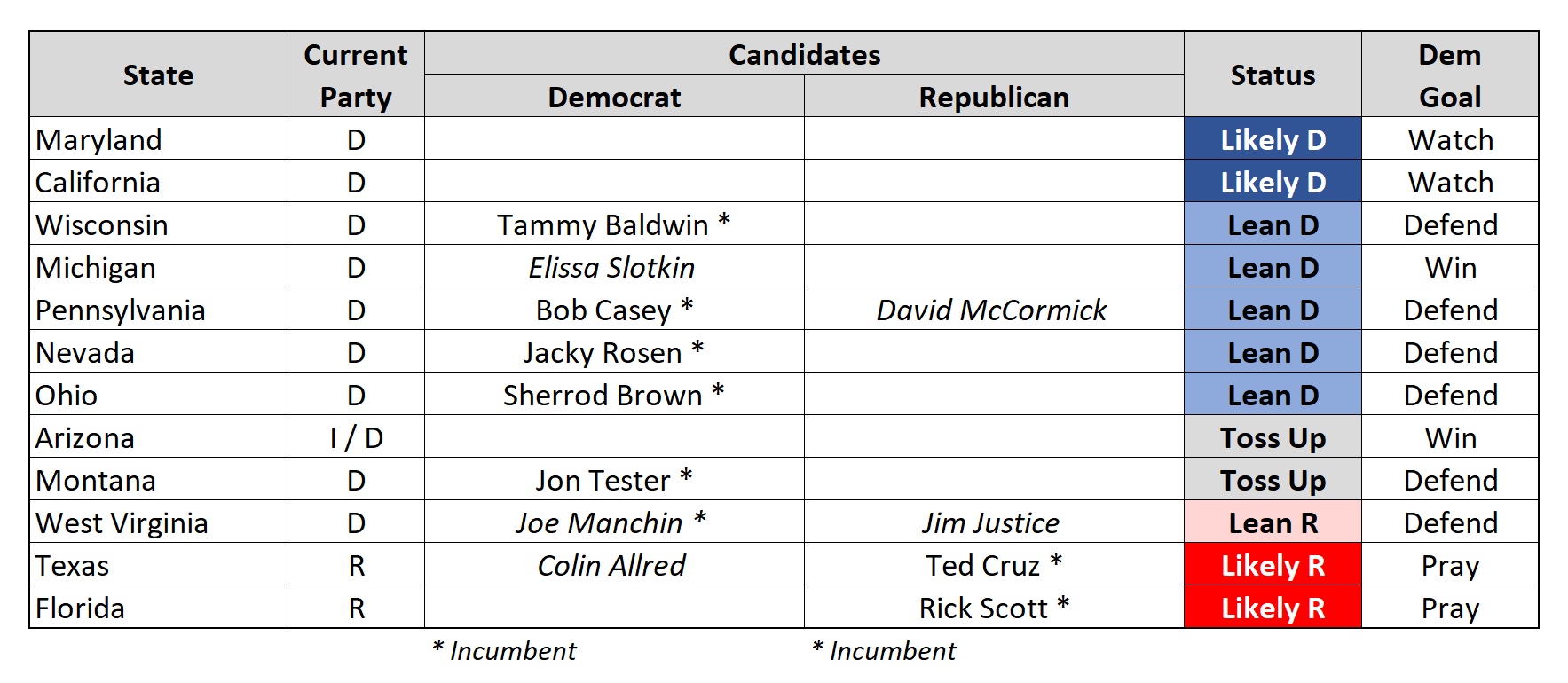
One reason (of many) for the importance of the 2024 Presidency is the 2024 Senate.  Republicans are heavy favorites in this playground.  In this visual summary, the green states don’t have Senators up for election; the dark red and dark blue states are in the bag for the Republicans and Democrats candidates, respectively; the light blue and pink states Lean D and Lean R, respectively; the grey states are true Toss-Ups.

Of the 34 Senates seats up for election in 2024, 13 are Solid D and 10 are Solid R.  That’s the good news.

The bad news is that six Senate seats currently held by Democrats are only Lean D and only one seat currently held by a Republican is Lean R.  [ The lone Lean R is admittedly wishful thinking on my part.  As a Texan, I’d dearly love to believe that Ted Cruz is beatable; As a data analyst, however, I just don’t see it happening. ]

The worse news is that all four of the Toss-Up Senate seats are currently held by Democrats.

The bottom line here is that Republicans have a MUCH better chance of flipping D seats than Democrats have of flipping R seats.  Democrats will be stuck playing defense; Republicans will be playing offense.  At the moment, the odds definitely favor Republicans taking control of the Senate in 2024.

U.S. House

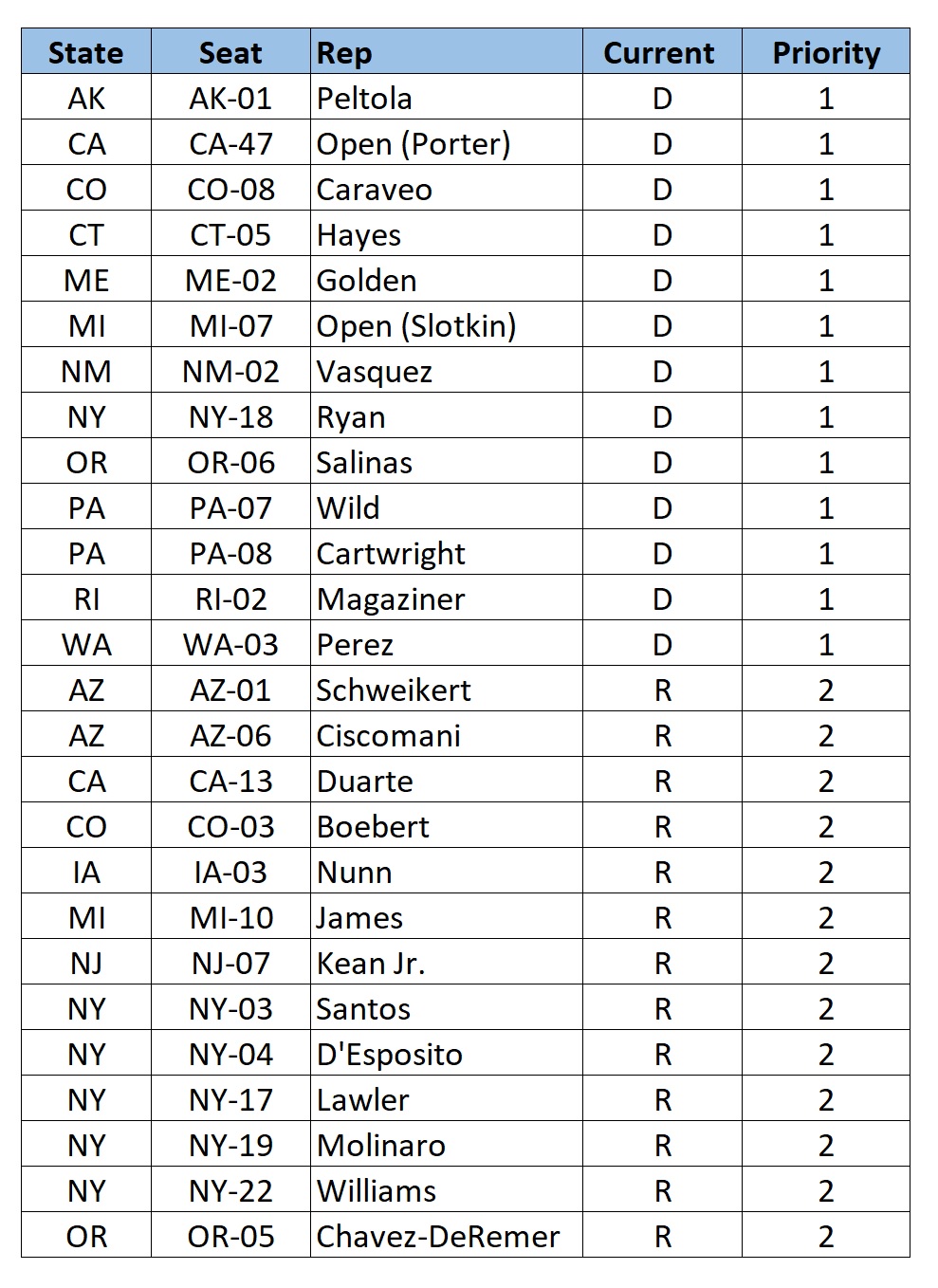
The House is much tougher to handicap this far in advance.  However, since the incoming Republican majority will be paper-thin, the House will definitely be up for grabs in 2024.  While the vast majority of House seats will be Solid D or Solid R, there is a small middle ground where either party could win a given race in the right environment.

The bottom line here is that House candidates will matter and the top of the ticket will matter.  In particular, Democrats will likely focus on the seats they lost in New York and California in 2022.

===

Democrats will be focused on winning the White House and the House in 2024.  Senate Democrats will sadly be reduced to limiting the damage, trying their best not to give Senate Republicans a super-majority.

Democratic Primary Calendar

The Rules and Bylaws Committee of the Democratic National Committee recently approved President Biden’s proposed changes to the 2024 primary calendar.  Their intention was to favor the Democratic party’s current demographics, rearranging state primaries so that the party faithful have more of a voice in selecting a candidate.  Here’s a comparison of the first month of primaries in 2020 vs. the 2024 proposal:The 2024 proposal:

  • Increases the February states from four to five.
  • Elevates South Carolina to hold the first-in-the-nation primary.
  • Demotes New Hampshire out of its traditional first-in-the-nation spot.
  • Elevates Georgia and Michigan into February.
  • Demotes the Iowa caucuses entirely out of February.

While the new calendar would be very Biden-friendly, it could actually be meaningless if Biden ends up running unopposed in 2024.  Furthermore, even if the broader DNC formally approves the changes (which seems likely), it’s unclear whether all of the changes will actually happen:

  • Some states (e.g. Iowa & New Hampshire) that would lose their historic influence might well decide to jump the line, in spite of the DNC’s calendar.  While the DNC could certainly penalize those states – with the nuclear option being to not count those states’ votes at the nominating convention – that internal conflict wouldn’t play well on national TV.
  • Some states (e.g. Georgia) might not be willing to hold the two primary elections on different dates – since the Republican Party isn’t yet planning any changes to their primary calendar.

So would the change be a good idea?  And why should you care?

The proposed calendar would likely increase the influence of younger, more racially diverse, and more moderate Democratic voters.  That’s a good thing.  I also argued back in early 2019 that Iowa was an abysmal choice to lead the parade and, since it’s no longer even a swing state, its exclusion is a good thing  The remaining states that had early dates in 2020 would still have early dates in 2024.

Thus, the new calendar is an improvement.  It just doesn’t go far enough.

For years, I’ve made no secret of my utter disdain for the Electoral College.  However, it is the game we’re playing.  With the rules of that game in the current political environment, I count only ten states where Presidential votes will matter AT ALL in the 2024 Presidential election.  I’ll revisit this at a later date, but for now, here’s my interpretation of the current 2024 Electoral landscape:

The dark red and dark blue states are in the bag for whoever the two parties nominate in 2024 .  (And, yes, I’m aware that I’m ignoring the split Electoral votes in NE and ME – which is fine for my current purposes.)

While some candidates would certainly make a much better showing than others in many of these states, a majority of voters in these states will vote for their party’s 2024 candidate regardless of who it is.  Given our winner-take-all approach to state primaries, even a thin majority gives a candidate ALL of each state’s Electoral votes.

As such, these states simply aren’t variables and there is no reason for either party to care which primary candidates their voters prefer.  I don’t like it, but that’s the way it is.

That leaves the other ten states as possible swing states.  Depending on who the final candidates are, two states that lean Republican “could” vote for the Democrat and five states that lean Democratic “could” vote for the Republican.  Only three states are true toss-ups.

Democrats should indeed change their primary calendar, but they should change it to optimize for a general election win.  Nothing else matters.  Since winning these ten swing states is the goal of the game, the primary calendar should exclusively prioritize these states so that they have the most say in selecting the Democratic candidate.

Four of the five states in the proposed Democratic calendar are potential swing states, with the outlier being South Carolina.  While I understand the related desire to increase the influence of black voters in the nominating process, there were better choices.  South Carolina has the fifth highest percentage of black voters in the U.S. but that state is not going to cast its Electoral votes for the Democratic candidate whoever it is.  Georgia has the third highest percentage of black voters and Virginia has the ninth highest.  Both are potential swing states and either would be a better choice to satisfy that need.

Personally, I’d compress the 2024 calendar to hold Democratic primaries for all ten swing states within the six weeks between February 3 and March 16.  The proposed early primaries for Nevada, New Hampshire, Georgia, and Michigan are great, but Arizona, Wisconsin, Minnesota, Pennsylvania, Virginia, and North Carolina should also hold early primaries.  The order would be less important in a compressed calendar since it would decrease the media attention given to the early winners.  However, I would group the primaries geographically to lessen the travel expenses for candidates campaigning in multiple states at once.

All that said, if further tweaks are too big of an ask, the proposed calendar changes are at least a minor improvement.

Georgia Runoff Update

While it would be logical to assume that the daily barrage of negative stories about Hershel Walker would be impacting the Georgia Senate race, I wanted to see if any available data would back up that assumption.

So, I took a quick peek today at the data gathered by TargetEarly for the Georgia Senate runoff election.

As I discussed on the day of the general election, TargetEarly analyzes publicly available early voter data and individual voter profiles to produce a fairly accurate picture of the state of an election during the early voting period.

Warnock ended up with 49.4% of the 2022 general election vote and TargetEarly’s model estimated that he won 50.8% of the total early votes.  Five days prior to the general election, TargetEarly modeled Democratic early voters at 48.8%.

At five days prior to the runoff election, TargetEarly models early Democratic voters at 54.1%.

In short, Warnock appears to be beating his early voting performance in the general election.  While that snapshot model is certainly no guarantee of a final result, it’s still good news.