Forecasting the weather for November 3 might be easier than forecasting the U.S. House races being held that day. However, since people keep asking me whether Democrats will take control of the House in the upcoming election, I’ll weigh in.
Disclaimers & Caveats
Nothing is certain.
The election is almost three months away and things will change. Numerous districts have been redrawn. A few primaries have yet to be held. Our economy remains in flux. Wars are still being fought. New candidate scandals are surfacing daily. My model is a work-in-progress. My data is incomplete. Etc.
Approach
My rough predictive model includes weighted professional analyst opinions (Cook, Sabato, etc.), the district’s partisan voting index (reflecting historical voting trends), DNC & RNC targeting data, cash-on-hand for each district campaign (based on FEC filings), the incumbent’s years in office, etc. I gave very minimal weight to the prediction markets since I don’t fully trust that data this far away from the election. I considered candidate-specific factors on the assumption that qualifications might actually still matter. I also took into account the top-of-ticket contests in the states where the races will be held. Hey, if I was being paid to do this, my model would be better.
In an attempt to simplify my own analysis this year, I took a first pass to eliminate not only those seats that are safely Democratic or Republican but also those seats that I deemed “likely” to fall one way or the other. Upsets in those races are possible, but they are not currently probable.
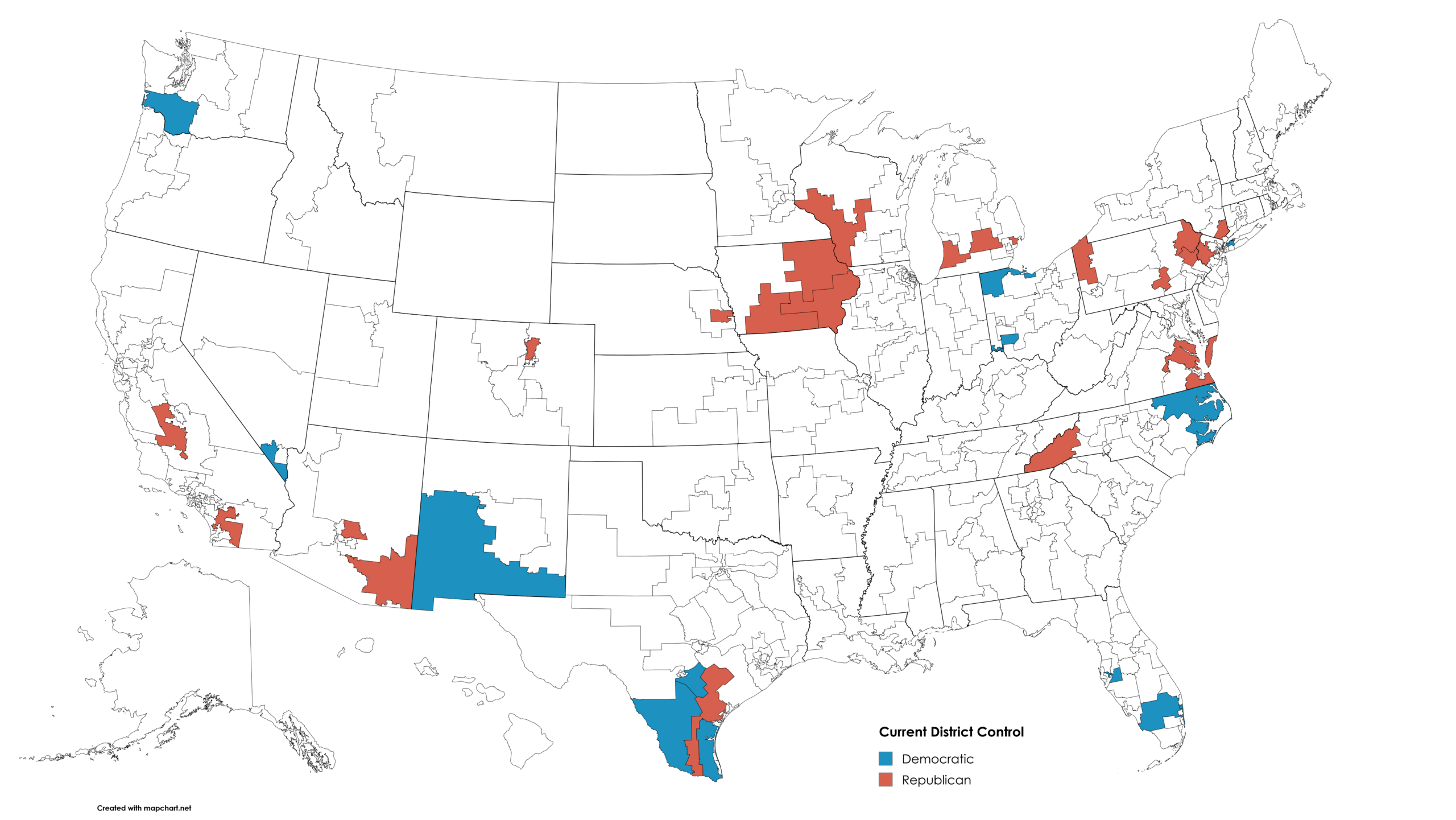
I thus narrowed my focus to include only true toss-up races and races that are competitive despite leaning toward a particular party. Of the 435 House seats up for election in 2026, my current subset contains only 35 seats. 202 seats seem predestined to be won by Republicans while Democrats can count on 198 seats. Sadly, then, House control in 2026 will be decided by only 8% of the districts in the country in only 18 states.
Analysis
From a Democratic perspective on the 35 seats in-play:
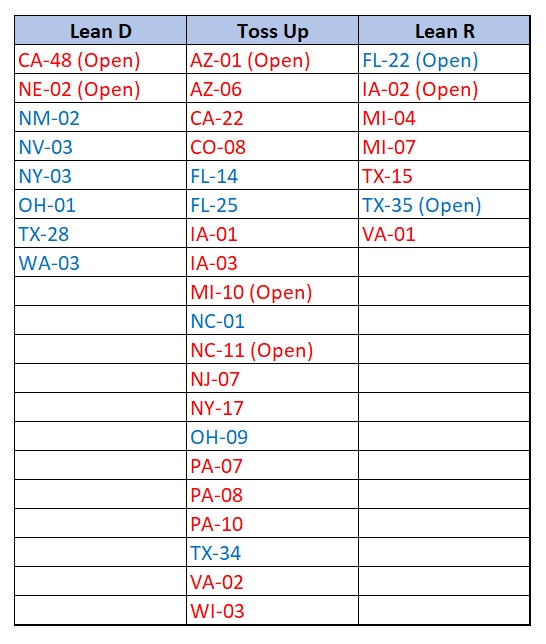
- Of the 8 Lean D races, 6 are defending current D incumbents and 2 are in open races for current R seats. Democrats need to win all of these.
- Of the 20 Toss-Up races:
- 5 are defending current D incumbents. Democrats need to win all of these.
- 3 are in open races for current R seats. Democrats need to win all of these.
- 12 are trying to beat current R incumbents. Democrats need to win at least 4 of these to eke out a House majority. Of course, they need to win more to make up for any losses above and, hopefully, to pad their majority beyond a single vote.
- Of the 7 Lean R races, 5 are trying to beat current R incumbents and 2 are in open races for current D seats. I’d consider these to be extra-credit races to make up for any surprises above.
 Bottom Line
Democrats need to win AT LEAST 20 of the 35 races above to reach the 218 necessary to control the House. A 57% win-rate is doable, but that’s not a cakewalk. Numerous pundits claim Democratic control of the House is a near certainty. Prediction markets put the odds in the mid-80s. I have no idea why.
Why Democrats Might Not Win the House
- Democrats lost the redistricting battle. Badly. My rough estimate is that the GOP will net 10 seats they would not have won under the old maps.
- Democrats remain focused on their significant lead in national polls. Unfortunately, it doesn’t matter what a majority of voters may want. The House is a collection of district races and the ultra-gerrymandered districts in many states don’t nearly reflect the population.
- Democratic infighting is problematic. Wounds from some very rough primary battles between the party’s progressive wing and the establishment wing will be tough to heal before November. In swing districts, neither wing can win the general election on their own.
- The DNC and the DCCC are borderline incompetent and are way behind their Republican counterparts in fundraising. The GOP’s massive money advantage was given even more leverage by the recent (partisan) Supreme Court ruling that invalidated long-held Congressionally-mandated limits on how much political parties can spend in coordination with candidates.
- There will be federal interference in the 2026 elections. Count on it. From National Guard troops being deployed to polling places, to ballot seizures in swing districts, to “observers” obstructing ballot processing, to court filings in GOP-controlled courts to delay vote counts and/or invalidate ballots, to efforts (administrative, legislative, and/or judicial) to decertify any Democratic wins. The only open question is the impact that interference will have, particularly in Republican-controlled states.
Why Democrats Might Win the House
- Historically, mid-term elections punish the party that holds the White House. At the moment, Trump’s unpopularity is a major advantage for Democrats everywhere.
- Most Republican candidates have been forced to declare unquestioned loyalty to Trump. Not to the nation. Not to their state. Not to the presidency. To Trump personally. That kind of submissive prostration will not go over well with the independent voters necessary to win swing districts.
- Republicans could have nominated moderate conservatives against some of the far-left Democrats running in swing districts. Instead, the GOP chose far-right candidates, many of whom are 2020 election-deniers and conspiracy theorists (read: idiots).
- The Republican party may have more money, but they are even more dysfunctional than the Democrats. Trump’s personal control over party expenditures will be a nightmare for the GOP’s professional campaign staffs.
Help?
Democratic candidates rely heavily on small dollar donors. To help Democrats win control of the House, the best option is to directly contribute to the individual campaigns of the Democrats running in the races above. As I’ve noted before, ActBlue works great.
Unfortunately, I’d avoid donating to the DNC and the DCCC as I have very little confidence that they know where to best direct the money. A better option for making a one-shot donation might be Swing Left. While I’ve had some concerns about their salary overhead in the past, I’ve come to believe that their impressive groundwork justifies the expense.
Specifically, Swing Left’s Flip the House fund is quite interesting this year. After completing my preliminary analysis above, I ran across their evaluation of the 2026 landscape. Swing Left also identified a number of House races to target this cycle – which exactly matches the Republican-held seats within my Lean D and Toss-Up categories. Great minds, I guess. And this particular fund mostly just passes along contributions to the individual campaigns. I wish they’d consider adding some defensive positions to help protect vulnerable Democratic incumbents, but what they have is better than I’ve seen elsewhere. (You might consider other Swing Left funds as well.)
Next?
At the moment, Democratic control of the House isn’t the slam dunk everyone seems to think it is. It’s going to take some work.
I’ll revisit both the House and Senate pictures as we get closer to Election Day. I’m hoping for brighter pictures.