The Electoral College

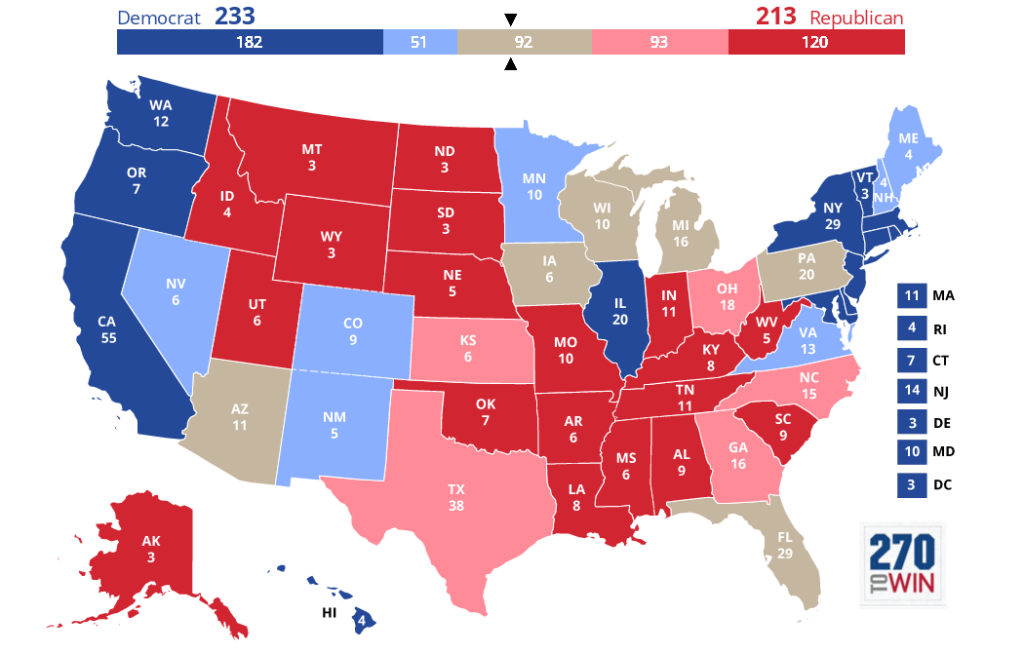
In partial preparation for an initial analysis of the 2020 Presidential election, some of the first state-level data I gathered related to the Electoral College.  That data subset quickly took me down a rabbit hole chasing after a rodent that’s been on my nerves for a very long time.

This is why I have a blog.  I need to vent.

First, a short civics lesson is required.  [Yes, Dr. Philpott, I was apparently paying attention in your American Experience class during my Freshman year at UT.  Who knew?  Sure, I did my own research years later but I can trace at least some of my political interests and my tendency to question everything back to your class.  Thank you.]

First, let’s recognize that the Founding Fathers did a phenomenal job defining a very complex governmental structure that has survived for over two centuries.  However, they were human and had to make compromises to complete a Constitution that could actually be ratified by the states.  In many cases, those compromises were brilliant.  However, with respect to the election of the President, not so much.

The process to elect the President is codified in Article II, Section 1 of the U.S. Constitution as modified by the 12th and 23rd Amendments.  In essence, the Constitution mandates that each state select a number of Electors equal to the total number of U.S. Senators and U.S. Representatives from that state.  These Electors then each cast separate votes for the President and Vice President.

If one or both elections fail to get a majority of Electors, then all hell breaks loose.  With processes that would confuse Rube Goldberg, the House and Senate then decide the outcome(s).  This topic might deserve its own post at some point, particularly since an Electoral College tie is a distinct possibility these days.  For now, however, we’ll just consider the basic Constitutional mandates above.  They are quite literally as simple as the preceding paragraph.

Note that:

  • The Constitution does not mandate how a state’s Electors should be selected.
  • The Constitution does not mandate how a state’s Electors should be apportioned between candidates.
  • The Constitution does not mandate how a state’s Electors should vote.

These important decisions are left entirely to each state.  Thus, a whole lot of what we accept as givens with respect to the Electoral College are just state laws and practices, not Constitutional mandates.  Indeed, even the term “Electoral College” isn’t in the Constitution.

So, before we get to the states’ implementation issues, we need to understand why we have Electors in the first place.  There were two primary reasons:

  1. The Founding Fathers simply didn’t trust the masses.
    • Alexander Hamilton summarized his rationale in The Federalist Papers: No. 68.  Therein, Hamilton claimed that Electors would be “men most capable of analyzing the qualities adapted to the station” and that they would be “most likely to possess the information and discernment requisite to such complicated investigations.”  In his view, Electors would prevent a candidate with “Talents for low intrigue, and the little arts of popularity” from conning his way into the Presidency and prevent “the desire in foreign powers to gain an improper ascendant in our councils.”  Hamilton not only thought that it was acceptable for each state Elector to vote independently of any apparent state preference.  He considered it their purpose to vote in possible defiance of uneducated popular opinion that favored an unqualified candidate with foreign influences.
    • That’s almost funny.  Almost.
  2. The Electoral College was an accommodation to slave-owning states.
    • The number of Electors is tied to representation in Congress, representation in Congress is based on population, and the Three-Fifths Compromise originally counted five slaves as equal to three free people for population purposes.  While James Madison originally favored the direct election of the President, he wrote in his Notes of the Constitutional Convention that it would put southern states like his at a disadvantage.   Under a direct vote approach to Presidential elections, states would get no political benefit from their citizens’ ownership of non-voting slaves.  Hence, Madison lobbied for the Electoral College.
    • That’s not funny at all.

The states, in their collective wisdom over time, subsequently took this framework of a bad idea and managed to make it worse.

All states currently hold popular elections for President and most states (48 states and DC) then assign all of their Electoral votes to supporters of the candidate receiving a plurality of the popular vote.  Only two states (Maine and Nebraska) apportion their Electors.  For what it’s worth, Hamilton favored choosing Electors by district but eventually decided to leave that decision to the states. Unfortunately, once one state tried to increase its influence with a winner-take-all scheme, most of the other states quickly followed suit so as to not be disadvantaged.

Since all states have decided that their Electors should be party-assigned, hard-line loyalists, Electors are very unlikely to vote otherwise.  So-called “faithless Electors” have appeared but last impacted an end result in 1796.  Thus, large numbers of voters in each state – from both parties – are completely without representation in the Electoral College.

We are all well aware of the recent history of Electoral College results being at odds with the popular vote.  Al Gore beat George W. Bush by 543,895 popular votes but lost the Electoral College 266 to 271; Hillary Clinton beat Donald Trump by 2,868,686 popular votes but lost the Electoral College 227 to 304.

What most people fail to realize is that it is largely an accident that Electoral College results and popular votes have ever been close at all.

In the current political environment, both Democrats and Republicans generally enjoy a mix of both large and small states.  Imagine, however, a scenario where the smaller states all favored Party A and the larger states all favored Party B.  Using Elector counts by state, the 40 smallest states plus DC account for 282 Electors – more than enough to decide the Presidency.  Using total vote counts by state from 2016, those same 40 states plus DC accounted for 66,253K votes.  Since only a popular majority is required to capture all of a state’s associated Electors, we can cut that vote total in half, making the required vote count 33,168K.  Since a total of 137,536K votes were cast nationwide in 2016, that means that 24% of all voters could have easily won the election.

Think about that.  The President of the United States could have been legally elected in 2016 with less than a quarter of the popular vote and with no votes in the 10 largest states having any consequence at all.

It would be tough to consider this scenario fair by any standard.  If you’re thinking it could never happen, remember that California cast its Electoral votes for George H.W. Bush and that Texas cast its Electoral votes for Jimmy Carter.  Things change.  Things change quickly.  Things change in unpredictable ways.

The Connecticut Compromise created our bicameral legislature with states having proportional representation in the lower chamber and equal representation in the upper chamber.  This was the key to avoiding what Alexis de Tocqueville would later refer to as “the tyranny of the majority” in the Legislative branch of our government.  What the Electoral College essentially enables in the Executive branch is the tyranny of the minority, whereby a minority collection of voters can enjoy an unchecked ability to override the will of the majority in selecting the President.

A revamping of the way we select our President could also correct an unfortunate side-effect where Presidential candidates campaign almost exclusively in a handful of “swing states” largely ignoring the vast majority of “safe states” that heavily favor either party.  A national election in 1787 might well have been impractical.  The Founding Fathers can hardly be faulted for not predicting radio, television, and the Internet.  However, there is simply no modern excuse for not correcting this affront to the basic tenets of democracy.  It’s safe to say that most of the framers of the Constitution would be appalled by what the Electoral College has become.

There are three possible solutions:

  1. Adopt a Constitutional amendment that substitutes a nationwide popular vote for the Electoral college.  While this is the cleanest approach, it’s a tough hurdle since it requires approval by two-thirds of the Senate, two-thirds of the House, and two-thirds of the States.
  2. Adopt a proportional allocation of Electors in every state as Hamilton intended.  This isn’t a perfect solution and the winner of the nationwide popular vote might still not get a majority of Electors.  However, it would definitely be better.  Unfortunately, there is little reason to believe that all states could ever act in tandem to implement this change.
  3. Adopt a multi-state agreement where the winner of the national popular vote gets awarded all of the Electors in each state participating in the agreement.  The advantage of this solution is that it only requires the buy-in of enough states to form an Electoral majority.  There is, in fact, an effort underway to implement this plan.  The National Popular Vote bill has been enacted by 12 states with a total of 172 Electoral votes.  It could be put into practice if it gets support from additional states with a total of 98 Electoral votes.

Do I think any of the above are actually going to happen?  Unfortunately, no.  Something needs to change, but it probably won’t in my lifetime.  We’re likely stuck with what we have and the best we can do is figure out how to game the existing system to our advantage while the other side tries to do the same.

You can almost smell the democracy in action.  The Founding Fathers would be so proud.

Inside Baseball

I’ve just begun the process of gathering and organizing the necessary data to do some predictive and prescriptive 2020 election analytics.  The questionable key word here is “necessary”.  As I piece together a data set from a multitude of sources (that are often not easily consumable), I constantly find additional data sets that might also prove useful.  Is that additional data necessary?  I have no clue.  I find it fascinating, though, and I’d rather have data I don’t eventually use than miss something important.  It’s a geeky FOMO.  Help me.

Anyway, as previously noted, the 2020 Presidential election will obviously be all about Electoral College votes.  Hence, the data I’m currently gathering is organized by state.

At the moment, I’m accumulating the mostly obvious state-level data related to such things as population, population growth, voter counts (eligible, registered, & participating) by election year, military population, # of Electors, Elector voting history by party, Governor’s party, Senators’ parties, US House party split, cumulative US House voting history by party by year, State Legislatures’ party control, concurrent 2020 Governor and US Senator races, region, % of US GDP, federal tax per capita, federal aid as a % of state revenue, military $s as a % of state GDP, … you get the idea.

I really want to add state-level voter estimates by age, sex, race, religion, education, etc., but that’s going to require a ton of work and I may decide to only pull that data for states that I otherwise deem to be “in-play”.  Or I may find myself on my couch at 3am with my second bag of Cheetos, an empty bottle of bourbon, and 50 state websites open on my laptop.  We’ll see.

Through the haze, I can begin to see patterns emerging even within the embryonic version of the collected data.  A few of the patterns have surprised me; some appear supportive of early conjectures by a few of the better analysts that do this professionally (e.g. the Cook Political Report, 270toWin).  While I’m not interested in simply duplicating others’ work, it is nice to reach some similar conclusions as validation.

There is so much available data out there in so many relevant arenas that every analysis must define its own scope limitations.  My scope will likely be limited by my patience and alcohol budget.  However, I will eventually try to interpret whatever data I ultimately assemble from what I hope will be a fresh perspective.

2018 Elections – My Report Card

It really hadn’t occurred to me to go back and evaluate my 2018 race analyses.  But when a reader asked, I thought it was an interesting question.  I’m currently online at a bar, so a little self-indulgence seems quite appropriate.

With respect to the Senate, I mostly just called a Democratic takeover improbable at best.  True enough.  I didn’t exactly go out on a limb there.

With respect to the House, however, I did rely on some rather complex custom data analytics.  I didn’t so much make predictions as I suggested where money could best be spent in the closing months of the campaign to guarantee that the Democrats took control of the chamber.

  • I said there were 11 races where the Democrats would win without much additional help.  Democrats won all 11 of those races.
  • I picked 20 races where I thought additional money should be concentrated to help the Democratic candidates who had a decent chance to win.  Democrats won 14 of those races and another 3 races have yet to be called.  To date, Republicans have won only 3 of the races that I picked.
  • In Texas, I said there were two seats that the Democrats should flip and, indeed, both flipped.  I saw an outside chance of Democrats taking two additional Texas seats and the Democrats took one of them.

Considering only the Democratic wins above, the Democrats would have taken the House.  While they won additional races to pad their margin, I think I can claim success.  I’ll give my analysis a “B” in the unlikely scenario where the Democrats lose all three of the outstanding races but I think I deserve an “A” if they win them all.

That’s not too bad for my initial attempt at political data analytics and I have the data to tweak the model for the next cycle.

Cheers!

2018 Elections – By The Numbers

Rather than doing “real” work, I’ve found myself digging through initial election results data.  Yeah, I’m a geek.  I could do this all day.  All night.  Whatever.  However, I thought I’d best share a snapshot of what I have and try to move on for now.

As every political commentator has constantly noted, a lot more people voted this year than is normal for a mid-term election.  Nationwide, 49.2% of eligible voters cast ballots earlier this month.  Yeah, okay.  While I personally don’t find a cause for celebration in the fact that half of the electorate couldn’t bother to vote, I guess I should be happy with the improvement from the 36.7% turnout in 2014.

Beyond the raw voter totals, however, there’s really not a whole lot that we know for sure quite yet.  Despite a ton of pundits citing mid-term voter breakdowns to make various prognostications, the numbers we have are based on very preliminary data – and those numbers are open to interpretation.  That, of course, didn’t stop me from taking a peek.

I cobbled together my current take from numerous sources, each with their own issues.  As such, I suggest that no one look too hard at the exact numbers since some things won’t quite add up.  In an attempt to compare apples-to-apples, I did try to only consider available data in U.S. House races – since all voters had an opportunity to vote in exactly one of those races.  Of course, candidates really do matter and the breakdowns are thus not necessarily indicative of any generic preference.  However, this is what we have.  Consider this an extremely rough first take of a very broad (D) vs. (R) voter profile for 2018:

In brief:

  • Men favored Republicans but more women voted and they favored Democrats by a wider margin.
  • White voters outnumbered non-white voters and they favored Republicans, but non-white voters favored Democrats by much wider margins.
  • White men went heavily Republican but white women were evenly split.
  • College-educated voters favored Democrats and the parties split the rest.
  • Protestants favored Republicans but non-Protestants favored Democrats by wider margins.
  • Older voters outnumbered younger voters and they favored Republicans, but younger voters favored Democrats by much wider margins.
  • Democrats took the cities, Republicans took the country, and the parties split the suburbs.
  • Self-identified independents favored Democrats.

Got all that?  Now forget it.  While the above is certainly fascinating (at least to me), it’s just not as enlightening as you might expect going forward.

Yes, the above data is minimally useful to derive early projections with respect to the 2020 House races.  The current numbers look decent for Democrats and it’s always easier to defend a majority than to build one.  However, the dynamics of a concurrent 2020 Presidential election will most certainly have a huge impact that is as yet unknown.  Also, the up-ticket Senate and Governor races will be quite different in 2020 than they were this year.

In the Senate, it’ll be a brand new game with a different set of 33 seats on the table – 21 held by Republicans and 12 held by Democrats.  At least one reasonable scenario has the Democrats flipping just enough net seats to split the Senate 50-50.  In that case, with the VP potentially casting decisive Senate votes, the 2020 Presidential election becomes even more important – if that’s even possible.

And so.  Everything comes down to the 2020 Presidential election.  That election, of course, will be decided solely by Electoral College votes.  Given that most states allocate all of their electors to the victor in their state, overall popular vote totals don’t matter and state-level margins don’t matter.  State wins and state elector counts are the whole game.  Thus, Democrats need to look at voter profiles and turnout rates for each state completely independent of the others.  The above national analysis needs to be considered separately for every in-play state, state-level trends need to be estimated, state-level outreach strategies need to be defined, candidates need to be evaluated using state-based metrics, and, somehow, a Democratic ticket needs to be formed that can piece together a 50%+1 majority in enough states to get at least 270 electoral votes.  My head hurts.

Whether or not the Electoral College is still a good idea might well be the topic of a future blog post.  (Spoiler Alert:  It’s not a good idea.)  However, for now, we have to assume the rules we have.  At some point in the hopefully near future, I’ll take an early look at the 2020 Electoral College map along with some Democratic ticket options.

Sure, the 2020 elections are two years away.  But there’s a whole lot of work to do and the time to start is now.  Break’s over.

Recounts

Election results are still in doubt in Georgia, Florida, and Arizona.  Because, of course.

Look.  We’re quite obviously a pretty evenly divided country at the moment.  One side or the other isn’t going to be happy with any final results in these races.  It’s tough to lose and it’s even tougher to lose when it’s a close race.

But seriously.  Have we learned nothing?  In none of these races is there a pressing need to rush to any decision.  The two Senate races will not change the balance of power in the Senate even if both races eventually go to Democrats.  Florida and Georgia can survive without a called Governor’s race for at least a few weeks.  Everybody needs to take a deep breath.

Of course, I’d personally like to see the Democrats win every one of the races.  I’m an admitted partisan at this point and would thus be a horrible person to put in charge of the recounts.  That said, I like to think I’m a fair person.  Based only on what I’ve read, I’d guess that the Arizona Senate race is clearly a Democratic win and that the Georgia Governor race is clearly a Republican win.  Both the Florida Senate and Governor races are tight and I have no clue.  It’s Florida.

In any case, here’s my two cents:  If we’d object to similar vote counting practices in a third-world country, why the hell would we accept them in ours?  How hard is this?  Votes matter.  Rules matter.  Follow the rules and count all the votes.  Every damn vote.  Don’t rush it.  Do it right.  Do it transparently.

This is, unfortunately, not a job for the courts.  The Supreme Court lost a lot of credibility with a purely partisan vote in Bush v. Gore.  They should have stayed in session until they could have issued a ruling – any ruling – with no less than a 7-2 majority.  The 5-4 ruling deciding the American Presidency was an insult to democracy.  As a direct result, any decisive court decisions in the current races would be questioned in terms of the makeup of whatever court had jurisdiction. In my humble opinion, the best a court could do is to appoint a neutral third-party, acceptable to both sides, to interpret the rules and evaluate ballots as necessary in each race.

For the love of God, please don’t just call any race for either side just because you can.  We deserve better.

2018 Elections – Results

Well.  That was interesting.  I considered making a drinking game out of election night.  You know, like taking a shot whenever a seat flipped from (R) to (D).  Or pouring a drink whenever Wolf Blitzer reported a race’s results, with less than 5% reporting, as being a bellwether for the whole country.  Or whenever polling data was massively wrong.  Then I decided I’d just drink.  Good call.

Things aren’t over yet, but I thought I’d post a few raw impressions before I turn off the TV, close the laptop, recharge the iPad, and put away the Scotch:

  • There were, of course, numerous surprises in individual races.  At a macro level, however, things went pretty much as expected.
  • The great news is that Democrats will have a significant majority in the House.  There will now be at least some check on the Trump administration and an end to complete Republican control of the government.  I do see a Constitutional crisis in our future as subpoenas get issued by House committees and then get ignored by the White House.
  • The bad news is that Republicans will significantly increase their majority in the Senate.  Democrats were never going to win the Senate, but there’s no way to spin the lost seats as anything other than defeat.  Republicans will spend the next two years stacking the courts.  Pray for Ruth Bader Ginsburg.  From a legislative perspective, however, there’s just not much the Senate can do without negotiating with the House.  Thus, another Constitutional crisis will likely be triggered as Trump attempts to govern solely by Executive order.
  • Democrats picked up a few Governors’ offices, but not two important ones that were on the table:  Florida and Ohio.  Their importance will be evident in 2020.
  • Incumbent moderates in both parties got creamed.  That is not a good thing.
  • A lot of women candidates won.  That is a good thing.
  • At the individual race level, I’m personally disappointed that some Democratic candidates didn’t win (Beto O’Rourke, Andrew Gillum, Richard Cordray, Amy McGrath, MJ Hegar, etc.), but I’m not particularly surprised about the results.  Pollsters, however, will be trying to figure out how to modify their methodologies since some of their predictions in these races were way off base.
  • Both Democrats and Republicans will claim victory.  Both have a point.
  • My bottom line is that I’m not throwing a party, but I’ll sleep just fine tonight.
  • Cue the prognostications about 2020.

October Surprise

There has long been an expectation that an “October Surprise” would impact the upcoming November 6 elections.  Even though October is now behind us, I know better than to assume that one or more major news events won’t occur before election day.  However, I will contend that the October Surprise has indeed already occurred.  It’s just not that much of a surprise.

October was a truly tragic month for sanity and humanity.

  • A Saudi Arabian journalist for the Washington Post was killed at the Saudi Consulate in Istanbul.
  • Packages containing apparent pipe bombs were sent to numerous Trump critics.
  • A racially-motivated shooting at a Kroger in Kentucky left two people dead.
  • A Jewish synagogue in Pittsburgh was the scene of a mass shooting.

At times like these, we look to our leaders for consolation and assurance.  In particular, we look to the President of the United States to provide comfort and perspective to a grieving nation.

To be sure, not all Presidents have had the same intrinsic abilities to command a moment and provide the necessary tonic to a nation thirsty for guidance.  It is phenomenally difficult for even the most talented orator to strike the right balances between anger and resolve, between sadness and compassion, between despair and hope.  And yet, past Presidents of both parties have risen to the occasion when tragedy struck:  Lyndon Johnson after the Kennedy assassination, Ronald Reagan after the Challenger disaster, Bill Clinton after the Oklahoma City bombing, George W. Bush after the 9/11 attacks, Barack Obama after the Sandy Hook massacre.

Each of these leaders did more than simply read a script provided by a seasoned speechwriter.  It is largely in the unscripted moments (Bush’s extemporaneous bullhorn speech at Ground Zero, Obama’s voice cracking as he spoke of the murdered children in Newton) that each of these leaders rose above politics and self-interest to display a heartfelt personal empathy on behalf of us all.  That is what true leaders do.  Regardless of political persuasion, the President of the United States is unfortunately often called upon to be the Consoler-In-Chief.

How far we have fallen.

Donald Trump has proven yet again that he is temperamentally, intellectually, and spiritually incapable of performing this duty.  Indeed, he is only making things worse.

While occasionally straining to read a few throw-away “thoughts and prayers” Hallmark sentiments, Trump has then proceeded to provide almost daily servings of word casseroles, seasoned with dog-whistles to his political base.  These rants are simply falsehoods at best, inane policy pronouncements at the norm, and dangerous incitements to violent intolerance at worst.  There is no comfort here.  Only raw politics.

In the midst of all of October’s violence…

  • Trump demonized a caravan of mostly Honduran refugees slowly headed toward the United States.  These migrants, fleeing violence in their home countries and seeking a better life, are largely on foot with severely limited resources.  Nevertheless, Trump announced that he was sending over 5000 Army troops to stop the “invasion”.  For the subset of the migrants that somehow manage to eventually reach the U.S. border, they would have the right to apply for asylum, and the United States would have the right to deny that asylum.  That’s it.  The U.S. Border Patrol is perfectly capable of handling this relatively minor non-invasion.  In 2000 alone, an unassisted Border Patrol – with half of the agents it currently employs — arrested more than 1.6 million migrants.  If the Border Patrol needed the help, they could be ably assisted by over 2000 National Guard troops already at the border.  Lost in the politics is the fact that the United States Army is legally barred from directly enforcing immigration laws and can be used only in support roles.  The Army troops cannot themselves use force to stop anyone at the border.  Thus, active duty military personnel are being deployed as a political prop for Donald Trump.
  • Trump claimed that “Republicans will totally protect people with Pre-Existing Conditions, Democrats will not!”  In fact, it is the Obama-era Affordable Care Act that first protected people with pre-existing conditions.  (I know this personally as the only way that I can get coverage is via the ACA.)  The Republican Congress voted 54 times to repeal the ACA with no replacement and the Trump administration has made it their mission to weaken it as much as they possibly can.  There has never been a Republican plan to protect people with pre-existing conditions.  Trump’s claim is more than dishonest; it is dishonorable.
  • Trump announced the imminent introduction of legislation to enact a 10% tax cut for the middle class.  This despite the fact that Congress isn’t even in session and that Congressional leaders appeared clueless.  Trump also claimed, without any explanation, that the cut would be revenue neutral despite clearly providing 10% less revenue. The attempted pandering here is simply too obvious.
  • Trump announced plans to end birthright citizenship by Executive Order.  This despite the fact that the 14th Amendment makes it quite clear that he cannot.  Trump also claimed that the U.S. was the only nation that offered birthright citizenship when, in fact, about three dozen countries do so (including Canada and Mexico).
  • Trump claimed to be a “nationalist” – despite that word being very closely associated with the alt-right agenda.  Concurrently, Trump also specifically claimed to not be a “globalist” – which is just someone that acknowledges the fact that economic and foreign policies cannot be considered in total isolation in today’s inter-connected society.  Thus, Trump essentially said, “I’m a racist, not a realist.”
  • Trump continued his political rallies at full throttle.  He praised a sitting Congressman for physically attacking a journalist.  He claimed that the mail bombs were a Democratic “false flag” operation and then quickly pivoted to blaming the media after the Trump-enthusiast perpetrator was arrested.  He increased his attacks on CNN after they were targeted by the mail bomber.  He floated a ludicrous conspiracy theory about George Soros funding the caravan after Soros was targeted by the mail bomber.  He blamed the victims of the Pittsburgh massacre for not having armed guards in their synagogue.  He couldn’t even resist adding a political endorsement while speaking of the tragedy.  And yet, at every turn, Trump insists that he is the true victim.

Donald Trump is a failure as a leader and a failure as a human being.  For the moment, however, we are largely unable to hold him accountable.  Barring some miracle, it will be another two years before the electorate will have a chance to correct its 2016 mistake.  Our President obviously has no shame so there is little benefit in trying to shame him.  Donald Trump is who he is.  He is not going to change.  That’s unfortunate, but it’s not a surprise.

What we can do now is hold Trump’s enablers accountable.  Republicans, the majority of whom really do know better, have blithely looked the other way while Trump’s vitriolic rhetoric divides the nation.  They have traded their souls in blind pursuit of policy achievements.  Eventually, many will recognize that whatever political battles they won were not worth the destruction of what truly makes America great.

We need to have intelligent and spirited conversations about immigration, the deficit, health care, and gun rights.  There are strong and reasonable opinions on all sides of these and many other issues.  I personally look forward to the eventual return of sane Republicans with whom we can engage in passionate debates and tough compromises.  I look forward to a time when not everything needs to be a zero-sum game.

In the meantime, however, the only solution is to remove the current Republican enablers from their all-encompassing control of the legislative branch in the upcoming mid-term elections.  I pray for our nation and eagerly await a November 6 judgment.

Voting Begins

Across the nation, early voting has been pretty popular – beating 2016 thus far.  Texas is having record-breaking early voting turnout for a mid-term election.  That’s great.  It just doesn’t mean a whole lot yet.

People who were going to vote anyway this cycle could just be voting early.  I did.  Stuff happens and I wanted to make sure that I participated in this election.  If you don’t vote, you can’t complain.  And I like to complain.

Yes, large early turnout numbers could mean a broader election turnout of registered voters – which should help Democrats.  Yes, the numbers could mean more new voters are participating in the election – which should help Democrats.  But, sadly, Republicans simply vote more often than Democrats and the numbers could portend an enthusiastic GOP turnout.  The effect of the different early voting processes in each state is unclear but it’s bound to have an impact as well.

The bottom line is that no one knows anything at this point.  Despite pundits of all stripes wanting to read all sorts of crap into initial early voting patterns and statistics, it’s just way too early to make any end-game assumptions whatsoever using that data.

Based on polling data, however, Democrats nationwide still look to be in good shape to take the House but perhaps lose ground in the Senate.  In Texas, the fundamentals still heavily favor Republicans.  Unless Texas Democrats are consistently polling over the margin of error in their races (they’re mostly not), it’s not a good sign.  That said, there’s always hope for Texas.  On the flip side, there’s still a real chance that the GOP maintains control of the House.  The polling data could be wrong all around.  See: 2016.

In any case, polls are just semi-educated guesses at best.  It’s only votes that count.  If you’re reading a political blog, I presume you’re a voter.  But I’ll say it anyway:

PLEASE VOTE!!!

Democrats & Marketing 102

I’m not a marketing expert.  Don’t claim to be one.  In the course of my career, however, I’ve certainly done the job and I at least know enough to recognize good versus bad with respect to marketing efforts.

I say this because I’m about to complain about a piece of this cycle’s Democratic marketing strategy – although calling it a “strategy” is perhaps giving it too much credit.

As I’ve previously noted, I’ve donated to several campaigns and committees this cycle and I’ve sent multiple donations to some of them.  All of my donations have been made via ActBlue.  In addition to functioning as a great conduit for the money transfer, ActBlue collects donor contact information, as required by law, and obviously shares that information with the recipients.  The campaigns, in turn, are free to independently contact their donors.  That’s fair – as long as the data isn’t abused.  Yeah.

In one 7-day period, I received just shy of 300 emails from the campaigns to which I donated.  That’s over 40 emails a day.  On average, each campaign sent me 5 emails every single day.  The well-behaved Justin Nelson campaign averaged 1 email a day; the overly communicative Jacky Rosen campaign averaged a whopping 11 emails a day.  [ As an aside, the DCCC also sent me 12 texts during my test week.  No.  Just no.  Don’t do that.  Bad donkey! ]

First, some disclaimers:

  • I realize that the sheer volume of emails is at least partially my own fault since I donated to multiple campaigns.
  • I realize that prior donors are a sweet spot for getting additional money.
  • I realize that sending emails costs the campaign nothing.
  • I realize that Republicans may be just as bad at this and maybe even worse.

That said, here’s just a few helpful hints (read: irritated complaints) directed at the campaigns:

  • Don’t spam me.  One email a day from each campaign is a lot; more simply guarantees I’m hitting “Delete” with increasing force.
  • Don’t just constantly ask for money.  I’m not your dad.
  • Don’t lie to me.  About half of the 300 emails contained the word “deadline”.  Don’t tell me there’s an absolute deadline for contributions (usually midnight of the day of the email) and then produce a new one immediately after that one expires.  That’s not a deadline.  That’s the passage of time.
  • Don’t get basic facts wrong.  If you include poll numbers to bolster your message, make sure they’re correct.  You know I’m on a computer, right?  I can check them myself.  I did.  You were often full of shit.
  • Don’t make it look like you’ve never seen a computer.  While there’s nothing nearly as bad as the Cruz attempt at using Facebook Live, I did receive 17 emails from one campaign with subject lines over 80 characters long.  Seriously?
  • Don’t base your entire message on beating the Republicans.  I get it.  I know why that’s important.  But your message is mostly “I need to win because my opponent needs to lose.”  Occasionally, you need to tell people why they should vote FOR you.
  • Don’t claim that Senate/House control rests solely on your race.  Your race is important, but so is every other race.
  • Don’t regularly tell me that Armageddon is upon us.  Listen, Chicken Little, you’re depressing the hell out of me.  You could well be right, but some folks might just decide not to vote since, apparently, we’re all going to die.  Try some humor, for God’s sake!
  • Don’t be so damn pathetic.  “We don’t have much time” … “We’re IMPLORING you” … “We’re PLEADING with you” … “We’re BEGGING”.  Have some pride, people.  This is embarrassing.
  • Don’t focus your outreach entirely on television.  Almost all of the pleas for money are to buy more TV ad time.  While television is an important part of the equation, younger voters (a demographic you really, really need) use Netflix.  They’re much more reachable via digital strategies.  I haven’t done the analysis to see how well you’re doing in that arena but I sincerely hope that your overall digital strategy is better than your email strategy.

Folks, I’m a political junkie and donor who desperately wants you to win and, yet, you’ve managed to over-saturate me.  Not good.

TX-31 & Marketing 101

My gerrymandered TX-31 Congressional district includes Ft. Hood – the largest active-duty armored military installation in the country.  Hence, the military vote here is pretty important.  As I’ve noted in previous posts, the Democratic candidate for TX-31 is MJ Hegar.  She’s an Air Force veteran who served three tours in Afghanistan as a rescue helicopter pilot and who earned a Purple Heart after being shot down by enemy fire.  The Republican incumbent is John Carter, who never served in uniform.

Hegar has run a generally good campaign that raised almost $2M in Q3 – beating Carter’s fundraising by a 3-1 margin.  Unfortunately, this is Texas, TX-31 is a Republican stronghold, Carter’s been in his seat for 15 years, and Hegar’s running well behind in recent polls.  But that’s okay.  She’s trying.  She has my vote and I was a small part of her Q3 haul.  There’s always hope.

What’s not okay is this flyer mailed to my home address (front & back):

Let’s imagine an internal conversation by a typical voter at the mailbox.  This internal dialogue lasts mere seconds in real time:

Great.  A junk mail flyer.  There’s a soldier, holding his smiling daughter, holding an American flag.  Okay, got it.  This is a good thing.  Of course we need to take care of our military veterans.  Let’s flip it over.  The name “JOHN CARTER” stands out in all caps and there’s a picture of a smiling guy.  Guess that’s John Carter.  He must be taking care of the vets.  Good for him.  Elections are coming up.  Maybe I’ll vote for John Carter – if I vote at all.  But first I’ll trash this flyer.

Sure, if you actually read the smaller text, you’d see that the flyer claims Carter is actually making it harder for veterans to get health care.  If by some minuscule chance you read the even smaller text, you’d see that the flyer was paid for by the Texas Democratic Party.

Yes, that’s right.  This is a Democratic piece.

NEWS FLASH:  No one reads this crap (unless they happen to have a political blog).  You have a few moments at best to make an impression.  And, congratulations!!  You did.

Gee, guys.  Thanks for the help.  I know this independent “attack ad” wasn’t coordinated with Hegar’s campaign but did you have to spend good money to make it look like you coordinated with Carter’s?