Priorities

<sigh>

I recently received a blast email from the Democratic Party suggesting nine candidates to whom I should donate to help flip the House.  Great timing, since I just did my own research.  However, only one of those candidates is on my Top 20 list of target races. Another looks likely to win without much outside assistance.  All are great candidates deserving of support, but money needs to go where it can to do the most good.

For example, one of the suggested candidates is Amy McGrath.

Amy McGrath (D) is a retired Marine Lieutenant Colonel who served in both Afghanistan and Iraq.  She was the first female Marine to fly combat missions in an F/A-18.  She is a graduate of the Naval Academy and has a master’s in international and global security studies.  She has taught at the Naval Academy, served as the Pentagon’s Marine liaison to the State Department, and worked as a Congressional foreign affairs advisor.  Her father is a high school teacher; her mother is a doctor; she is the mother of three.  As one proof of her ability to work across the aisle, her husband (a retired Navy officer) is a life-long registered Republican.  McGrath published a 32-page economic plan with a surprising level of detail for a House race.  While understandably focused on her Kentucky district’s specific needs, it’s a template for a reasonable, practical, non-partisan approach to government.  She’s running for the KY-06 seat against Andy Barr (R), an unremarkable incumbent who seems to be little more than a rubber stamp for the Republican majority.

I want Amy McGrath in Congress.

However, her polling is all over the map.  While some polls do have her doing better – and the trend is in her favor – my analysis currently gives her only about a 32% chance of winning in a very Republican district.  That puts the KY-06 race at #36 on my target list.  My analysis may well be wrong but I have to go with the numbers for now.

The Wall

While I refuse to waste my time responding to each latest edition of Trump’s Trite Tweets, I will leverage one recent missive as a starting point to address a topic that has been front and center since the 2016 campaign:  The Border Wall.

First, the tweet:

I would be willing to “shut down” government if the Democrats do not give us the votes for Border Security, which includes the Wall! Must get rid of Lottery, Catch & Release etc. and finally go to system of Immigration based on MERIT! We need great people coming into our Country!

— Donald Trump, July 2018

I have neither the time nor inclination to attempt to parse the apparently random set of words therein.  The larger, serious issues related to immigration are deserving of an in-depth post — which I will try to eventually address.  For now, though, I want to focus solely on “the Wall”.

Trump’s proposal was summarized in his initial campaign speech:

“I will build a great wall — and nobody builds walls better than me, believe me — and I’ll build them very inexpensively. I will build a great, great wall on our southern border, and I will make Mexico pay for that wall. Mark my words.”

— Donald Trump, June 2015

The U.S.-Mexico border stretches for about 2,000 miles.  Only about 350 miles of that are currently fenced with a design intended to stop people (as opposed to vehicles).  Some prototype “walls” have been built in California but they aren’t in extensive use.  The bottom line is that this isn’t an easy project.  And the estimated cost is a moving target.

In 2016, Trump originally estimated the cost at about $12B.  A Department of Homeland Security report in early 2017 increased that estimate to about $22B.  A funding request from the Trump administration in early 2018 set the estimate at $33B.  That’s already real money and the trend isn’t promising.  Even more interesting is that fact that all of these estimates consider only the actual construction costs of the wall.

None of these estimates include on-going maintenance of the wall.  None of these estimates include the cost of peripheral construction (e.g. the cost of building and maintaining a road alongside the border).  None of these estimates include the costs for additional border agents to patrol the wall (without whom the wall is simply an expensive speed bump).  And, my favorite part, none of these estimates consider the cost of land acquisition.  Seriously.  A border wall would impact approximately 5,000 parcels of property and no related costs have been included in the cost estimates.

My home state of Texas accounts for over half of the US side of the border with Mexico.  As one might expect, this isn’t our first rodeo with respect to border issues.

Since our border with Mexico runs through the middle of the Rio Grande, any Texas wall needs to be built north of the border itself.  The 2006 Secure Fence Act enabled the federal government to pursue private land in Texas for double-layer border fences through outright purchase, easements, or condemnation.  More than 300 condemnation cases were brought against Texas landowners – who didn’t take kindly to the government taking their land.  As of 2017 – eleven years later – over a quarter of those cases were still in court.  There is little reason to believe that a more intrusive wall would go over any better with landowners.  In any case, it certainly won’t be cheap.  Some more inclusive estimates have placed the total cost of the wall at between $70B and $400B.

Which brings us to a core tenant of the original Trump plan:  Mexico will pay for the wall.  Trump wasn’t clear about many things, but he was quite clear about this.  In fact, this was arguably the cornerstone of his campaign.  He even said, “Mark my words.”  So I am.

Frankly, while I personally believe that the environmental and social impacts of building an impractical and largely useless wall make it a fool’s errand, my primary objection to the wall is that I DON’T WANT TO PAY FOR IT.  Make some other fool pay for it and I might move on to something else.  Well, okay, maybe not.  But this blog post would have certainly been a lot shorter.

Multiple iterations of the Mexican government have made it abundantly clear that they simply aren’t going to pay for the wall.  Mexico’s current president, Enrique Peña Nieto, recently stated:  “Not now, not ever.”  Mexico’s president-elect, Andrés Manuel López Obrador, took it one step further:  “We won’t allow this wall to be built.”  Mexico’s former president, Vicente Fox, was perhaps the most clear: “We’ll never pay for that fucking wall.”

So, if Mexico isn’t likely to write us a big check, how exactly does Trump intend to get them to pay?  While there simply aren’t many options, the most discussed approach is via tariffs.  Unfortunately, no reasonable tariffs would generate anywhere near the funds required to pay for the wall.  And that assumes that tariffs actually work in the first place.

For example, Mexico currently supplies about 75% of the fresh vegetables sold in the U.S. to the tune of about $6B annually.  Cool.  However, any tariffs imposed by the U.S. government on Mexican farmers will simply be passed on to consumers in the U.S.  Thus, the border wall would still be funded by Americans – we’d just be paying more for tomatoes instead of paying more in taxes.  Nice try, but you don’t get credit for just shifting my expense to another line item in Quicken.  Add the economic impact of any retaliatory tariffs that will likely be imposed by Mexico and the tariff methodology wouldn’t pay for a bathroom wall.

If reasonable people were actually prevalent in Washington, perhaps an alternative solution could be found.  A bipartisan plan last year to substitute a “smart wall” concept went nowhere.  In essence, the plan would leverage state-of-the-art technology – including drones, motion-sensitive cameras with night vision, real-time image analysis, seismic sensors, etc. — linked to a central control room with access to several rapid-response teams deployed along the border.  This virtual wall would be considerably more flexible, arguably more effective, easier to maintain, substantially less intrusive, and a whole lot cheaper.

But that’s not the “physical, tall, powerful, beautiful” wall that Trump promised.  So, no.

By all means, Mr. President, please force a government shutdown over funding of an unpopular border wall just prior to the mid-term elections.  Even the Democrats can’t screw up that gift.
2018 Elections – The House

While I don’t have the personal wealth to make a huge dent in any political campaign, I do feel the personal need to contribute … something … to assist the Democrats in taking control of … something.  Or, more accurately from my own perspective, to help wrest control of any section of the federal government away from the Republicans.

I will undoubtedly contribute to the two federal candidates for whom I can also vote in November.  These include Beto O’Roarke (D) in the Texas Senate race against Ted Cruz (R) & and M.J. Hegar (D) in the TX-31 House race against John Carter (R).  I really like both of the Democratic nominees.  I also know that neither has a reasonable chance of actually being elected.

Which brings me to my point for this particular blog entry.

I will continue to hold good thoughts about the Democrats taking control of the Senate in 2018.  Miracles do indeed happen.  However, since the 2018 Senate map is enormously favorable to the GOP, I’m not willing to throw money at Senate races beyond a token donation in my home state.  (I may expand on this thought in a future blog entry.)

The House of Representatives, however, is quite another matter.  The Democrats have a real opportunity to take control.  While it’s very early in the cycle, some advance focus and solid organization — tweaked as necessary as things progress — can make a takeover of the House a reality.  Unfortunately, focus and organization aren’t exactly hallmarks of the Democratic Party. They will fight among themselves; they will spend tons of money against candidates they can’t beat; they will ignore races they can win; they will forget to defend the Democratic seats that are in-play; they will apply position litmus tests that have absolutely nothing to do with winning in a given Congressional district. Dandy.

Thus, in my copious spare time, I decided to apply the tools of my day job (data analytics) to take a data-centric approach to determining where the Democrats should best focus their funds and efforts.  It started as a simple effort, but turned complex very quickly.  The good news is that I’m a data geek and I found this endlessly interesting.  I’d really like to believe that someone is being paid a ton of money by the DCCC to do a similar but much more detailed analysis than I can muster in my spare time with publicly available data.  I’d also really like a pony.  Just sayin’.

I started by defining the goal:  The Democrats need to flip a net total of 24 seats in 2018 to take control of the House.  Note that this includes protecting any (D) seats that are in play in addition to flipping (R) seats.  Nothing else matters.

Next, we need data.  For this, I cheated a bit – using several publicly available sources that themselves leverage other sources.  In the tradition of FiveThirtyEight, I’m not only taking a poll of polls, I’m essentially taking a poll of polls of polls.  My sources include recent data from the Cook Political Report, the Economist, Real Clear Politics, Daily Kos, Sabato’s Crystal Ball, and the Crosstab.

For the analysis, I determine the current probability of a general election win and then rank the races based on where focus and funds could apparently do the most good.  While my formula is complex, it essentially ranks the races as follows:

  1. Lean D:  Targeting races where the Democrat is already slightly ahead.
  2. Toss-up: Targeting races that are the most competitive.
  3. Lean R:  Targeting races where the Democrat is only slightly behind.
  4. Likely D:  Targeting races where the Democrat is likely, but not guaranteed, to win.
  5. Likely R:  Targeting races where the Democrat is likely, but not guaranteed, to lose.
  6. Safe R/D:  Targeting races for no good reason whatsoever.

I also track tertiary qualifiers for each Democratic candidate, which I use only to order races that are equal based on the above analysis.  These criteria are:

  • Favored by the House Majority PAC.  [Which means money.]
  • Favored by the Red to Blue initiative of the DCCC. [Which means money.]
  • Military veteran.  [Just because.]
  • Female.  [Just because.]
  • Legislative/political experience.  [Experience is NOT a bad thing.]
  • Running against a jackass.  [Hey, it’s my analysis.]

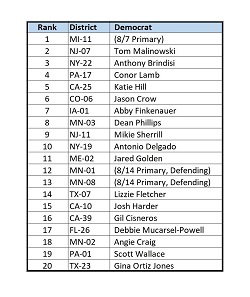
Out of 435 total House races, I identified only 58 that were “interesting” along at least some axis.  Of those 58, I identified 20 races to seriously target – 2 (D) seats that need to be defended and 18 (R) seats that should be targeted to flip.  The primaries haven’t yet completed in 3 of these races, but all of the races currently Lean D or are Toss-Ups.  Outside of the 20 targeted races, I identified an additional eight seats that seem likely to flip from (R) to (D) with little to no assistance.  There are no unassisted (D) to (R) seats expected in 2018.

Thus, according to my analysis, if the Democrats win all of the 20 targeted House races plus the 8 unassisted races, they should end up with a razor-thin 2-vote majority in the House.  I’d obviously like a larger margin and I’d really like to suggest contributing to more races.  If I had the time, I would love to add consideration of campaign financials to determine where additional donations might have the most impact.  I’d also like to consider up/down ticket races, district turnout history, voter registrations by party, and a number of other criteria.  And, again, I’d really like that pony.  ‘Cause, you know, if wishes were horses, then bloggers would ride.  Or something like that.

Anyway, here’s my Top 20:

FYI, the eight seats that, at the moment, look to flip more-or-less on their own are: PA-06, NV-04. FL-27, CA-49, VA-10, AZ-02, NJ-02, & PA-07.

So.  Will I now contribute to all 20 campaigns?  I might.  ActBlue Express lets you set up a single account to fairly easily donate to multiple candidates – including everyone on my list.  While it still requires some work, the good news is that over 98% of money contributed via ActBlue goes directly to the campaigns.  I will wait until the primaries are complete to contribute to the TBD races.  While I believe that early contributions are more valuable than late contributions, I will also reserve some money for later in the cycle after a final round of analysis.

My funds may be limited, but I can at least say I tried.

Dear Mr. President

I wrote and sent this a while back.  I stand by it and thought it appropriate to share in this venue.


Dear Mr. President,

While I didn’t vote for you, I acknowledge you as the duly-elected President of the United States.  I accept that we will never agree on most issues and I will count myself among the forces of the loyal opposition until the next election cycle.  The special counsel’s investigation should continue without interference for as long as it takes and, if necessary, there are constitutional remedies in place to address any wrongdoings.  Until then, I am not looking for ways to call into question the legitimacy of your presidency.  That’s the way our democracy works.

I presume that our vast policy differences will continue to provoke serious debates and disagreements.  Despite those differences, however, it is not unreasonable for me to expect you to represent our nation in a manner that is consistent with our common values and heritage. You have been given a sacred trust to conduct yourself as a representative of the best of America – both as a model for all American citizens and as a symbol to the world at large.

Unfortunately, what you apparently see as merely being self-confident and politically incorrect, many of us see as the actions of a puerile, narcissistic boor.  That persona was frankly quite entertaining when you were a reality show host and it obviously served you very well in the 2016 election cycle.  As the President, however, it is unacceptable at best and, at worst, increasingly dangerous.

Being kind, gracious, inclusive, and humble with a self-deprecating sense of humor are basic traits of decent human behavior that all good parents teach their children.  Conducting yourself as a gentleman and a scholar is not a sign of weakness.  Conducting yourself as the embodiment of the “Ugly American” stereotype is not a sign of strength.

You are no longer a private citizen.  I expect you to be worthy of the office you hold by setting a much better example than you have thus far.

Cold Reboot

So.

I once had this blog. A political blog called Political Ramblings. I started it way back in ’03 from my remarkably non-Beltway vantage point in Austin, Texas.

I wasn’t necessarily looking to influence others’ opinions; I merely needed an outlet to express my own. Rather than just rant, the blog forced me to put my random thoughts / observations / ideas into moderately coherent sentences / paragraphs / articles. It also provided a means of indulging my analytical nature without completely boring the crap out of my friends.

I often spent more time writing blog entries than I probably should have. While my readership was initially limited to a relatively small circle of friends, the act of pushing something into the public domain was serious enough in my own mind to force me to verify statements presented as facts, edit content to accurately capture my intended tone, and at least attempt to research multiple sides of an issue before weighing in. While those may seem to be obvious prerequisites to political discourse, very few of our paid political practitioners (officeholders, candidates, and pundits alike) seem to follow them. That’s just wrong.

Even with zero traffic-generating efforts on my part, my blog’s audience slightly expanded over time to an interesting amalgam of friends, acquaintances, and strangers. I didn’t so much have a “following”; I had a group of people who were interested in reading my opinions but who also weren’t shy about expressing their own. In fact, my blog spawned some spirited debates. Since the opposing arguments were almost always made by reasonable people whose intelligence and perspectives I respected, I definitely learned from those debates. And maybe — just maybe — I did occasionally influence others.

While spending considerable time on individual blog entries, I didn’t devote nearly enough time to the blog itself. Updates weren’t exactly regular. The blog was a hobby and life constantly intervened. My last entry wasn’t intended to be the last. It just was.

This reincarnation is simply an overdue attempt to return to where I was. Given the current political environment, I need the outlet now more than ever.

While the frequency and regularity of blog updates is not likely to improve, I thought I’d try dipping a proverbial toe back into the political pond. That toe is still positioned a little left of center — although even that is a matter of perspective.  The new name is both a practical implementation issue and an acknowledgement that reasonable political discourse should always be nuanced.